




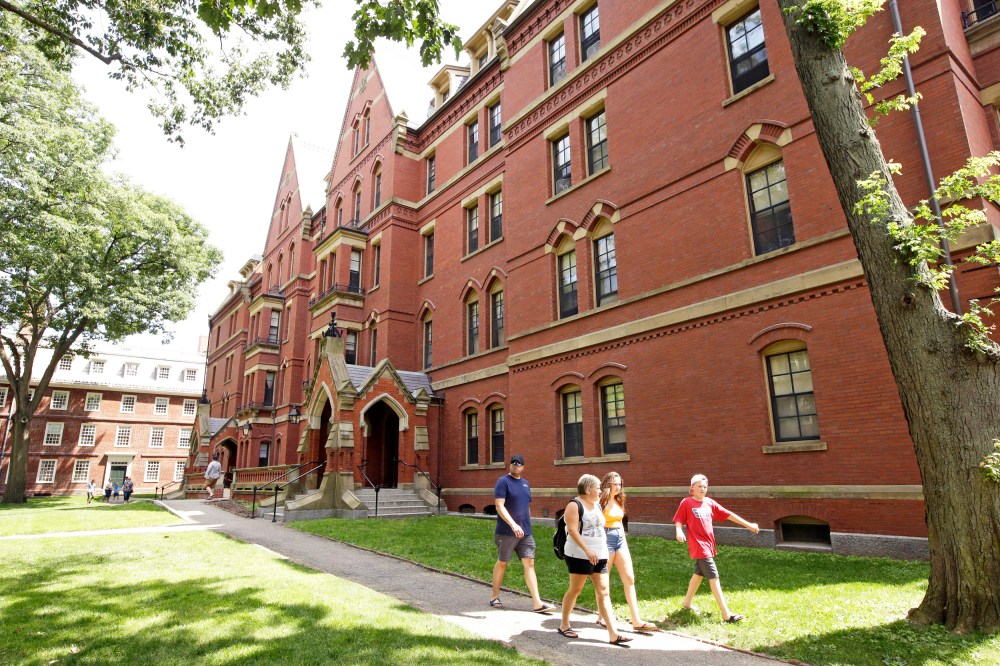
Kenneth Griffin, a hedge fund titan and the 35th richest person in the world, recently donated $300 million to Harvard University — a gift so large that the university announced it would rename its Graduate School of Arts and Sciences after him. Harvard has only named a school after a donor three times since 1638.
Griffin’s donation is a reminder of how the vanity and influence-peddling of the super-rich lead to retrograde philanthropy. Harvard is the last place that needs financial gifts. And the constant stream of funds from ultra-wealthy people to ultra-elite institutions only helps replicate and deepen extreme inequality in our society.
This wasn’t Griffin’s first donation — he gifted Harvard $150 million in 2014, and cumulatively he’s contributed over half a billion dollars to the country’s most prestigious institute of higher learning. Yet even that fortune will make little difference to Harvard’s financial outlook; currently the university’s endowment fund holds over $50 billion — the largest academic endowment in the world, and larger than the gross domestic product of at least 90 countries.
Giving money to schools like Harvard is fluffing the cushions for a tiny hyper-elite stratum of the population.
Harvard is, of course, one of the most competitive higher education institutions in the world, and it mostly serves people from well-off or highly affluent backgrounds. The university, like many schools, also shows extreme favoritism toward children of alumni, and keeps a “Dean’s Interest List” to identify applicants tied to major donors or potential donors. Giving money to schools like Harvard is fluffing the cushions for a tiny hyper-elite stratum of the population that is guaranteed to play a hugely disproportionate role in shaping American life. The accumulation of gratuitous donations simply widens the resource gulf between this stratum and the general public.
But it would be naive to assume that Griffin, a 54-year-old alumnus of Harvard, is unaware of that. Countless underfunded colleges that serve people from underprivileged backgrounds could be transformed by large donations, but gifts to elite universities aren’t pure acts of beneficence. At the level of wealth that Griffin possesses, money is the go-to tool for building cache and wielding influence. Having the rare honor of having a school named after you at Harvard is the kind of status affirmation that some ultra-wealthy people seem to live for. And it could surely help his three children, who appear to be approaching college-application age, or any applicants whose parents are friendly with Griffin. In turn, Griffin’s prominent connection to Harvard makes him an even more attractive friend or business associate in elite circles.


Griffin’s track record of purchasing access and influence extends well beyond Harvard. A self-identified “Reagan Republican,” he especially likes to use money to shape politics — he donated over $60 million to Republican candidates and super PACs in the 2022 midterm elections. While he was once a supporter and fundraiser for former President Barack Obama, he flipped toward support of Mitt Romney as his challenger in 2012 because he believed Obama had “embraced class warfare.” In a 2012 interview with the Chicago Tribune, he said he believed that ultra-wealthy people have “insufficient influence” in American politics.
More recently, Griffin has become a champion of Florida Gov. Ron DeSantis — another clue regarding Griffin’s commitment to education. DeSantis has become a proud adversary of freedom of thought and self-expression with his “Don’t say Gay” bill and his rejection of African American studies coursework, and an opponent of the university tenure system. That hasn’t stopped Griffin from encouraging him to run for president or donating millions of dollars to him.
Griffin already has a record of masking the way that socioeconomic privilege shaped the arc of his life. Griffin told the Tribune in that 2012 interview, “Nothing was given to me per se, except for a great education — my college degree — and a country that allows somebody to just go for it.” What he didn’t mention was that his grandmother — who inherited multiple farms and businesses from her own family — paid for most of his Harvard degree.
Griffin’s propensity for buying influence underscores how ultra-wealthy philanthropy is often not driven by an interest in what’s good for the public. Instead, many elites can use it to entrench their status and power, and to ensure the elite institutions they value occupy an even more exclusive place in American society. That’s all the more reason to tax the hell out of people who have so much money they don’t know what to do with it.

Zeeshan Aleem is a writer and editor for MS NOW. He primarily writes about politics and foreign policy.