




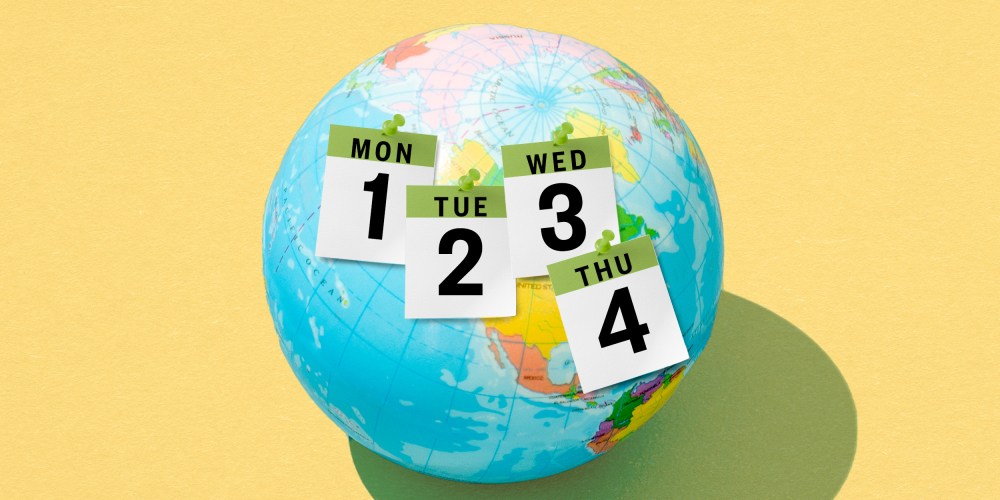
Compressing the workweek from five days to four days would dramatically improve the quality of life of workers while incentivizing them to get roughly the same amount of work done more efficiently. That’s the standard argument for the idea, and it’s one that’s gaining increasing traction around the world as companies and governments experiment with shorter weeks through pilot programs.
But what’s less commonly explored is how a four-day workweek could be good for the Earth. A fascinating new Washington Post analysis rounds up data suggesting that, if properly executed, a shorter workweek could also help reduce carbon emissions in substantial ways.
The Post report cites data from the University of Massachusetts Amherst’s Political Economy Research Institute showing that a 10% reduction in work hours could result in “drops in ecological footprint, carbon footprint and carbon dioxide emissions by 12.1%, 14.6% and 4.2%, respectively.”
Experts say that one way a four-day workweek could reduce carbon emissions is by lopping off a day of commuting. According to a 2021 survey in the U.K. cited in the Post article, a four-day workweek could decrease travel by 691 million miles a week. A four-day workweek could also conserve energy by reducing energy required to power large office buildings and work sites.
But critically, a shorter workweek would only meaningfully reduce emissions if coupled with a broader societal awareness of the need to use the extra time in a way that is friendly to the environment. I reached out to Juliet Schor, an economist and sociologist at Boston College who studies work, consumption and climate change, and asked her how a shorter workweek could be used effectively to reduce carbon emissions.


She pointed out that more spare time could allow people to use slower means of transportation, like walking, biking, public transportation and trains. With more leisure time, people also have more opportunity to eat in a way that causes fewer emissions. Cooking food at home produces fewer emissions than restaurant food — and also cuts out transportation emissions from traveling to a restaurant or ordering delivery. And if you use extra time to grow some of your own food in a garden, that’s also going to reduce emissions. Schor pointed out that participatory hobbies, like knitting and wood-working, are going to produce fewer emissions than, say, heading to a theme park.
And ultimately there’s also an enhanced possibility for social change: With more time for civic engagement, if more time is spent on activism for a more environmentally sustainable economy, that could pay long-term dividends for fighting global warming.
However, there are ways that a four-day workweek could also not go so well. If people end up spending their extra time constantly using transportation that produces a higher level of emissions and seeking out services that emit lots of carbon, that’s going to reverse the potential benefits of a shorter workweek. And if, for example, short flights inspired by three-day weekends skyrocketed in response to the extra time, a shorter workweek could be a net harm for the environment. Schor also pointed out that under certain economic conditions using the spare time to take an extra job could reverse the benefits of a shorter workweek.
The big picture takeaway seems to be that if a four-day workweek is ever implemented widely, it could boost the fight against climate change if it happened amidst a broader social shift toward sustainability, reduced consumption and a deliberately cultivated appreciation of the value of slowness and DIY culture. The extra time would buy people an opportunity to rethink and readjust their consumption — but it wouldn’t guarantee it.
At a time when work hours are expanding or becoming increasingly unpredictable for many sectors of the economy, the push among scholars and policy activists to consider a four-day workweek is getting more traction — and getting some promising results through preliminary studies. The fact that it could also be used to help reduce the chance of ecological catastrophe is another big point in favor of the idea. But in order to make a real impact, people wouldn’t need to just change how they think about work hours, but also change how they think about their free time as well.

Zeeshan Aleem is a writer and editor for MS NOW. He primarily writes about politics and foreign policy.