




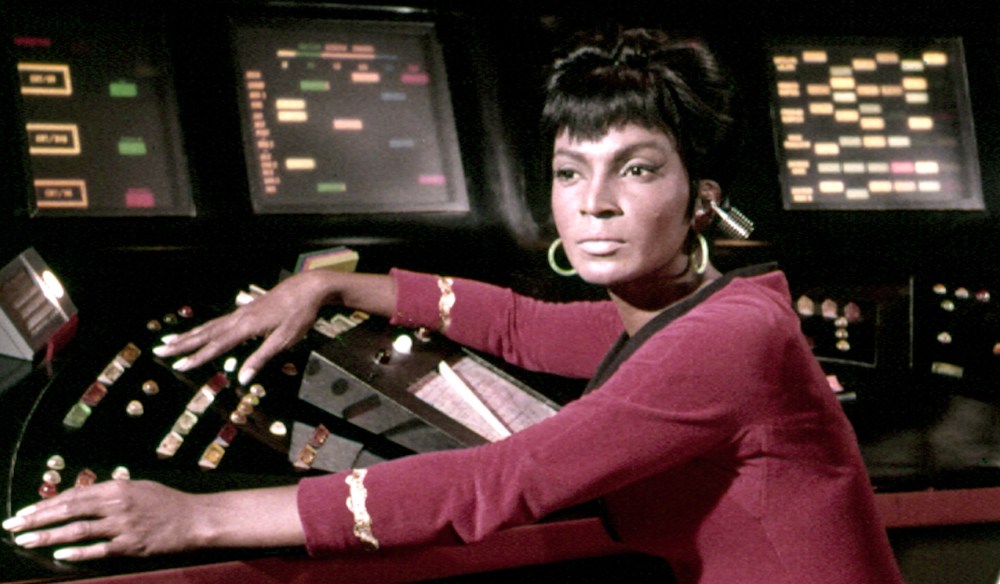
Over the weekend, when we lost 89-year-old Nichelle Nichols, the actor who portrayed Lt. Nyota Uhura on “Star Trek,” we lost more than one of the brightest lights of television and science fiction, one of the most powerful symbols of African American achievement and hope and one of the greatest recruiters of women and minorities into American science and spaceflight. We also lost a strong Black woman who showed the world a future with Black men and women being treated as integral parts of humanity’s future and not just background players.
Uhura, a fictional African communications officer soaring through the galaxy, made real-life boys and girls, men and women feel like their horizons were unlimited, as well.
Nichols’ Uhura, a fictional African communications officer on the bridge of a futuristic starship soaring through the galaxy on the original three-year run of “Star Trek” and its subsequent first series of movies, made real-life boys and girls, men and women feel like their horizons were unlimited, as well. It was living, breathing Afrofuturism. And Nichols made it glorious.
No less an authority than Martin Luther King Jr. told her so, at an NAACP fundraiser. “Ms. Nichols, I am your greatest fan. I am that Trekkie,” he said, and when she responded that she had told “Star Trek” creator Gene Rodenberry that she would leave the show, King stunned her with his objection. “‘You cannot do that,’” Nichols later quoted King as saying. “He said: ‘Don’t you understand what this man has achieved? For the first time, we are being seen the world over as we should be seen.’”
There was a time when Black characters on television were servants or slaves, pimps or prostitutes or mere background characters to white stories. They were the “magical Negro,” there to help white main characters discover something about themselves; “the Black best friend,” who comforts and pushes the white main character in his or her journey; the “domestic or mammy,” who serves those white characters; or the thug; or the angry, or sassy, Black woman.

Uhura, a beautiful Black woman working alongside Capt. James T. Kirk and Mr. Spock and other members of the crew of the famous USS Enterprise, was none of these.
In the same interview in which she mentioned King’s excitement at meeting her, Nichols said Whoopi Golberg described to her how, at 9 years old, she had yelled to her family when she first saw “Star Trek”: “Come quick, come quick. There’s a Black lady on TV, and she ain’t no maid!”
In a 1968 episode of “Star Trek” called “Plato’s Stepchildren,” humanlike aliens dressed as ancient Greeks torture the crew of the Enterprise and force William Shatner’s hypersexual Capt. Kirk to lock lips with Uhura. It was the first kiss on American television between a Black woman and a white man. That kiss, in a world still riddled with racist and sexist attitudes, foretold the coming acceptance of interracial relationships in a U.S., but it probably wouldn’t have happened if not for a bit of subversiveness from Nichols and Shatner.
Worried about reaction from Southern television stations, showrunners had filmed the kiss between Shatner and Nichols with their lips mostly obscured by the back of Nichols’ head, but they wanted to play it even safer and film a second scene in which the kiss happens off-screen.
But in her book “Beyond Uhura: Star Trek and Other Memories,” Nichols said she and Shatner deliberately flubbed their lines, leaving the show with no choice but to use the original take.
The episode aired without blowback. In fact, in a 2010 interview with the Archive of American Television, Nichols said it got the most “fan mail that Paramount had ever gotten on ‘Star Trek’ for one episode.” Unlike Goldberg, whose childhood excitement over Uhura preceded a career in entertainment, Mae Jemison’s excitement over Uhura preceded a career in science. When Jemison climbed aboard the space shuttle Endeavour in 1992, she became the first African American woman in space. She later told C-SPAN: “Lieutenant Uhura was maybe one of the first women you saw every day, every week on television who worked in a technical field. … And she was African, which was a very different feel for television back then. So, I very much liked Uhura and she was a very important person to me.” Mae Jemison’s excitement over Uhura preceded her career in science. She became the first African American woman in space. Nichols spent her time after “Star Trek’s” original television run recruiting women and minorities for NASA, and according to the documentary “Woman in Motion: Nichelle Nichols, Star Trek and the Remaking of NASA,” released last year, in just a few months, she brought in over 8,000 applicants, 1,600 of whom were women and 1,000 of whom were people of color, a significantly more diverse pool of applicants than NASA had seen before. As groundbreaking as her television work was, Nichols rose above being Uhura to help change the world. She wasn’t just the beautiful, trailblazing communications officer aboard a fictional spacecraft. She was the trailblazing advocate who helped the world see African Americans as an integral part of the future and of modern spaceflight. Thank you, Lieutenant. Hailing frequencies closed.
Jesse J. Holland
Jesse J. Holland, an award-winning author, professor and journalist, teaches journalism at the School of Media & Public Affairs at George Washington University and was a longtime congressional, Supreme Court and White House reporter with The Associated Press. He is the author of two African American history books about Washington, D.C., and has written for major entertainment franchises, including Lucasfilm’s "Star Wars," DC Comics’ "Superman" and Marvel’s "Black Panther." 

