




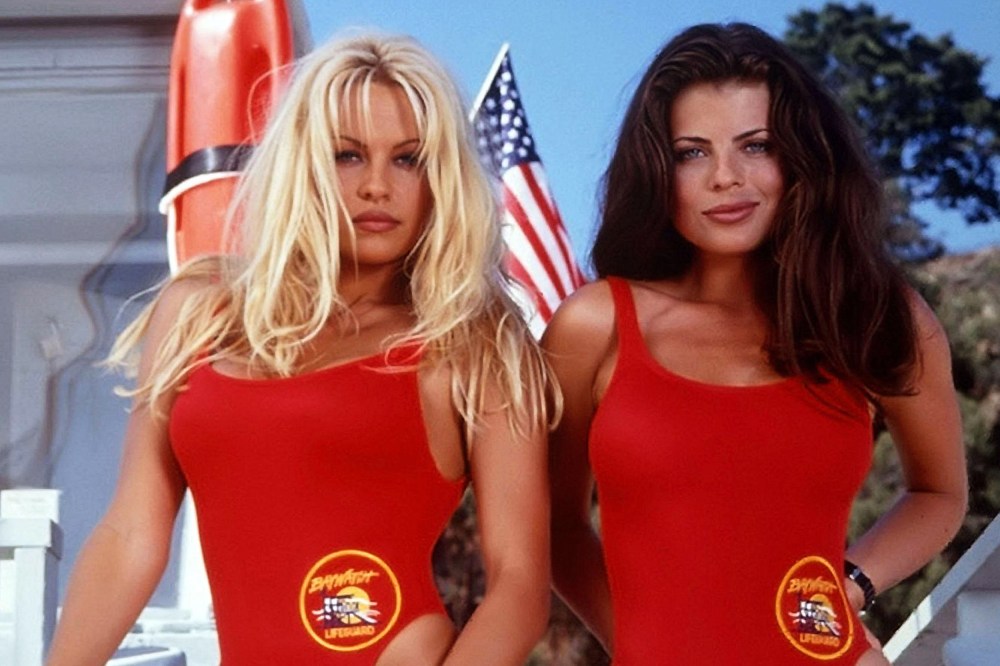
How did “Baywatch,” the 1990s television show that made Pamela Anderson and Carmen Electra household names, insert a specific vision of the California dream in the world’s imagination, turned the red one-piece into a cultural (and sexual) icon, and made the slow-motion run a staple performance for any hottie on the beach. What did this hugely popular show mean for America, and perhaps the world? A new Hulu docuseries, “After Baywatch,” tries to answer just that.
Spoiler: It doesn’t. But it does paint an illuminating picture of a shallow, hollow show made up of a shallow, hollow cast, as embodying some of the worst of ’90s pop culture. It also explores how the show set the stage for the rapidly devolving cheap entertainment that would eventually bring us reality TV and social media influencers.
In reality, there is much more to say about Anderson, and how she was a mess of contradictions that parallel so much of ’90s life for young women.
The most compelling star of “Baywatch” remains the most compelling person several decades later: Pamela Anderson. Anderson, though, didn’t sit for interviews for this documentary. After a life of tabloid exploitation, she has moved back to her Canadian hometown, where she has traded in her signature pencil-thin brows, smokey heavily lashed eyes and over-lined lips for a bare face. She’s been renovating her house. She runs a skin care brand. She’s an animal rights activist. She likes to hang out with her dogs.
Anderson isn’t absent from the documentary — filmmakers use old interviews to piece together her storyline — but the documentary’s treatment of her is flat and insubstantial: She was a compelling Playboy model who turned the magazine into a feeder for “Baywatch” talent; the paparazzi were aggressive; a leaked sex tape almost ruined her career but she got through it and, afterward, sex tapes actually catapulted some B-listers like Paris Hilton and Kim Kardashian to fame. The only somewhat interesting revelation is that David Hasselhoff initially didn’t want Anderson on the show because he worried everyone would be looking at her and not him.
In reality, there is much more to say about Anderson, and how she was a mess of contradictions that parallel so much of ’90s life for young women: She was super sexy and sexualized, and with that came the presumption that she had no right to privacy even in her most intimate sexual affairs; she partied and had bad taste in men and was happily a little bit trashy, which seemed to give permission to the public to ignore or even tongue-wag at the fact that she was married to a violent domestic abuser — a fact Anderson herself doesn’t seem to have totally processed or addressed, downplaying husband Tommy Lee’s abuse even decades later. Even now, she seems to both want to leave her past behind while not totally reckoning with it.

This is not so unlike the broader public’s relationship to the decade that made Anderson famous and the show that helped define it. Paris Hilton, arguably the Pam Anderson of the next decade — blond, beautiful, widely mocked, widely followed, the victim of her own leaked sex tape (made with a man who would go on to marry and divorce Anderson) told a reporter in the early 2000s, “My boyfriends always tell me I’m not sexual. Sexy, but not sexual.” This ideal, that women be sexually performative for men, but not actually sexual for themselves, was at the heart of both “Baywatch” and turn-of-the-century expectations for female celebrities. As the show went on, the legs of the red Baywatch suits got higher-cut and the necklines dropped lower, but the scripts remained cheesy and even wholesome. Sometimes, there just wasn’t enough actual footage to fill the show’s full run-time, and so it was padded with montages of California sunsets, perky butts on beaches, and of course the notorious slo-mo breast-bouncing runs down the sand.
The “Baywatch” docuseries, unfortunately, doesn’t do much to address the way in which the show both reflected and perpetuated the decade’s disparate views on female sexuality. And to be fair, the show’s cast — now Botoxed and fillered into the wide-eyed and duck-lipped aesthetic familiar to anyone who has tuned into a Real Housewives episode — simply does not seem capable of, or at least interested in, even the moderate intellectual inquiry required to offer any real insights about the show’s greater impact or meaning. “We had the gorgeous ones,” Hasselhoff observes about the “Baywatch” actresses. “And we had the real ones. But they’re all real. Because they all went in the water.” (His general diagnosis of the show’s quality? “The show — it wasn’t good. But we made it good.”) Carmen Electra takes a stab at assessing the show’s feminist impact by musing, “I think ‘Baywatch’ was ahead of its time. Because the men were featured. And men looked hot.” Actor after actor observes that being in the show “changed” their life. The docuseries, alas, seems unlikely to change anyone’s life, or even deepen anyone’s understanding of “Baywatch.” The docuseries, alas, seems unlikely to change anyone’s life, or even deepen anyone’s understanding of “Baywatch;” by the end of the first installment, one begins to wonder how it was even-stretched into four parts (the answer: significant repetition and, like the show itself, many bouncy montages). Perhaps this is the unintentional lesson. Not every cultural artifact has some deeper meaning. Sometimes, people make dumb things, and the rest of us watch because we’re animals who like boobs and washboard abs and the suggestion of sex. The ’90s didn’t invent that impulse, although it was the decade in which it arguably went into overdrive. And now, 30 years later, we have an unending glut of sexy-but-not-sexual drivel from reality TV to TikTok. Not to mention a former president (and perhaps future one) who has joined right in, starring in his own reality TV show and having an affair with a porn star that doesn’t sound like it was particularly enjoyable for her. But we also have new language to talk about this cultural coarsening, and new, better standards for the women whose lives and bodies were so often treated as stand-ins for our collective sexual dysfunctions. Pamela Anderson isn’t just living her best life on a Canadian island; she’s been culturally rehabilitated. The paparazzi-harassed and sexually exploited women who followed in her footsteps — Paris Hilton, Britney Spears, Lindsay Lohan, and so on — have also seen a more feminist public help them to rewrite their stories. While television has been saturated with cheaply made trash, viewers have also rebelled, opening up space for a TV renaissance. The post-“Baywatch” era brought some of the best television ever made to the viewing public. It’s too bad that this much more interesting stuff was ignored in favor of asinine observations and Jeremy Jackson saying he sniffed his fellow cast members’ bathing suits. But this was, for better or worse, “Baywatch”: empty, appealing to little more than a viewer’s most basic impulses, and flimsy as a little red one-piece.
Jill Filipovic
Jill Filipovic is a journalist and the author of "OK Boomer, Let's Talk: How My Generation Got Left Behind" and "The H-Spot: The Feminist Pursuit of Happiness." 

