




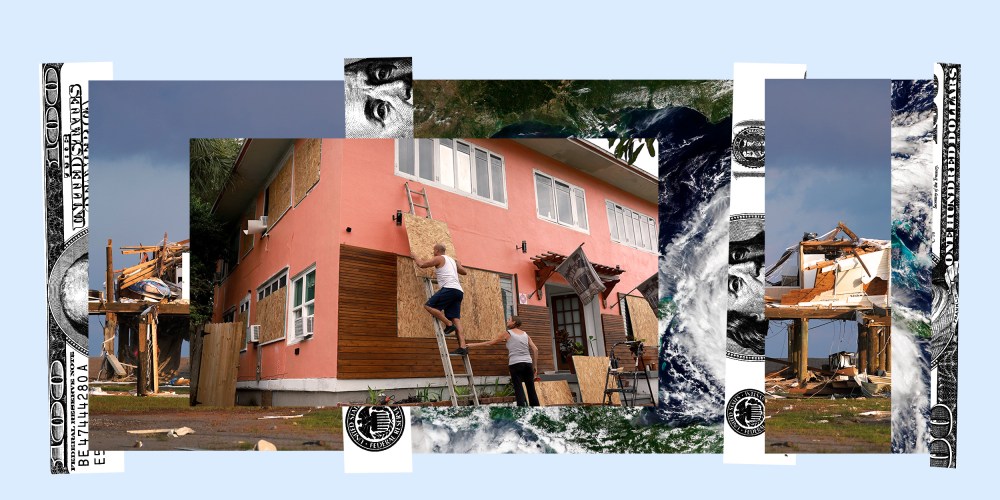
Hurricane Ian was still lashing southwestern Florida on Wednesday afternoon when NBC News meteorologist Bill Karins predicted that the damage and power outages would prevent tens of thousands (if not hundreds of thousands) of Floridians from returning home any time soon.
Ian had winds of only 75 mph Monday, but it intensified rapidly, as Laura and Delta did in 2020 and Ida did last year.
Take it from someone whose house took on 8 feet of water after Hurricane Katrina and who has covered disastrous storms since then: Karins is right to predict a long displacement for people from the hardest-hit areas. He’s also right to implicate climate change as the reason we’re seeing storms hit coastlines with more frequency and strength.
Forecast to reach Florida as a Category 3 hurricane, Ian struck Cayo Costa as a 150-mph Category 4 storm Wednesday afternoon. It was, Karins reported, the fifth-strongest storm to ever hit the continental U.S. Ian had winds of only 75 mph Monday, but it intensified rapidly, as Laura and Delta did in 2020 and Ida did last year.
We’ve been told to expect climate change to cause population shifts, and it’s likely that most people have imagined that such changes will be a function of land washing away or a function of crops and livestock dying as temperatures climb. But that’s not the only way climate change is going to push us around.

We’re already at the point where financial concerns — including the ability to get mortgages or to insure mortgaged property — are making it harder for some people to stay in the places they love and call home and making it harder for people who might be interested in those places to move there.
During the four years of quiet that preceded Ian’s landfall, a dozen insurance companies evacuated the Sunshine State. Six insurance companies left from February to last week. This leaves Floridians, more than a million of whom have been forced to obtain insurance from a “last resort” state plan, paying almost three times the national average for homeowners insurance.
Unlike Florida, Louisiana was repeatedly hammered by hurricanes in 2020 and 2021. Just like in Florida, insurance companies are falling into insolvency and stranding their policyholders. Last week, Louisiana lost its ninth homeowners insurance company since 2020, the same company that was just declared insolvent in Florida.
State Rep. Jerome “Z” Zeringue told Louisiana’s Houma Courier that he refused to pay the $9,000 premium Louisiana’s “last resort” insurer would have charged. He eventually found a private company that charged him $4,500 — twice as much as he paid before Ida, “and that’s with the highest deductible and bare minimum protection.”


The rates for Citizens, as the state-based insurer is called, are expected to increase by another 63% next year. Eugene Montgomery, who is on Citizens’ board and is an insurance company executive himself, told a reporter for Gannett: “Some people’s insurance payments are going to be larger than their mortgage payments. I’ve been in the insurance business 44 years and have never seen such a challenging market.”
Homeowners insurance companies don’t pay for flood damage. The National Flood Insurance Plan covers that, because private insurers generally don’t. Covering flood losses isn’t profitable. Last month, E&E News, citing news from the Federal Emergency Management Agency website, reported that 425,000 flood insurance policyholders had dropped their policies since October. FEMA took the data down, citing inaccuracies, but it acknowledged that there has been a “drop in policyholders.”
Make insurance too cheap and people will build in places more likely to be destroyed. Make it too expensive and people who call such places home will struggle.
Sen. Bob Menendez, D-N.J., blamed reports of flood insurance customers’ dropping coverage on a new FEMA policy called Risk Rating 2.0, which the agency says will use a more accurate calculation of flood risk and, thus, require some policyholders to pay higher premiums. “Families were already struggling to pay their flood insurance premium, and it’s now clear that Risk Rating 2.0 has only made this situation worse,” Menendez told NJ.com.
America faces a conundrum: Make insurance too cheap and people will build homes in places that are more likely to be destroyed. Make it too expensive and people who already call such places home will struggle to survive — or even sell their homes to anybody else.
Florida is now offering some homeowners money to fortify their homes. The state also recently enacted legislation that provides reinsurance coverage to insurance companies and legislation to cut down on what some officials there describe as frivolous lawsuits against insurance companies. But just like addressing higher sea levels and temperatures in general, solving the country’s insurance crisis resists any easy answers.
But make no mistake: When you hear, read or watch reports about desperate people not having the insurance coverage you think they ought to have, sometimes because their insurance companies have left, you’re seeing in their worried expressions one of many signs of climate change.

Jarvis DeBerry is an opinion editor for MS NOW Daily. He was previously editor-in-chief at the Louisiana Illuminator and a columnist and deputy opinion editor at The Times-Picayune.