




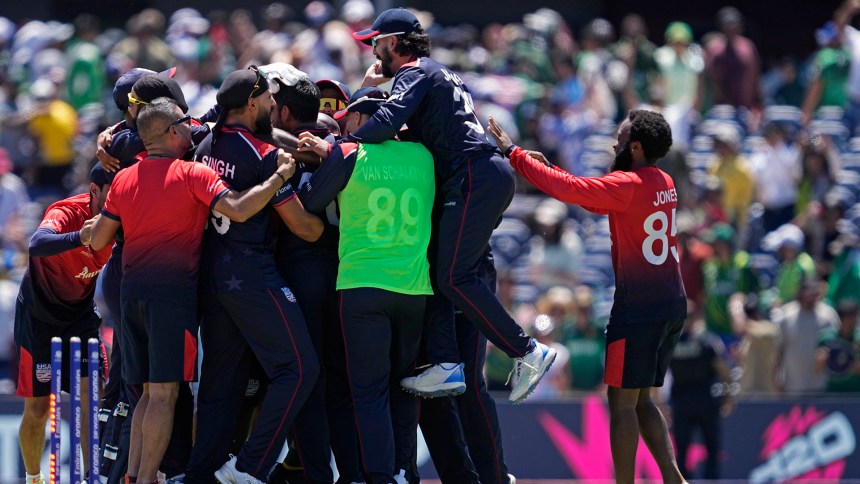
Nearly 200 years after the world’s first-ever international cricket match was played in the U.S., the sport has returned to America’s shores in the form of the T20 World Cup. On Sunday, Pakistan and India will meet in New York at the Nassau County Cricket Stadium for one of the tournament’s marquee games. This comes just days after Pakistan lost to the U.S. team in a historic upset.
More than half a billion viewers are expected to tune in to this blockbuster match between the South Asian rivals. The temporary grandstands will hold 34,000, and ticket prices on resale websites start at nearly $700 — before fees. “India vs. Pakistan is like the Super Bowl on steroids,” Nassau County Executive Bruce Blakeman told Reuters. “We had no idea how huge it was.”
Though the game is largely unknown in the U.S., this tournament is not America’s first encounter with cricket.
The India-Pakistan clash and the event as a whole are central to the push by the International Cricket Council (ICC) to grow cricket in the U.S., which is co-hosting the World Cup with the Caribbean. True growth and sustainability will require a long-term strategy that is not dependent on one-off tournaments, flashy matchups or once-in-a-century upsets, but the World Cup is still a sizable step toward helping cricket break into the mainstream in the U.S.
Though the game is largely unknown in the U.S., this tournament is not America’s first encounter with cricket. A Virginia plantation owner first documented the game’s presence in the future United States as early as 1709. George Washington’s troops played cricket at Valley Forge, Benjamin Franklin returned home from England with the sport’s official rule book, and Abraham Lincoln watched a match between teams from Chicago and Milwaukee in 1849. But around the Civil War, baseball became the country’s favorite bat-and-ball game. Cricket was left to the British colonies in Oceania, South Asia and the Caribbean.
As cricket writer (and editor-in-chief of the British Medical Journal) Kamran Abbasi, told me, “Cricket is now a global sport, but it’s hard for any sport to claim to be truly global without the involvement of major powers. [The] USA hosting this tournament feels a little forced, but it’s a significant moment.” America’s sheer size and financial might make the country a tantalizingly untapped market for the ICC and cricket’s power brokers. They hope to follow the successes of sports like soccer and Formula 1, which partly thanks to the internet have parlayed their considerable global reach into popularity in the U.S.
And while most Americans are unfamiliar with cricket, the sport isn’t starting from zero. The ICC estimates that the country is home to 30 million cricket fans. This alluring market — equal or larger in size than most of the sport’s powerhouses — is largely composed of immigrants from South Asia who watch and play the game throughout the country’s metropolises like New York City and Houston. Growing up in Chicago, I followed the sport from a young age thanks to one of those immigrants: my father. Nowadays during summer weekends, park spaces in and around the city transform into cricket grounds where more than a hundred teams compete.

“Wherever South Asians go, you will find cricket,” Abbasi told me. “The question really is whether that passion for cricket can be transferred to Americans who aren’t of South Asian origin.”
Cricket fans in America hope that transfer began last year with the launch of Major League Cricket (MLC), a new men’s professional league that consists of six teams. Founded with an initial $120 million from a zealous group of investors including Microsoft CEO Satya Nadella and Texas businessman Ross Perot Jr., the league bet on the diaspora of cricket-playing countries in America for its success.


Both the biennial World Cup and the MLC are based on a crowd-friendly, T20 version of cricket. Unlike the longer format of the sport that can last five days, T20 games last just three hours and are known for their aggressive batting displays and wily bowling. This action-packed format has already reinvigorated cricket globally and is unsurprisingly the version being exported to America, which is known for its short attention spans and need for instant gratification.
But staging shiny tournaments can only do so much to push the sport into America’s mainstream.
Perhaps nothing can promote the sport faster in the short term than the national team’s success and the ensuing coverage on social media and beyond. An unexpected lift came Thursday in the form of the USA’s improbable win against powerhouse Pakistan in Thursday’s group-stage game. This victory came on the heels of a dominant win against Canada in the tournament opener.
Any hopes to maintain the sport’s momentum start with the MLC. The league’s second season begins in early July and will feature more international superstars lured by the league’s growing profile and ample funding. Another stateside boost will come in 2028 when cricket will be played at the Summer Olympics in Los Angeles — the sport’s first appearance at the event since 1900.
But staging shiny tournaments can only do so much to push the sport into America’s mainstream. Long after Nassau County’s grandstands come down and the glow from Thursday’s upset fades, unglamorous work will be needed to organically grow the game through grassroots efforts and investments in infrastructure.
“I still think it will be tough. From the outside, it seems Americans like their sports — and they like to be the best at the sports they are competing in,” warned Abbasi. Nothing attracts American viewers like American stars. “A real danger is that ICC, a commercially driven organization, only sees dollar signs instead of planning a long-term strategy to establish cricket in the USA and make it sustainable.”
Despite the many uncertainties in the coming years, though, cricket fans and stakeholders hoping for the sport’s American expansion must keep the faith. As baseball fans are fond of saying, “If you build it, they will come.”

Dr. Jalal Baig
Dr. Jalal Baig is a physician and writer based in Chicago. His work has appeared in the Washington Post, The Atlantic, Foreign Policy, Guardian, Vice, Slate, Religion News Service and elsewhere.