




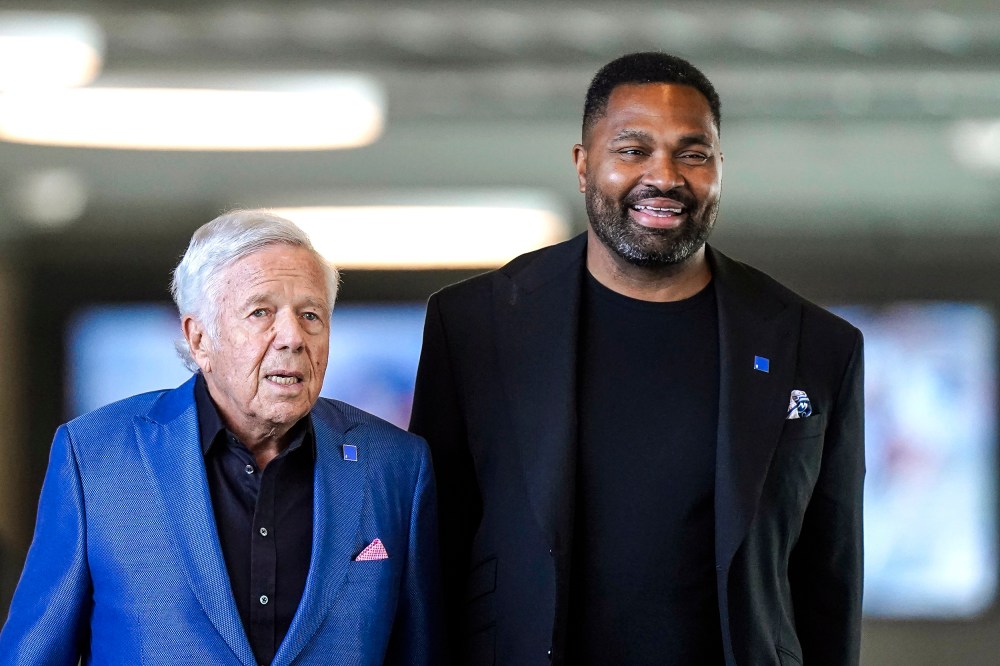
During a news conference Wednesday introducing Jerod Mayo as the new coach of the New England Patriots, Mayo, the first Black head coach the Patriots have ever had, put the NFL on notice that he’s not too timid to discuss race, not even after the team’s owner had just said he was “really colorblind” when hiring Mayo.
“I want to get the best people I can get,” Patriots owner Robert Kraft said in introducing Mayo. (The franchise and Bill Belichick, who won six Super Bowls as coach of the Patriots, mutually parted ways last week.) “I chose the best head coach for this organization,” Kraft said. He said Mayo “happens to be a man of color. But I chose him because I believe he’s best to do the job.”
“You want your locker room to be pretty diverse, and you want the world to look like that,” Mayo, a former Patriots star linebacker who’s now the NFL’s youngest coach, said. “What I will say, though, is I do see color because I believe if you don’t see color, you can’t see racism,” Mayo said. Later he added that seeing color is necessary so that “we can try to fix the problem that we all know we have.”
The “we” there could equally refer to the National Football League and to the city of Boston.
A new era in New England.
— New England Patriots (@Patriots) January 12, 2024
Congratulations, Head Coach Jerod Mayo! pic.twitter.com/Aj87oTu2S2
To say the NFL has a race and diversity problem is to state the obvious. According to data from 2021, 71% of NFL were players of color but, counting Mayo, there are only five Black head coaches. (A sixth, the Las Vegas Raiders’ Antonio Pierce, is serving as coach in an interim capacity.) In 2022, Bryan Flores, who is Black and a former coach of the Miami Dolphins, alleged in a lawsuit that the league “is racially segregated and is managed much like a plantation.”
But Mayo being one of a handful of Black coaches in the NFL is only half the story. The other half is where he’ll be coaching. “You’d better believe being the first Black coach here in New England means a lot to me,” he said Wednesday.
For a franchise that is beloved in the Boston area (full confession: I have been rooting for the Patriots since the late 1980s) and hated just about everywhere else, Mayo’s words run deep. Nobody can ignore how racism has permeated the region for decades.
Mayo being one of a handful of Black coaches in the NFL is only half the story. The other half is where he’ll be coaching.
There are several examples from the sports world to prove it. In 2022, LeBron James called Boston Celtics fans “racist as f—,” calling it his least favorite place to play. Celtics guard Jaylen Brown has acknowledged that part of the fan base is “extremely toxic,” although he notes that it does not apply to all Boston fans. Much has been chronicled about Boston’s racist history in sports, and it doesn’t help that the sports radio scene lacks any real diversity, and there are still incidents to confirm the late Bill Russell’s description of the city as a “flea market of racism.”
In December, the city of Boston finally apologized to the two Black men falsely accused of killing Carol Stuart in 1989. The extraordinary work from HBO and The Boston Globe about the Stuart murder opened up a necessary conversation about how racist the Boston area really was and, in some cases, still is.
Seeing a photo of Mayo with his family on the front page of a sports section exuding joy can be a symbol of what is possible. In Boston, such a photo is a rare sight.


Predictably, those who never see race in even the most obvious examples of racism quickly took to social media after Mayo’s introductory remarks, calling him an “ignorant bigot” who, they foolishly claim, betrayed the legacy of Martin Luther King Jr. Of course, they brought up King’s widely misconstrued “content of their character” quote. The Patriots’ official tweet of Mayo’s words show a barrage of complaints against wokeness and diversity.
What they don’t say is that the excellence of Black players in the heralded Patriots dynasty has long been ignored. When we think of the most successful Patriots to have dominated the mainstream culture, both on the field and off, all of them are white. Tom Brady. Rob Gronkowski. Julian Edelman. Belichick. All of them are global brands in their own right.
Left out of the effusive acclaim are Black players like Devin McCourty and Rodney Harrison, who both appear on NBC’s “Football Night in America.” Or even Hall of Fame wide receiver Randy Moss, whose 23 touchdowns in 2007 are still an NFL record. Mayo helps remind us of another reality: that the Patriots’ success was also due to some of the most talented Black players to ever play the game.
It won’t be easy for Mayo to follow Belichick.
It won’t be easy for Mayo to follow Belichick. But he has already claimed his space by simply stating how he really feels about leading the Patriots and, in a league that’s squeamish about race, how he feels about being a Black man leading the Patriots.
That’s important for the NFL, and it’s important for Boston.
“I think we’ve got someone very special who understands how to manage young people today,” Kraft said of Mayo. “The world is different than 20 years ago, even 10 years ago. In all our businesses, we try to create a culture that people want to stay with and be there long-term, and I think that Jerod has the makeup and chemistry, and it’s genuine.”
But in that same 20-year time frame that Kraft mentions, the NFL hasn’t changed enough. That’s why we should be rooting for Mayo, a Black coach who isn’t too shy to say that there’s still a problem that needs to be fixed.

Julio Ricardo Varela is the founder of "The Latino Newsletter" and co-editor of "Pressing Issues from Free Press."