




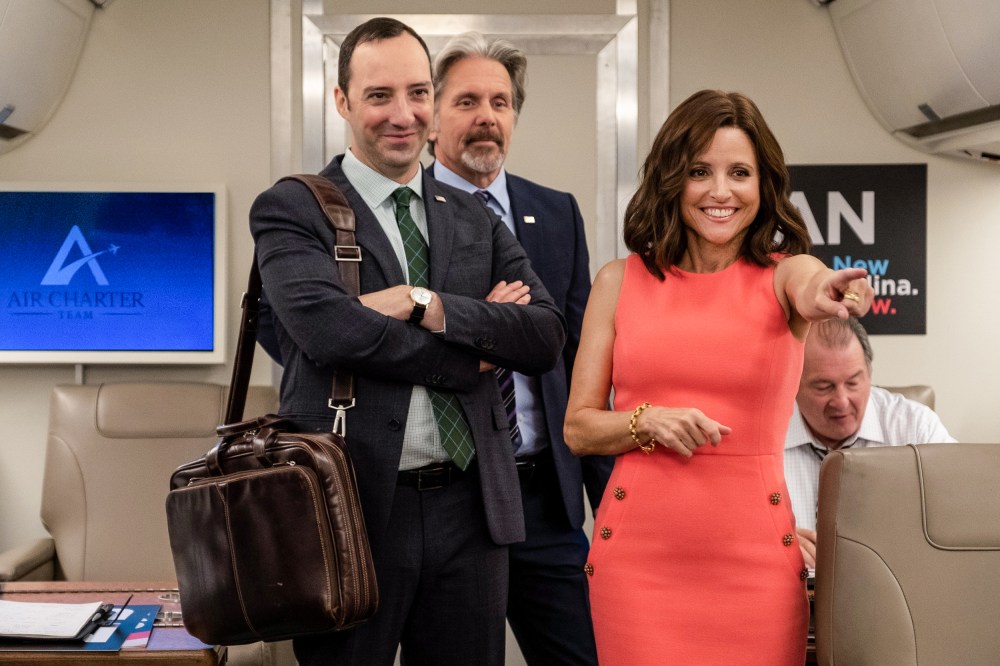
In the wake of Vice President Kamala Harris’ becoming the front-runner for the Democratic presidential nomination, viewership of HBO’s comedy series “Veep” is up a reported 353%.
The easiest, most likely (and laziest) explanation for this sudden surge of interest in a now-dormant program that ran from 2012 -2019 and chronicled the ups and downs (but mostly bottomless downs) of a make-believe politician is: digital culture.
Enough with algorithms and memes. They alone can’t account for why so many are binging the show’s 65 episodes.
After President Joe Biden announced he wouldn’t seek re-election (was that last Sunday or last year?), it appears some repost-hungry TikTokers couldn’t resist sharing one scene in particular, in which the show’s VP, Selina Meyer (played masterfully by Julia Louis-Dreyfus) threatens to deform a Colorado congresswomen’s genitals. Then there was a proliferation of “Veep” memes, including one in which Meyers is touched inappropriately in a professional workplace setting. Or the one in which the fictional and real vice presidents subject the English language to waterboarding and disgrace (naturally, parts of this meme were digitally altered and not real).
For “The Olds” (i.e., those 35 and above) who maybe googled something along the lines of “VP suddenly becomes presidential nominee” after the Biden’s announcement, the search engines ushered them to season 2, episode 10, where Vice President Meyer, like Vice President Harris, learns that POTUS will not be serving a second term. One episode prior, Meyer had accidentally bloodied herself walking through a glass door. To which her campaign adviser, Dan Egan (Reid Scott), sighed, “That woman has become a living metaphor for her own career.”
But enough with algorithms and memes. They alone can’t account for why so many are binging the show’s 65 episodes. To my mind, viewers are recognizing or recalling what many of us knew: “Veep” was, at least in its first few seasons, one of the funniest scripted series in the history of television, its genius residing in its portrayal of a group of cynical, bumbling, soulless, morally irredeemable politicos.
Characters’ mouths were essentially rotating gun turrets unleashing on anyone who annoyed them. Or, just anyone. Press secretary Mike McLintolk (Matt Walsh) is referred to by his colleagues as “the gash with the stash.” After Dan impregnated his co-worker Amy (Anna Chlumsky), he offered to Venmo her his share of the abortion costs. Selina, in one of her epic rants, complained that D.C. stood for “district of c—,” an insight she shared in front of three stunned junior high schoolers who were visiting the White House that day.
But perhaps what is most enduring about “Veep” is the even-handedness of its unrelenting nihilism. What was it that singer/philosopher Curtis Mayfield said? “If there’s a hell below, we’re all going to go!” That was “Veep’s” egalitarian comedic ethos. In pursuing that theme the show never worried if it insulted every last aggrieved majority and minority on earth.
In other words, “Veep” savaged everybody. With the exception of Richard Spleet (Sam Richardson), every political operative is depicted as a complete, unconscionable, self-absorbed jerk. Journalists are routinely shown to be corrupt narcissistic psychopaths. As are donors and, of course, lobbyists.


Perhaps what is most enduring about “Veep” is the even-handedness of its unrelenting nihilism.
Interestingly, “Veep” never valorized that old standby, “The American People.” The average voters/yokels who traipse through “Veep” seem fresh out of lobotomy rehab. It is their (our?) obliviousness to the machinations of their political class that powers that class’s existence.
Leaving digital explanations and the excellence of the writing aside, we might ask: Is “Veep” having its moment because it “speaks” to our present political predicament? Yes, and no. As for “no,” Biden’s White House doesn’t seem as dysfunctional, and certainly not as comically dysfunctional, as the one in “Veep.”
Then again, as Jon Stewart surmised with his “Colonel Butters” takedowns, Biden’s old age — and his staff’s refusal to recognize it — had some very real, very dysfunctional comedic potential. “Veep” canvassed similar territory in its “Eagle” episodes. There, Martin Mull played a revered, retired Beltway insider (i.e., “The Eagle”), summoned back into public service to fix a complex problem. No one in the campaign seemed to notice that The Eagle suffered from dementia and was popping pills as they obeyed his confident directives.
“Veep’s” showrunners have registered its sudden resurgence and seem none too happy! In The New York Times, the show’s creator, Armando Iannucci, frets that the line between entertainment and reality is blurring to the benefit of the most dangerous people in our reality. “What worries me,” he writes, “is that politics has become so much like entertainment that the first thing we do to make sense of the moment is to test it against a sitcom.” Iannucci wants less spectacle in politics; he craves more boring. In essence he affirms Selina’s cry about the fickleness of American voters “The rule book has been torn out and America is wiping its nasty a– with it!”
David Mandel, for his part, maintains in an interview with The Hollywood Reporter that Donald Trump, not Kamala Harris, is the “Selina-est candidate.” That could very well be true. It probably is true. But Mandel is not committing to the bit. He’s retreating from the show’s aforementioned Mayfieldian worldview. His comments undermine the rather bipartisan, almost apolitical takedown of American politics that made his show so intriguing.
Their comments remind us that comedy and politics serve different gods. What holds true in the former (i.e., we are all terrible people and deserve to be mocked) doesn’t always hold true in politics (i.e., some people are much more terrible than others and need to be mocked more). Nor should it. Kamala Harris, we hope, we pray, is not Selina Meyer. And our government, we hope, we pray, isn’t as incorrigibly messed up as “Veep” gleefully told us it was.

Jacques Berlinerblau is a professor of Jewish civilization at Georgetown University.