




UPDATE (August 16, 2023 2:55 p.m. E.T.): The prosecutor in Marion County, Kansas, said in a news release Wednesday that “insufficient evidence exists to establish a legally sufficient nexus between this alleged crime and the places searched and the items seized” and that the seized property should be returned to its owners.
At first blush, reports of an outrageous police raid on a small newspaper in rural Kansas appear as implausible as the fictional tornado that swept Dorothy and Toto out of that state. But this alarming incident — the stress from which, according to the newspaper’s publisher, contributed to the death of the paper’s 98-year-old co-owner, Joan Meyer — appears to be part of an insidious and growing trend of government censorship of free expression: one that we’ve seen lead to book bans and now threatens the freedom of the press.
This alarming incident appears to be part of an insidious trend of censorship of free expression: one that we’ve seen lead to book bans and that now threatens the freedom of the press.
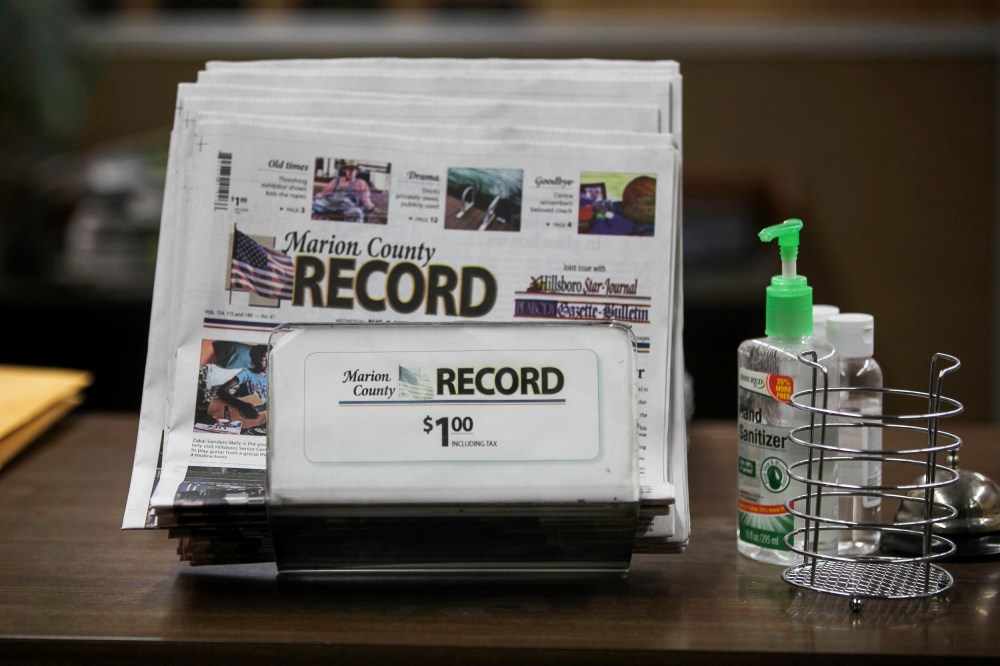
On Aug. 11, police, with a search warrant in hand, raided the office of the Marion County Record and the home its publisher Eric Meyer shared with his mother, Joan, in Marion, northern Kansas. Police seized digital communications, computers and cellphones. According to Meyer, the police took “everything we have.” Under federal law, journalists are generally protected from these types of paralyzing searches and seizures. Instead, law enforcement is supposed to serve a subpoena for any information it seeks.
Marion County Police claim its raid falls within an exception to federal law that applies when there’s probable cause to believe a journalist has committed a crime. The search warrant, which was signed by Magistrate Judge Laura Viar, allowed authorities to look for evidence of identity theft and evidence of criminal use of a computer. Over the weekend, local restaurateur Kari Newell (who reportedly threw a Record reporter out of a public event hosted at her restaurant for Rep. Jake LaTurner, R-Kan.) accused the paper of using illegal means to obtain information about her and her driving record. The paper denies any wrongdoing. According to Meyer, a source provided information about Newell to the paper. After attempts were made to verify the information, Meyer decided not to publish a story.
To be clear, receiving information from a source is not a crime. Nor is it a crime to fact-check that information, to publish that information or, in this case, not publish that information. To the contrary: Receiving tips, checking them out and deciding what, if anything, to do with that information if it’s confirmed, is the daily work of journalists and newsrooms. Even if the source who provided the information to the Record obtained it illegally, Supreme Court precedent holds that the paper cannot be held liable for receiving or publishing that information, unless it also participated in the illegal activity.


Moreover, in order to obtain a search warrant of a newsroom, even under the county’s claimed exception, law enforcement must establish probable cause by providing an affidavit to the court. Although the search warrant is publicly available, the underlying affidavit was reportedly being withheld by a county attorney who also owns the hotel that houses Newell’s restaurant, though local reports indicate it may be released in the coming days. It’s also been reported that the Record has been investigating the Marion County chief of police, who carried out the raid and has since defended it.

Without access to the affidavit, the public cannot begin to assess whether this raid on the small, rural newspaper was in any way justified, but as it stands now, it looks like a dramatic violation of basic press freedoms. Just as alarmingly, the confiscation of The Record’s devices and documents has jeopardized its ability to publish a paper at all, effectively erasing a vital source of news for the Marion community. This wholesale seizure appears not only to have violated federal law, but to have run roughshod over the paper’s First Amendment right to gather and disseminate the news.
The implications of the raid potentially stretch far beyond the Record. Sources far from Kansas may now be reluctant to share information with journalists out of fear that their communications and identities may become known to law enforcement if that journalist or newsroom is similarly raided. That’s precisely why protecting sources is vital to journalists’ ability to do their jobs.
The confiscation of the Record’s devices and documents has jeopardized its ability to publish a paper at all, effectively erasing a vital source of news for the Marion community.
Due in large part to the county withholding relevant information, the facts here are still largely in dispute. But if the current reporting is true, Marion County appears to be the latest in a line of state and local governments attempting to silence speech they find objectionable. Earlier this year, Florida Gov. Ron DeSantis, who’s seeking the Republican nomination for president, supported an ultimately unsuccessful and unconstitutional bill that would have characterized statements by anonymous sources as presumptively defamatory and characterized allegations of discrimination on the basis of race and sexual and gender identity defamatory per se.
At PEN America, we are all too familiar with government efforts to ban books in schools and to censor curriculum with which the government disagrees. If the free press is to remain free, then we must be just as outraged at any and every attempt to similarly censor the press. We can’t wait for a house to fall on us before we demand answers.

Shannon Jankowski
Shannon Jankowski is the Journalism and Disinformation Program Director at PEN America. Before joining PEN, she was a staff attorney at the Reporters Committee for Freedom of the Press where she led the Reporters Committee’s national amicus practice in matters involving access to courts and records, anti-SLAPP laws, newsgathering torts, and other First Amendment issues impacting the news media.