




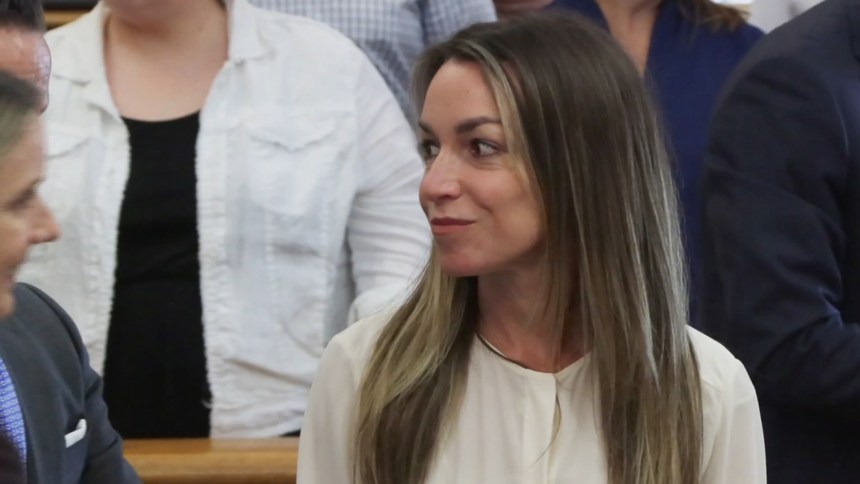
UPDATE (July 1, 2024, 2:50 p.m. ET): On Monday afternoon, Judge Beverly Cannone declared a mistrial after the jury was not able to reach a verdict.
My job is to follow legal stories in the news. Apparently, I’m not so great at my job. A month ago, when a nonjournalist friend messaged me to ask about my thoughts on the Karen Read murder trial. My response was: “Who’s Karen Read?” I didn’t know what they were talking about. Weeks later, and after many messages from other friends, I know who Karen Read is. I can’t avoid knowing who Karen Read is. This feels like the rare trial that has transcended the already-popular true crime realm and launched into the mainstream.
And as a Boston jury continues its dayslong deliberations, speculation is rampant. On Friday, the jury said it was struggling to reach a verdict. The judge told them to keep trying. And so we wait.
On Friday, the jury said it was struggling to reach a verdict. The judge told them to keep trying.
Karen Read is a 44-year-old finance professor in Massachusetts accused of intentionally backing her Lexus SUV into her boyfriend, John O’Keefe, a Boston police officer, and leaving him to die, unconscious outside a house party in a blizzard. There was damage to her vehicle, and Read allegedly made a number of incriminating statements at the scene of the crime, including: “I hit him. I hit him. Oh my God. I hit him.”
Case closed, right? The prosecution’s case seemed pretty straightforward: a classic lovers’ quarrel turned deadly. Or maybe another common scenario: drunken-driver-didn’t-realize-she-had-hit-someone. So at first I didn’t understand why this case had sparked so much interest. Prosecutors had evidence of damage to the back of Read’s vehicle, evidence she was driving drunk, evidence that she had a “rough” relationship with the victim, expletive-laced voicemails from Read to the victim’s phone, and what seemed to be voluntary admissions by the defendant that she had hit the victim.
But that was before I dug into the evidence, watched closing arguments and immersed myself in the defense’s theory of the case. Now, if I were on the jury, I’d vote not guilty.

I want to be clear here: I’m not so sure Read is innocent. Instead, I think there’s reasonable doubt of her guilt. And that means she’s not guilty. Read’s defense team has pulled off a rare miracle in criminal defense: They have constructed an alternate theory of police cover-up that actually has some evidence to support it.
The defense doesn’t need to put out an alternate theory of the case. They have no obligation to prove someone else committed the crime. The defense has no burden. They can rest and just argue that the prosecution didn’t meet their own burden to prove their case beyond a reasonable doubt. But ideally, the defense would want an alternate theory of the case, so jurors have something to believe in. Jurors like to feel that they solved a mystery. But putting forward an alternate theory is much harder than simply pointing at flaws in the prosecution, or claiming “some other dude did it” (the “SODDI” defense). What Read’s defense did is even more difficult. Her lawyers are claiming the police did it — that the “other dude” in this case is law enforcement, framing their client.
Criminal defense attorneys will tell you, in moments of candor, that their clients often want to pursue this sort of defense. (“The cops planted those drugs on me!”) But most of the time, there’s no actual hard evidence of police planting evidence or a cover-up, and defense counsel wisely declines this strategy.
Most of the time, there’s no actual hard evidence of police planting evidence or a cover-up, and defense counsel wisely declines this strategy.
But “the frame” can work. The O.J. Simpson defense team tried this tactic. It was a bold move. But the defense team pulled it off, despite the seemingly overwhelming evidence of Simpson’s guilt.
Read’s defense team has done a similarly magnificent job of uncovering critical inconsistencies, and sloppy police work. They employed top expert witnesses. They crunched the data. The defense used the health app on victim O’Keefe’s phone to suggest that he went downstairs into the basement at the house party — despite the prosecution, and the party hosts, arguing he never made it inside.
Read’s lawyers developed a theory that Read did drop off O’Keefe at the party, after which O’Keefe got into a fight with someone and was attacked by the family dog. Read’s defense brought in experts to say O’Keefe’s wounds were consistent with a dog bite, from a dog the size of the one in the house, who had a history of biting people. And, even if the police didn’t engage in a cover-up, they seemed to engage in questionable behavior. The lead investigator texted inappropriate comments about Read to others. Three different prosecution witnesses testified that at critical times, including the night of the killing, their calls back and forth to each other were inadvertent “butt dials.” But the “butt dial” itself is an anachronism. Phones don’t have buttons anymore that call people when you sit on them. It’s not a believable explanation for some suspicious phone calls. Certainly, the defense theory still has some holes in it. The most notable is why the police would engage in such a sophisticated cover-up, requiring a number of co-conspirators, but just leave the victim’s body outside of the house where the true crime was committed. Police officers should know better than anyone: If you’re going to “dump” a body somewhere, the worst place to do it is in your own front yard. Even as a criminal defense attorney myself, I find that I am frequently skeptical of defense theories. It’s fair to say that a lot of the time, the prosecution has put the right guy in the defendant’s chair. But I also know that police can be lazy, sloppy and, at their worst, willing to bend the truth to protect themselves and each other. In this case, I think the evidence at the very least suggests some degree of police self-interest and dishonesty. Most of this supposed cover-up required a lot of things to go right — not just the night of O’Keefe’s killing, but in the days that followed. The defense suggests that in the moments after an alleged fight, with a grievously wounded but still-alive victim, the best plan this group of friends could come up with was to just throw the man onto the house’s lawn. Sure, people make stupid decisions when they are drunk and panicked, but that’s a terrible plan. The prosecution pointed this out during their closing, while methodically marching through a lot of damning evidence against the defendant — much of it coming from the defendant’s mouth herself. And still, I wouldn’t vote “innocent.” But I’d vote “not guilty.”

