




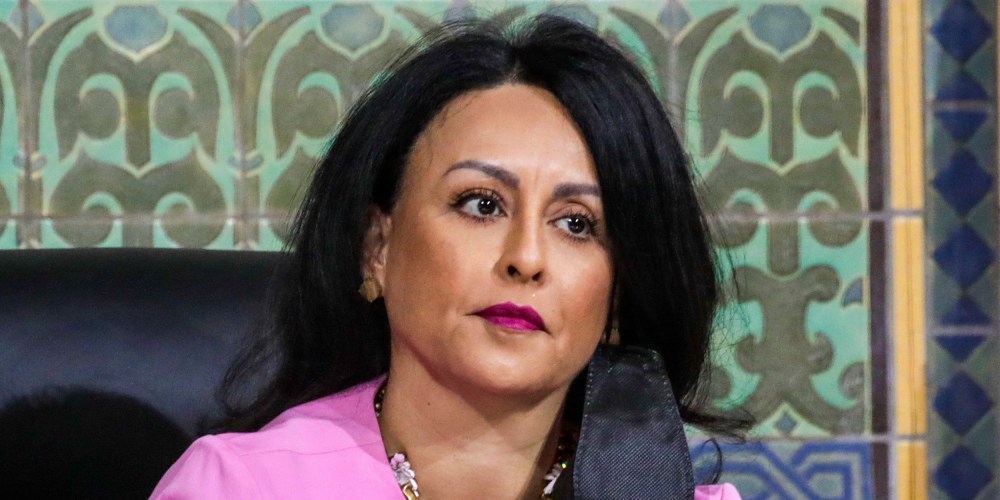
UPDATE (Oct. 12, 2022, 5:50 p.m. ET): On Wednesday, Nury Martinez announced she’ll resign her seat on the Los Angeles City Council days after audio leaked of her making racist comments in October 2021.
As the United States becomes more multiracial and multiethnic, the need for political alliances —especially between Black and Latino communities — is as great as it’s ever been. Coming together politically would help combat the disturbing anti-democratic trends from the extreme right, which means such alliances are necessary if this country is to become an inclusive and fully representative democracy. But recent news out of Los Angeles illustrates that such idealistic calls for unity for now remain just that: idealistic.
The need for political alliances—especially between Black and Latino communities — is as great as it’s ever been.
On Sunday, the Los Angeles Times wrote of a leaked October 2021 audio conversation in which Los Angeles City Council President Nury Martinez referred to a gay councilmember’s Black son as a “changuito,” Spanish for “monkey.” Kevin de León and Gil Cedillo, two other Latino councilmembers, were a part of that conversation, which also included homophobic comments and even derogatory comments about other Latinos in Los Angeles.
The day after the recording was published, Martinez, in a statement, said: “I ask for forgiveness from my colleagues and from the residents of this city that I love so much. In the end, it is not my apologies that matter most; it will be the actions I take from this day forward. I hope that you will give me the opportunity to make amends.” She resigned her position as City Council president, but the City Council chambers were packed Tuesday as angry Angelenos demanded that Martinez, de Leon and Cedillo step down from the City Council. President Joe Biden Tuesday also said the three should resign.
Martinez announced Tuesday she’ll be taking an indefinite “leave of absence” from her council position.
This latest episode speaks to the deeper issue of anti-Blackness in the Latino community, and it’s not an isolated incident, especially not in California. As the Times reported this summer, “the two largest racial bias cases brought by the federal government in California in the last decade” involve Black employees accusing their mostly Latino managers of racial harassment, including using racial slurs and displaying racist images.
Speaking of those race harassment cases, Anna Park, a Los Angeles-based Equal Employment Opportunity Commission attorney, told the newspaper then that “the nature of them has gotten uglier. There’s a more blatant display of hatred with the N-word, with imagery, with nooses.” She added: “Two decades ago discrimination was viewed as a Black-white paradigm” and “the feeling was minorities can’t be discriminating.” But now, she said, “it could be Asians discriminating, it could be Latinos discriminating. Regardless of what color you are, you don’t get a free pass.”
At a time when political unity among underrepresented communities should be the goal, Martínez’s hateful remarks and the discrimination cases Park mentions reveal the fractured reality. Too many Latinos have fallen into the trap of white supremacy and blatant racism instead of celebrating the Black community for what it has accomplished for American democracy. And this engrained anti-Blackness emanating from Latino communities will continue to play a role in fomenting such divisions.


And some politicians will exploit those divisions as best they can. Former President Donald Trump often regurgitated the talking point that undocumented immigrants steal jobs from Blacks and Hispanic Americans despite data showing those claims lacked merit. It’s a xenophobic trope with bipartisan roots. Some of that anti-immigrant position came from Black politicians, too. In the mid-1990s, for example, Rep. Barbara Jordan, D-Texas, while pushing for comprehensive immigration reform, used the slur “illegals” to describe migrants she claimed had “no intention to integrate”

Such language has been used to drive a wedge between the Black and Latino communities over the years. Even so, a recent poll analysis from PRRI concluded that “Black Americans’ views toward immigration and immigrants have been extremely positive overall, and in some ways have become more positive and welcoming than they were in the past.”
Still, despite data showing that both Black people and Latinos in the U.S. share similar views on the importance of how their respective histories shape their identities and that Afro-Latinos are polling at significant numbers in recent Pew data — suggesting a common ground that could lead to stronger political coalitions — there will always be examples of Latinos being pitted against Black people, and vice versa. For example, this summer, the rapper Tyga apologized for anti-Mexican tropes in his “Ay Caramba” video, but after he apologized, anti-Black remarks from the Latino critics who lambasted him was also exposed. The divisions that we see in pop culture are the same we see in other places where Blacks and Latinos co-exist, whether on City Council boards or in work places.
The building blocks were there for past alliances, but they never fully materialized.
Issues such as voting rights, racial equity, criminal justice, police reform, climate change, women’s rights and student loan debt should motivate Black and Latino communities to form alliances. The building blocks were there for alliances in the past, but they never fully materialized. Weeks before his assassination in April 1968, Martin Luther King Jr. was corresponding with the labor leader César Chávez and praising him for his 25-day fast to promote nonviolence. That same decade Black Panther member Bobby Lee actively recruited Puerto Ricans and white Southerners in Chicago to form a “Rainbow Coalition.”
Given that not much has changed for Black and Latino communities since the ‘60s, striving to establish and form deeper political alliances will benefit both communities. The 2008 Obama multiracial, multiethnic coalition proved that political power is viable, even though governing such a coalition still has its challenges. The Obama strategy of 2008 worked for President Joe Biden and Vice President Kamala Harris in 2020, although Republicans are savvy enough to divide and conquer communities in the interests of staying relevant and in power.
Both the Martinez recording and the racial bias settlements from California prove that so much more work needs to be done, but the work can’t begin until Latinos condemn anti-Blackness and racism in any form or setting. There need to be more intentional attempts to understand those shortcomings and begin to heal the past by understanding that Latinos will need Black people and that Black people will also need Latinos if either group has any hope of surviving an extreme right targeting them both.

Julio Ricardo Varela is the founder of "The Latino Newsletter" and co-editor of "Pressing Issues from Free Press."