




Update (Jan. 13, 2022, 5:05 p.m. ET): This article has been updated to clarify Turning Point USA’s connections to white nationalist beliefs.
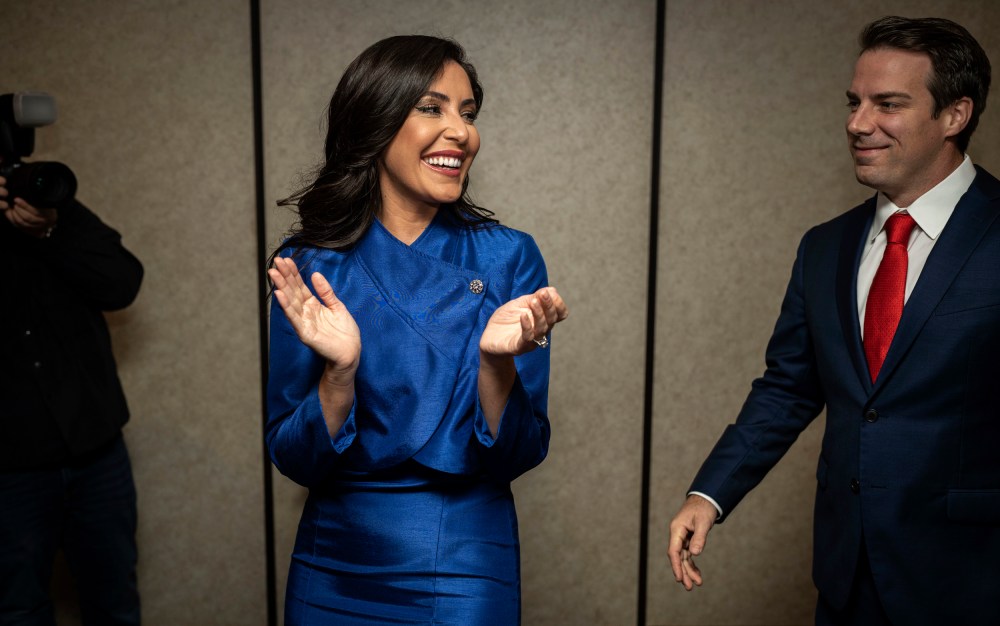
The same week she voted 11 times against Republican House leader Kevin McCarthy for speaker as part of the most extreme MAGA wing of the GOP, Anna Paulina Luna was being accused of witchcraft by a political opponent aligned with MAGA personality Roger Stone.
There will be 47 Latino members in the House, that is, 11% of the country’s 435 representatives.
Welcome to the 118th Congress. According to a 2022 post-election analysis of state and federal races from the National Association of Latino Elected and Appointed Officials (NALEO) Educational Fund, the election of 14 new Latino members will make this the most Latino House ever. There will be 47 Latino members in the House, that is, 11% of the country’s 435 representatives.
Among those new members are Maxwell Alejandro Frost, D-Fla., an Afro-Latino who became the first Generation Z member to be elected to the House, and Robert Garcia, D-Calif., the country’s first LGBTQ+ immigrant to be elected and also the House’s first member of Peruvian descent. Other newly elected Latinos, such as Reps. Greg Casar (D-Texas) and Gabriel Vasquez (D-N.M.), add to the fact that the progressive moment has indeed tapped into the Latino electorate.
As for veteran House members, Rep. Pete Aguilar, D-Calif., chair of the House Democratic Caucus, will be the highest-ranking Latino ever.

But Luna is, perhaps, the most glaring example that the election of more Latinas and Latinos to Congress isn’t just a boon to the progressive movement or to Democrats. According to the NALEO analysis, 12 Latino Republicans will serve in the House, five of them new members. Juan Ciscomani will serve as Arizona’s first Latino Republican representative, and Lori Chavez-DeRemer will be the first Latina to represent Oregon in the House of Representatives. In Texas, Monica De La Cruz defeated progressive Michelle Vallejo, who’s also Latina, to give the GOP a district in the Rio Grande Valley, and then there’s Florida, which elected Luna as the state’s first Mexican-American representative.
If you’re surprised that a representative of Mexican-American descent belongs to the MAGA camp when MAGA began with then-candidate Donald Trump’s incitement of hatred against Mexicans, then you shouldn’t be. There were plenty of Latinos and Latinas who instantly sided with the authoritarian xenophobe, and the MAGA movement has always had Latino support.
If you’re surprised that a Mexican-American representative belongs to the MAGA camp, you shouldn’t be.
Their support might seem counterintuitive to those who believe Latinos would turn against Trump, but there has always been a minority of Latinos who view fellow Latinos and Latinas as the “other.” What MAGA has done is give these voices a platform that not only amplifies such extremist views but also provides cover for their white nationalist allies. Not much separates Luna from disgraced Proud Boy and Afro-Latino Enrique Tario. The difference is that, unlike Tario, Luna is now a member of Congress and has a vote that for the first four days of voting last week, she used to block the election of a House speaker and continue what my political podcast co-host and MSNBC contributor Maria Hinojosa has called “a perpetual state of attempted coup.”


A Latina version of Rep. Lauren Boebert, R-Colo., Luna, according to a summary of her career in the Tampa Bay Times, followed the MAGA playbook to gain political fame. She has ties to chief Kevin McCarthy opponent, Rep. Matt Gaetz, R-Fla., and has worked with Turning Point USA, whose founder Charlie Kirk has expressed concern over the “diminishing and decreasing white demographics in America,” and pushes the white nationalist belief of great replacement theory.
There is also the moment in 2019, the year before she decided to first run for Congress, when she decided to stop using her married name Gamberzky and changed it to Luna.

Luna claims she was a Barack Obama supporter and a Democrat, but, according to the Tampa Bay Times, “underwent a political transformation once she started looking more seriously into what each political party stands for.” As I know from having covered U.S. Latino politics for close to 15 years, the dissatisfaction with Democrats from a small sector of Latinos has always been there. The MAGA movement — as anti-democratic, racist and anti-American as it is — gives these voices a home against “woke” Latino leftist culture and debates about the word “Latinx.”
It’s no longer a question of if Latino conservatives will play a role in politics and upcoming elections, it’s now how much influence will they actually exert to recast American conservatism and extremism. At the same time, the 2022 midterms showed that the MAGA message has very little appeal to Latinos, who overwhelmingly voted for Democratic members of Congress.
Latinos supporting the MAGA agenda doesn’t mean the overall MAGA crowd supports Latinos.
But, as was illustrated when Roger Stone associate Matt Tito, Luna’s primary opponent, accused Luna of practicing witchcraft, Latinos’ support of the MAGA agenda doesn’t mean the overall MAGA crowd supports Latinos. Though Luna’s ascension to the House of Representatives is certainly newsworthy, it’s important that we journalists avoid placing too much emphasis on a representative of Mexican descent who’s signed on to a political movement that began with the demonization of Mexicans.
While Luna, who eventually voted for McCarthy on the 12th ballot, represents an ideology that has some appeal within the Latino community, it’s far from the dominant view. The loudest voice is never the most representative one, and as MAGA Latinos go mainstream, we should take care not to forget that.

Julio Ricardo Varela is the founder of "The Latino Newsletter" and co-editor of "Pressing Issues from Free Press."