





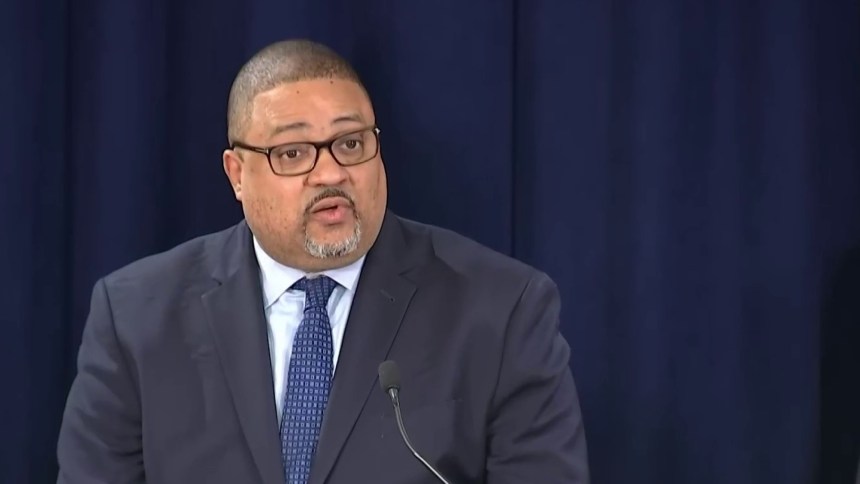
On Tuesday, Manhattan district attorney Alvin Bragg obtained a six-count indictment against Luigi Mangione. The 26-year-old is accused of shooting UnitedHealthcare CEO Brian Thompson at close range as the executive entered the Hilton in midtown Manhattan for a shareholder meeting on Dec. 4. Mangione was arrested in Pennsylvania after a dayslong manhunt.
Among the charges are first-degree murder “in furtherance of an act of terrorism.”
Among the charges are first-degree murder “in furtherance of an act of terrorism.” We typically think of terrorism as a mass casualty attack committed by a designated foreign organization to advance its political agenda, as when Al Qaeda terrorists killed almost 3,000 people on 9/11. Even domestic terrorism, such as the 1995 destruction of the Alfred P. Murrah Federal Building in Oklahoma City, has usually involved attacks on government targets. A lone American shooting a businessman in the back on the streets of New York does not readily fit that mold.
And yet, this case presents the kind of violence that requires an additional message of deterrence to prevent copycat killers. Already, Mangione has attracted hero worship, a troubling development in a country that relies on laws and courts to settle disputes.
Certainly, Bragg did not have to bring such charges. Under New York law, a garden-variety killing, if there is such a thing, is classified as second-degree murder. Defined as “intentionally causing the death of another,” second-degree murder is punishable by up to life in prison. The main difference between the penalties for these two categories is that parole is unavailable for first-degree murder.
Instead of taking an easier route, Bragg correctly recognized that more was at stake in this case than the death of one individual victim. This killing appears to be a case of vigilanteism, with one individual serving as judge, jury and executioner for a pattern of corporate conduct that is not known to have violated any criminal laws. And that is a distortion of our system of justice.
To rise to the level of first-degree murder, the killing must meet one of several aggravating factors, such as furthering an act of terrorism. This factor requires proof that a defendant had one of three motives: to “intimidate or coerce a civilian population,” to “influence the policy of a unit of government by intimidation or coercion” or to “affect the conduct of a unit of government by murder, assassination or kidnapping.” Bragg’s indictment alleges all three motives. At trial, however, a jury may convict Mangione if it finds that any one of these motives is proved.
One of Mangione’s New York attorneys, Karen Friedman Agnifilo, told NBC News that his legal team is “ready to fight these charges in whatever court they are brought.” Mangione’s Pennsylvania lawyer, Thomas Dickey, has previously said Mangione will plead not guilty to all charges.
All defendants are presumed innocent, but the evidence against Mangione appears strong. Police indicate that his fingerprints were discovered near the scene of the shooting. At the time of his arrest, he possessed a gun, which New York’s ballistics experts say matches the shell casings recovered in New York City. He also reportedly possessed a notebook in which handwritten words expressed ill will against corporate America. His physical appearance — distinctive eyebrows and all — appears to match the surveillance photos of the shooter circulated by the NYPD.


One significant piece of evidence Bragg’s prosecutors will no doubt point to is the words written on the bullets used to kill Thompson.
One significant piece of evidence Bragg’s prosecutors will no doubt point to is the words written on ammunition left at the murder scene: “delay,” “deny,” “depose.” They are believed to allude to tactics insurance companies use to reject claims. And the only reason to take the time to write those words on ammunition, prosecutors will doubtless argue, is to send a message to the public. Combined with other examples of his writing, prosecutors can argue Mangione intended to intimidate or coerce the insurance industry or influence government insurance regulators or affect the government’s conduct with regard to the insurance industry.
Of course, there is some risk that Bragg’s strategy will backfire. Jurors who share Mangione’s apparent views about insurance companies will most likely be weeded out during the jury selection process, but some may still harbor frustration toward the industry. If they see Mangione as a David taking on the insurance Goliath, there is some risk of jury nullification.
To mitigate that risk, I would expect Bragg to file a motion with the court to exclude any evidence or argument that Mangione’s alleged conduct was justified under the law as an act of civil disobedience. Justification requires an act that achieves a greater societal good that is in the public, rather than personal, interest and that has no reasonable alternative. Murder, in most instances, cannot meet this test.

One way Bragg has backstopped the terrorism charge is by also including a second-degree murder charge. This means even if jurors find the state’s evidence is insufficient to support the terrorism theory, they can still convict Mangione of murder.
The terrorism charge in this case has some parallels to hate crimes, which usually carry higher penalties than their generic counterparts. When I served as a prosecutor, critics would sometimes attack hate crimes statutes as “special rules” for “special groups.” An assault with any motive is still an assault, the thinking goes, and so hate crimes statutes are unnecessary. In fact, charging hate crimes serves an important function by sending a message to society that the body politic finds a violent act to be particularly egregious when it is committed on account of a person’s race, religion or sexual orientation.
In the same way, Bragg is undertaking the additional effort to send a message that society will not tolerate political violence.

Barbara McQuade is a former Michigan U.S. attorney and legal analyst.