




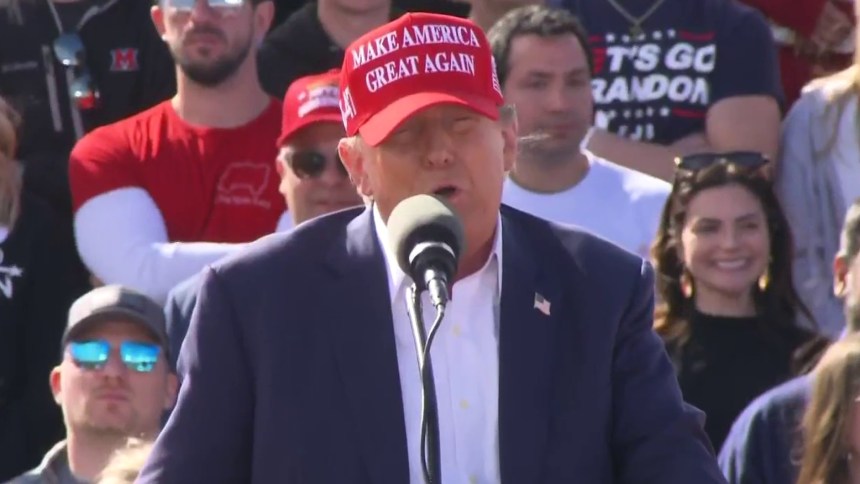
There’s little evidence that GOP elected officials will ever accept that former President Donald Trump is in the wrong. When he visited Congress on Thursday, he was feted like a returning hero just a few years after having encouraged a mob to run rampant against many of those present. His criminal conviction has likewise prompted no bouts of introspection or calls for Trump to drop out; instead, Republicans have dug in their heels and bashed the justice system.
A few hours before his Thursday visit to Capitol Hill, a little over half of the Senate GOP sent a letter to Attorney General Merrick Garland to complain yet again about that conviction. Spearheaded by Sen. Rand Paul, R-Ky., the one-page letter is filled with Republican talking points without a shred of real evidence. But it was the final line of the letter that stands out: “We condemn this show trial,” the senators wrote, “not just because it marks the attempt to imprison a leader of the loyal opposition, but because it threatens the existence of due process of law, without which a constitutional republic dedicated to individual liberty is not possible.”
What I take issue with is the idea that Trump leads a “loyal opposition.”
Leave aside for a moment that Trump absolutely received due process in this case: He had ample opportunity to defend himself and was convicted by a jury of his peers, and neither Garland nor President Joe Biden had anything to do with the case. What I take issue with is the idea that Trump leads a “loyal opposition.” Under no definition of the term could that be considered true, not when he and the MAGA movement are so overtly dedicated to undermining American democracy.
At its root, democracy requires everyone involved to be invested in its outcomes. All parties who take part in an election must be willing to accept the results of an election if the system is to work at all. Within that structure, there must likewise be an ability for the minority to criticize the majority’s plans and policies without fear of retribution. In doing so, the minority hopes to win over enough support that the government changes hands peacefully in the next election.
In this way, democracy differs sharply from other forms of governance where any opposition to the ruling order could be deemed treasonous. After all, if the only way to remove a government is through revolt, its leaders will work hard to ensure that theirs are the only ideas that can circulate. We see this in tyrannies stretching back into antiquity and in modern totalitarian states where dissent is stifled through whatever means possible.
The representative democratic models that developed in the late 18th and early 19th centuries offered an alternative to autocracy that provided a much less violent method of shifting a country’s direction. In the United Kingdom, the House of Commons became the primary administrator of authority, supplanting the direct rule of the crown. But still, on paper at least, Parliament to this day derives its authority from King Charles III, in essence governing on his behalf in roles that have been granted through the British people via elections.
It was in the U.K. that the term the “loyal opposition” was first used, born out of the rise of formal political parties (the Conservatives and the Whigs) that could trade control of the government based on the will of the voters. The word “loyal” reflected the assumption that no matter how much the parties disagreed, they were still loyal to king and country — vastly reducing the risk of beheadings when administrations turned over.
Meanwhile, in the U.S., the idea of loyalty to the monarchy was supplanted by an adherence to the Constitution and the democratic processes it outlined. Even as polarization increased the ideological gap between the two main parties, the bedrock principle remained that elections’ results must be respected and if a party loses an election, it will yield power, confident in its ability to try again next time.


As you may have determined by now, none of this applies to Trump. Or, rather, Trump has made clear that he rejects the social contract that makes such an arrangement possible. When he was defeated in 2020, he falsely claimed that Democrats utilized mass election fraud to block him from office. He used that lie to attempt to overturn the election results; that campaign ended with a mob storming the U.S. Capitol to prevent Congress’ certification of Biden’s victory.
By themselves, Trump’s rants would mean nothing if not for his ability to bring others on board with his lies and the rejection of democratic norms and processes.
Those schemes earned him a federal indictment for his efforts nationally and state-level charges for his alleged schemes to do the same in Georgia. Accordingly, Trump’s claim that he is merely a humble politician suffering persecution for being Biden’s political opponent is in no way true. Nor is his insistence that Democrats will have somehow cheated if he loses again in November. Despite that, he’s using both as a dual pretext: to pre-emptively refuse to accept the results if he loses, and to target his opponents with phony investigations and the full force of federal law enforcement if he wins.
By themselves, Trump’s rants would mean nothing if not for his ability to bring others on board with his lies and the rejection of democratic norms and processes. A 2021 poll found that while most Democrats see Republicans as political opponents, as would befit a “loyal opposition,” most Republicans see Democrats as enemies. This dark juxtaposition speaks to why the GOP has been so willing to embrace Trump’s revenge-driven rhetoric.
Under Trump’s watch, the Republican National Committee is building out infrastructure to undercut confidence in the 2024 election. Russell Vought, the chief architect of the MAGA movement’s policies, has said that we “are living in a post-Constitutional time” and argued for a purge of any federal employees who won’t unquestioningly carry out Trump’s wishes. Multiple GOP senators who signed on to Paul’s letter have refused to say whether they’re willing to accept the results of this fall’s election. Many of their counterparts in the House continue to press the false claim that Trump won in 2020; several of them remain in their seats despite being an integral part of his plotting.
I would ask these Republicans who have been so willing to follow Trump in his continued rampage against the Constitution and the foundations of our democracy: Where exactly does “loyalty” come into play here?

Hayes Brown is a writer and editor for MS NOW. He focuses on politics and policymaking at the federal level, including Congress and the White House.