




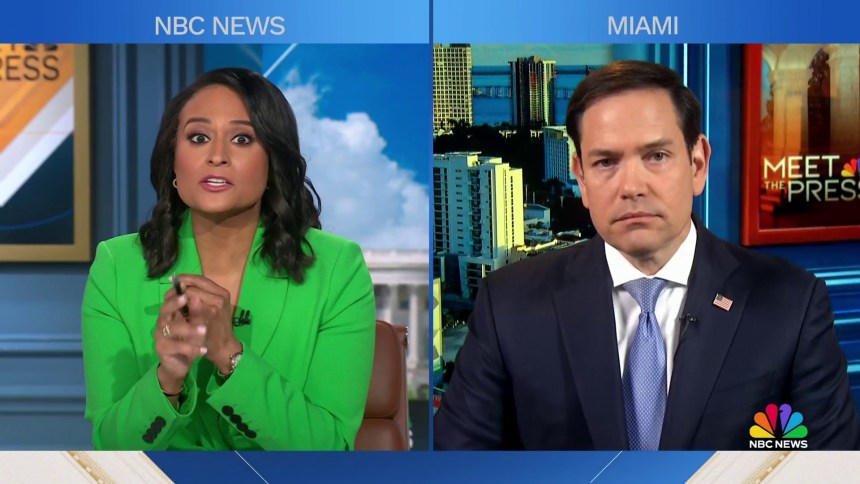
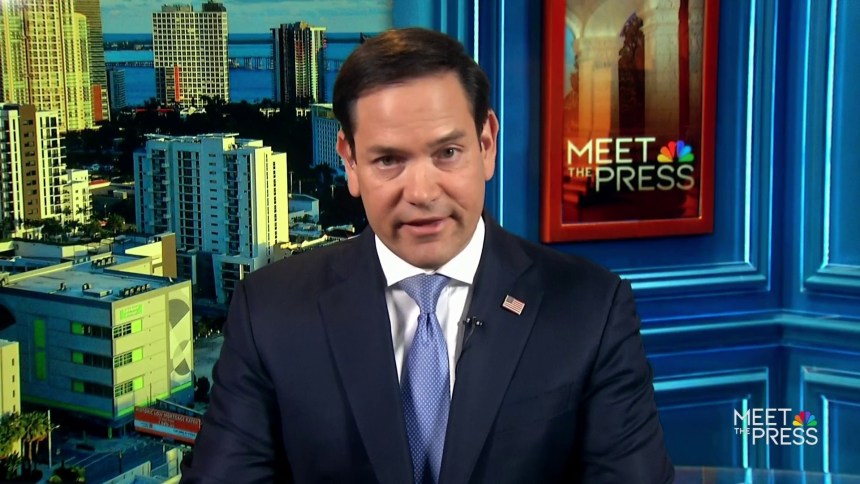
GOP Sen. Marco Rubio of Florida refuses to commit to accepting the results of the 2024 elections. And his reasoning is based on the bizarre claim that the real election denialists are not Republicans, but Democrats.
Asked Sunday on NBC’s “Meet the Press” whether he would accept the election results no matter who wins, Rubio said: “I think you’re asking the wrong person. The Democrats are the ones that have opposed every Republican victory since 2000. Every single one.”
Rubio is referring to real events. But he is creating an indefensible false equivalence.
Rubio, who is on former President Donald Trump’s list of potential vice presidential candidates, went on to point out that former Secretary of State Hillary Clinton said the 2016 election was “stolen” from her. And he pointed out that some Democrats did not vote to certify the election results in 2004.
Rubio is referring to real events. But he is creating an indefensible false equivalence between Democrats’ questioning specific results in the past and a modern GOP whose leader inspired an insurrection attempt, and whose party agenda has put lies about the electoral system at the center of its ideology.
Clinton has indeed said the election was “stolen from her” and called Trump’s presidency “illegitimate.” But let’s unpack that a bit more.
Substantively speaking, Clinton’s basis for arguing that Trump’s presidency was “stolen” is tied primarily to something there is documented evidence of: Russia’s interference in the election on behalf of Trump, after Trump solicited Russia’s intervention in the election. Whether that interference was decisive or even effective, among the many other factors behind Clinton’s loss, is debatable. But it stands in contrast to Trump’s claims about voter fraud in the 2020 election, which we know there is no evidence for and which often relied on fabricated claims.
Crucially, also, Clinton’s comments came years after the 2016 election — after she conceded to Trump and helped ensure a peaceful transfer of power from President Barack Obama to Trump. And Clinton never argued for overturning the election results or attempting a coup against Trump. Neither did leaders of the Democratic Party, even as they criticized Russian meddling and oversaw investigations into its possible effects on the elections.


Rubio also correctly recalled that in 2004 around 30 Democrats objected to the counting of Ohio’s 20 electoral votes. Those Democrats pointed to concerns that Ohioans in Democratic-leaning areas were disenfranchised after a report by Democratic members of the House Judiciary Committee claimed serious election irregularities in the state (and elsewhere). The members of Congress who filed the objection said that it was not meant to overturn the election but that it was a symbolic gesture intended to put a spotlight on election reform. During the brief debate in Congress prompted by the challenge, Democrats admitted that George W. Bush had won the election while describing alleged voting irregularities.
Like Clinton, then-Sen. John Kerry conceded that he lost the election, and the Democratic Party stood behind the outcome of Bush’s re-election. Contrast those outcomes with Trump and his Republican Party in 2020. Trump lied about supposed fraud in the election before the election even transpired. He concocted countless evidence-free falsehoods about fraud, he made efforts to coerce state officials and pressure his own vice president to defraud voters, and he called up a raucous crowd to the nation’s capital and encouraged it to storm the U.S. Capitol and disrupt the election’s certification. This was not questioning the election results — it was an agenda to subvert them.
The GOP has co-signed this agenda. The Republican Party did not reject Trump’s conduct as the behavior of an aspiring autocrat but endorsed it — nearly 150 House Republicans voted to overturn the election in 2017, including House Speaker Kevin McCarthy. Then, Senate Republicans shielded Trump from a conviction after the House impeached him for his role in the Jan. 6 insurrection and declined to explore the sanction of barring their aspiring tyrant from running again.
And since the 2020 election, most of the GOP has aligned itself with Trump as he has put the lie of a rigged election in 2020 — and a possible rigging of the 2024 election — at the center of his campaign messaging.
It’s possible that Rubio hopes to catch Trump’s eye by peddling this bizarrely inverted version of reality. But his suggestion that Democrats, not Republicans, are the ones who should be chided over not accepting election results is demonstrably absurd.

Zeeshan Aleem is a writer and editor for MS NOW. He primarily writes about politics and foreign policy.