





There was something unsettling about the House’s debate Tuesday over whether to strip Rep. Kevin McCarthy, R-Calif., of the speakership. I didn’t just feel dread for the state of the country or annoyance that McCarthy had let things get to this point, though both were there. Instead, as I listened to Rep. Matt Gaetz, R-Fla., the lead instigator of McCarthy’s downfall, speak about the ways Washington is broken, a weird thing happened: I realized that he was right.
Gaetz’s central argument against McCarthy was a condemnation of the way the House and Congress more broadly have functioned for decades. It made sense — or at least it would have if it were anyone but Gaetz saying it. Because reading back through the Congressional Record really highlighted several things for me that made clear how cynical he was being. In his attacks on McCarthy, he was really criticizing the Washington that Republicans built and revealing how little he actually cares about the legislative work he claimed to be championing.
It made sense — or at least it would have if it were anyone but Gaetz saying it.
Let me be very clear: Gaetz is in no way some kind of hero or martyr. He is reportedly a creep of various, potentially disturbing flavors. He has abhorrent beliefs about democracy and the rule of law. And he is a supporter of numerous cruel policies and a fanboy for former President Donald Trump. But he was clever in framing his opposition to the continuing resolution McCarthy passed, mostly with Democratic votes, to keep the government open last week — and to McCarthy’s speakership broadly — as an act of rebellion against the broken status quo.
There is “a dirty little secret in this town,” Gaetz said Tuesday: If “you back everybody up against shutdown politics, well, nobody wants to shut the government down. No one cheers for a shutdown, and, of course, when people are backed up against shutdown politics, the decision calculus changes.” The outcome more often than not is a leadership-negotiated omnibus bill, he lamented, or a series of “minibuses” that lump together some or all of the spending bills, forcing all-or-nothing votes by rank-and-file members.
The Florida firebrand also called for several reforms that he rightly noted had support from members in both parties. In doing so, he sounded, if not bipartisan, at least more open to the idea of losing votes than most far-right Republicans. “If we had single-subject bills, if we had an understanding on the top line, if we had open amendments, if we had trust and honesty and understanding, there would be times when my conservative colleagues and I would lose,” he said. “There might be a few times when we would win. There would be times when we would form partnerships that might otherwise not be really predictable in the American body politic, but the American people would see us legislating.”
McCarthy definitely didn’t do himself any favors by leaving work on the appropriations bills until the last minute. He instead prioritized “a series of unrelated distractions,” as The Washington Post’s Paul Kane put it, including an impeachment inquiry into President Joe Biden.


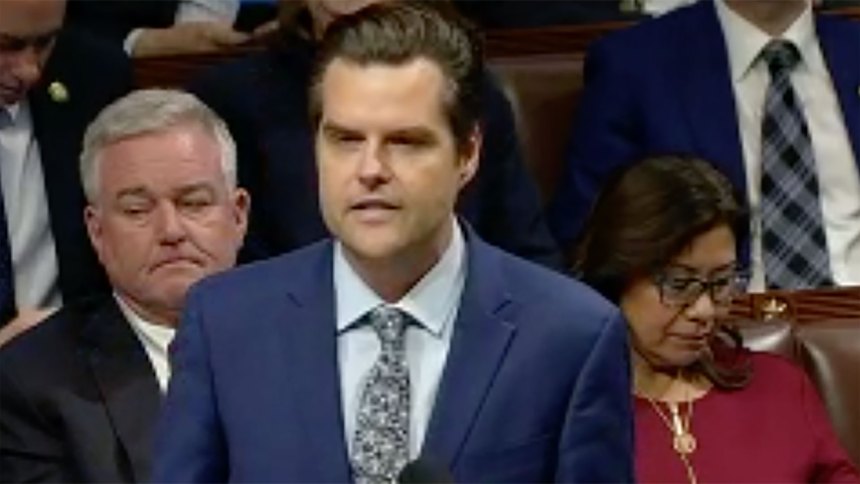
But many of the problems Gaetz described are the result of Republicans’ priming their voters to see compromise as a dirty word. Many Republicans, including Gaetz, hold extremely gerrymandered seats, incentivizing them to cater only to the most extreme primary voters. And in a February poll, Monmouth University found that over half of the Republicans polled thought elected officials’ not standing for principles causes more problems in American politics than officials’ being unwilling to compromise. In this environment, the only logical choice is to frame working with Democrats as weakness.
And another problem with Gaetz’s argument arises when you play out the counterfactual in which all 12 annual spending bills pass the House on time, even on a purely partisan basis, and Republicans use them as a starting point in negotiations with Senate Democrats. The final bills the two chambers hammer out might win over a majority of each party, and everyone could say that at last regular order had returned to Washington. But there’s no indication that Gaetz and others on the far right would have accepted the compromises that would be necessary in those bills to pass the Senate and avoid a Biden veto. That would leave them in the same place: accusing McCarthy of refusing to stand up for the sort of total victory that the GOP constantly promises its voters. The only major difference would be the timing.
He may decry the system that Republicans built, but he is absolutely a beneficiary, left free to make outrageous demands of leadership and fundraise off of their failure to meet them.
Relatedly, the shutdown politics that Gaetz decried was a Republican innovation. As I wrote last month, it was only in the 1990s that Speaker Newt Gingrich, R-Ga., first tried to use a lengthy federal shutdown as leverage. The House Freedom Caucus, of which Gaetz is a prominent member, pushed a shutdown in 2013 to try to force the end of Obamacare. (It failed utterly.) Trump championed the longest shutdown ever in late 2018 and early 2019 to get more funding for his border wall, which also failed. That didn’t stop the former president from urging McCarthy to shut the government down last month.
Finally, in a body where members are divided into workhorses and show horses, Gaetz is deliberately choosing to be the latter. He is smart enough to identify Washington dysfunction and potentially even to do the hard work that comes with actually legislating. He simply chooses not to, in favor of the kind of attention-grabbing stunts that have made his own party furious with him. He may decry the system that Republicans built, but he is absolutely a beneficiary, left free to make outrageous demands of leadership and fundraise off of their failure to meet them.
In one sense, Gaetz is the end result of a decadeslong process in which, through old members’ retiring or losing primaries and their replacements’ moving constantly to the right, House Republicans have all but forgotten how to govern. The sort of changes that Gaetz claimed to support are real, viable goals that would return the Congress to more effectively doing its most basic job: levying taxes and appropriating funding. But they run in opposition to the toxic political ecosystem that has allowed the Gaetzes of the world to evolve and thrive.

Hayes Brown is a writer and editor for MS NOW. He focuses on politics and policymaking at the federal level, including Congress and the White House.