




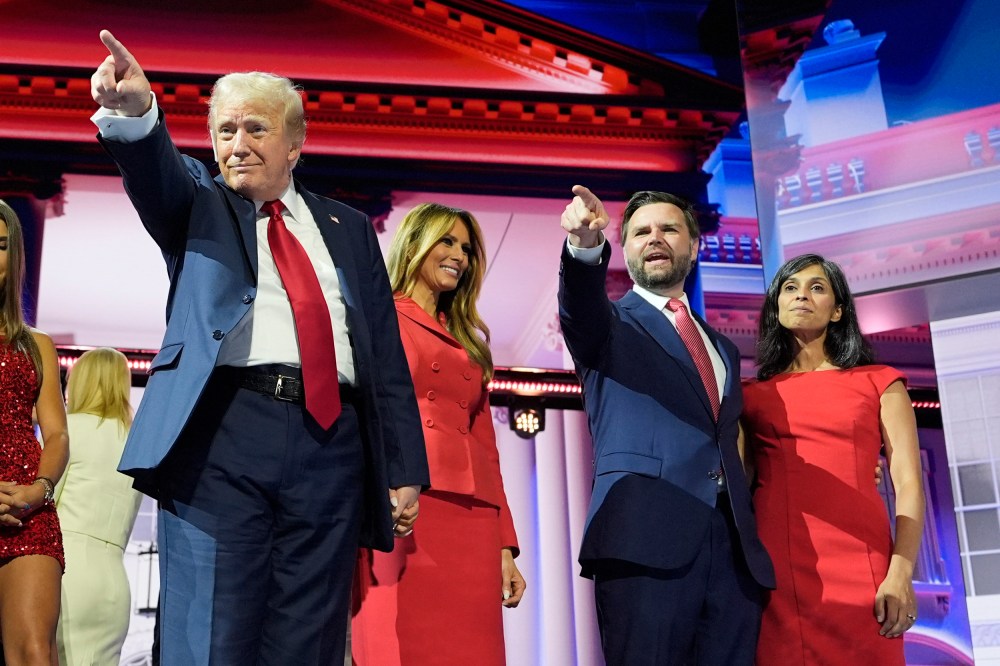
Who, exactly, is Melania Trump? Since the sphinx-eyed former model came onto the political scene alongside her husband, former President Donald Trump, she’s been something of an enigma: often seemingly apolitical and largely silent, with opaque motivations. She clearly doesn’t believe Trump’s politics were a deal-breaker — after all, she remains married to the guy. But she didn’t exactly seem enthusiastic about being in the political crosshairs, either.
The former first lady’s very short memoir, with an all-black cover interrupted only by “MELANIA” printed in neat white block letters, promised to offer some insight “into the life of a remarkable woman who has navigated challenges with grace and determination.”
In fact, no such insight is offered. It is a difficult book to remark on, because it contains nothing remarkable. This is a book you can judge by its cover. “Melania” isn’t just boring; it’s a void.
This is a book you can judge by its cover. “Melania” isn’t just boring; it’s a void.
Perhaps Melania is, too. Journalists have tried to profile her, interviewing friends and family members and even people she grew up with, trying to find anyone who can help them decode this cipher. But Melania may be more stick figure than hieroglyphic; there seems to be no complex code to crack.
Melania is exactly who she seems to be: a beautiful woman who has spent a long time trying to be beautiful, who found a rich man to take care of her. She loves her son, Barron, and her parents (her mother recently passed away). She likes expensive clothes and other luxuries. She may not be an aggressively cruel person like her husband, but she doesn’t seem to be an ardently compassionate one, either.
And that would be all fine and good had she stayed on the Upper East Side of Manhattan with her wealthy if boorish and allegedly philandering husband. But Trump’s foray in politics has dragged her in, too, and her decision to stand by his side (even if she didn’t go to the trial stemming from his alleged dalliance with porn star Stormy Daniels during their marriage) is at the very least a symbol of her acceptance of his vulgarities and goals.

She did get some headlines — good and bad — for using her memoir to voice public support for abortion rights just weeks before an election in which abortion is one of her husband’s weaker issues. But this, too, seems less a statement of true independence and more one of cynical political game-playing — her husband needs to rope in more female voters, and many women are angry that he appointed Supreme Court justices who overturned Roe v. Wade.
In this sense, perhaps Melania and Donald aren’t so different. Neither are politically sophisticated or particularly attentive to policy. Neither evince much in the way of compassion or even interest in other people. Trump is angry and vitriolic, while Melania is purse-lipped and stoic; he is emotionally incontinent, while she often appears to be in emotional rigor mortis; he is behaviorally uninhibited and says whatever he wants, while she is studiously reserved, perhaps because she has very little to say. But with both Trumps, what you see is what you get: There’s just not all that much there.
The Vances — JD, who is running for vice president, and Usha, who would be the second lady — are far more fascinating. But they, too, may be more transparent than the public would hope.

Journalist Irin Carmon has a compelling profile of Usha Vance in The Cut, and it sketches out a woman who on her face seems ill-suited for the role of political spouse to a MAGA maniac.
Usha is the high-achieving daughter of highly educated immigrant parents, who married a man whom she academically outperformed and who was attracted to her intelligence; JD even reportedly considered taking her last name and being the primary caregiver for their kids. Now, he’s a different kind of guy, one who rails against childless cat ladies and, as Carmon writes, “refer[s] to his children as belonging to Usha” (“She’s got three kids,” he recently said on a New York Times podcast).
Vance, Carmon writes, “often describes Usha as a ‘working mother’ without implying that he himself has anything to juggle. He has come a long way from the would-be stay-at-home dad who put his wife’s career first.” Usha Vance has clerked for conservative judges, including federal appeals Judge Brett Kavanaugh, now a Supreme Court justice, and Chief Justice John Roberts, but she doesn’t seem particularly conservative (or political) herself. JD Vance once compared Trump to Hitler and voiced his respect for ambitious women; now he’s Trump’s highest-level lackey and mocks professional women who delay or — for whatever reason — don’t end up giving birth. JD Vance once compared Trump to Hitler and voiced his respect for ambitious women; now he’s Trump’s highest-level lackey. After he graduated from law school, Vance did a little bit of time in the world of corporate law before moving into bigger-money venture capital. While there, he published a finger-wagging memoir about his working-class Appalachian roots, writing about rural America in a way that appealed to moneyed coastal conservatives who wanted to believe that the poor and miserable immiserated themselves. (While the book garnered plenty of bipartisan praise, leftists, it’s worth pointing out, were some of the harshest critics of “Hillbilly Elegy.”) When he decided to run for the Senate in Ohio, he was barely living in the state and had to quickly rebrand as a real working-class man — and one sympathetic to the MAGA movement. Usha hasn’t adopted many of the aesthetics of the MAGA female, but she has quit her job, joined her husband on the campaign and stood by her man even as he demeans the sort of smart, well-educated, ambitious female archetype she very recently embodied. The public wants the people in high office — and most people in the public eye, whether they are in politics or are celebrities of another kind — to have depth. We want them to be decipherable, but we want to believe they are special. When they seem insubstantial or fueled by some silly and transparent motivation, we may assume there’s something they’re obscuring. If they’re at the top of their game, then there must be something there, right? Maybe with these four — the Trumps and the Vances — that’s simply assuming too much. Perhaps they are exactly who they appear to be: The Trumps are superficial, intellectually shallow and money-obsessed; the Vances have principles that seemingly bend to their grand ambitions. All four of these people have had enough time to show the public who they are. I suspect that what we see is exactly what we get.
Jill Filipovic
Jill Filipovic is a journalist and the author of "OK Boomer, Let's Talk: How My Generation Got Left Behind" and "The H-Spot: The Feminist Pursuit of Happiness." 

