




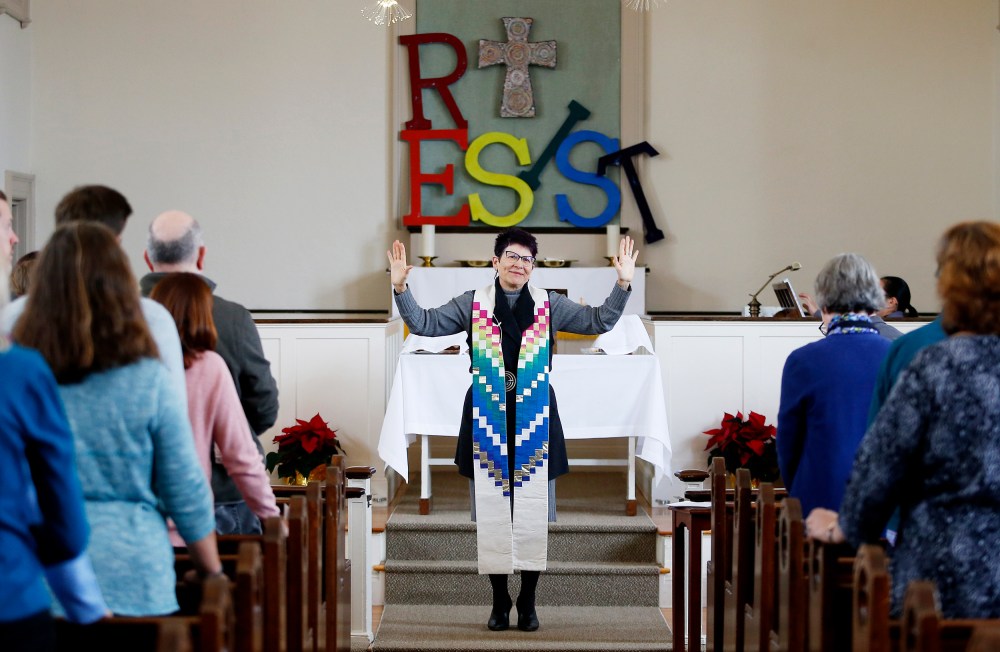
On Dec. 31, the United Methodist Church will officially complete its realignment, a period of several years during which congregations could vote to leave the denomination. Up to a quarter of American congregations have chosen this option. The percentage of churches and percentage of congregants is not the same — it may be a smaller percentage of actual members who split off — but this schism has changed the shape of Methodism. And yet, while the schism will bring challenges, it also has provided a way forward for the vast majority of members to affirm and love its LGBTQ members, as well as their many family members and other allies.
Over the past 50 years, the question of how to treat LGBTQ Methodists has been debated, avoided, postponed — and dreaded — since before I entered the ministry in 1979.
Like other Protestant denominations (for example the Episcopal, Presbyterian and Lutheran churches), the United Methodist Church has faced decades of conflict, largely over the full humanity of gay people. Also like other denominations, after years of national and other meetings, the denomination has at long last come to a conclusive point after deliberations by the General Conference (the church’s governing body).
These divisions are by no means a surprise, and in fact have existed openly since at least 1970. Over the past 50 years, the question of how to treat LGBTQ Methodists has been debated, avoided, postponed — and dreaded — since before I entered the ministry in 1979.
Politics has played a clear role here, as it has in church decisions for the more than 200-year history of Methodism. The United Methodist Church has always been the most national, most representative Protestant denomination, with at least one church in every county in the United States.
Given this reality, LGBTQ rights is not the only wedge issue dividing the denomination. Our current Book of Discipline affirms a moderate pro-choice position on abortion, something many of those leaving the denomination similarly oppose. Methodism also has a long track record of advocacy for the rights of women, including the right to ordination, which some of those leaving the denomination oppose. And even broader cultural issues related to lifestyle, parenting and schooling have percolated not only through the body politic of the country, but also through the community and communities of faith.
There is a direct relation and correlation between the denominational debates and national political currents. Some of this is simply the societal: John and Mary argue at the school board meeting on Tuesday evening and then worship together on Sunday morning. But it’s also tied to differing churchgoers’ divergent perspectives on local versus national authority, and state versus federal authority.
Having had the privilege of preaching from 10 different pulpits, I’ve observed just how localized and culturally distinctive each congregation becomes, in matters great and not so great.
But while our faith communities, like our country, have become polarized across a wide range of issues, differing stances on gay rights have contributed most directly to the current denominational move forward. This is an issue that is biblically misunderstood. There are, in all 66 books of the Bible, including both Hebrew Scriptures and New Testament, some 30,000 verses. Exactly six of those — six out of 30,000 — arguably have anything directly to say about same-gender relationships. It was not exactly a central theme for the biblical writers.
But what makes this matter so devilish for modern Methodism is not the utter paucity of any biblical material related to this theme, but rather the very clear, centrally admonished teaching otherwise. Take Galatians 3:28, often a favorite verse for conservatives. Paul writes: “In Christ there is neither Jew nor Greek, there is neither slave nor free, there is no male and female.” Martin Luther called Galatians “the Magna Carta of Christian liberty.” And in it, Paul very clearly sets aside religious, economic and sexual distinctions, on the power of the unity of faith, of baptism and the Gospel of Christ. “There is no male and female,” but rather the unity of faith, hope and love in the person of Christ, crucified and risen. (For more analysis on this topic, see J.L. Martyn’s magisterial “Anchor Yale Bible Commentary.”) Thus, many of those now leaving the denomination, purportedly on biblical grounds, have apparently not read all of the Bible, or at least have not read some parts of it carefully, faithfully and fully, especially Galatians 3:28 and similar passages within the full and fully liberating arc of biblical theology. What makes this matter so devilish for modern Methodism is not the utter paucity of any biblical material related to this theme. Nevertheless, the separation is happening. And for the future, that means hard work for Methodism. It means the ongoing struggle to support urban ministry with poor and underprivileged people, the struggle to support growing churches in Africa and Asia, the struggle to support summer camping ministries, campus ministries, elder care ministries and many other forms of service that our connectional system has effectively and efficiently provided over decades, will have to go on with fewer people, churches and far less money. We will have to cut in all these mission-driven areas and of course in many other administrative ones (number of Bishops, superintendents and other). Politics is downstream from economics, which is downstream from culture, which is downstream from religion (and here I mean religion very broadly construed). What happens in religion really matters, and it both conditions and reflects the broader American landscape, for good or ill or very ill. Our divisions flow downstream into others. The work of the church will get more difficult after today. But 2024 also brings a new day, a chance for creative repositioning, a moment for younger clergy coming of age to find their voice and influence, and the kind of freedom that comes with change.
Robert Allan Hill
Robert Allan Hill is the dean of Marsh Chapel and a professor of New Testament and pastoral theology at Boston University. He is the author of 17 books and is an elder (Upper New York Conference) in the United Methodist Church. 

