





According to a Dec. 14 CNN report, the Navy Federal Credit Union, the largest credit union in the United States, denied more than 50% of Black applicants for new conventional home mortgages in 2022, even as it had an approval rate greater than 75% for white applicants seeking the same product. According to that report, among all major lenders last year, Navy Federal was responsible for the widest disparity in approval rates between Black and white borrowers.
Among all major lenders last year, Navy Federal was responsible for the widest disparity in approval rates between Black and white borrowers.
That CNN report found that “Black applicants to Navy Federal were more than twice as likely to be denied as White applicants even when more than a dozen different variables — including income, debt-to-income ratio, property value, downpayment percentage, and neighborhood characteristics — were the same.”
CNN, whose report is based on its analysis of public data made available through the Consumer Financial Protection Board, also found wide disparities between Latino borrowers and white ones.
A class-action lawsuit was quickly filed against the credit union alleging that it had discriminated against Black and Latino applicants, and Rep. Maxine Waters of California, the ranking Democrat on the House Financial Services Committee, said in a statement that “Navy Federal must explain both to Congress and their members how such practices took place, what immediate steps are being taken to correct the harm done, and who in management will be held responsible.”
Waters is right to call for an examination of the practices that contribute to those racial disparities. However, the problem with calling one lender on the carpet is that it often lets industry practices off the hook. Waters’ call must go out to the entire housing industry, not just one financial institution.
Where there’s smoke, there’s fire, and when it comes to discrimination in lending, racial disparities represent the smoke not the fire. The fire is burning in foundational elements of underwriting, servicing and regulations that not just Navy Federal Credit Union abides by, but that other institutions abide by, too.
The CNN analysis considered income, debt-to-income ratios, and other crucial factors like property value, down payment percentage, and neighborhood characteristics — variables readily available through publicly accessible databases. In a statement to CNN, Navy Federal spokesperson Bill Pearson said CNN’s report “does not accurately reflect our practices” because it did not account for “major criteria required by any financial institution to approve a mortgage loan.” He said those factors included “credit score, available cash deposits and relationship history with lender.”
Credit scores, which constitute a significant component of all lenders’ underwriting practices, are not publicly available. But as Lisa Rice and Deidre Swesnik, both with the National Fair Housing Allowance, explain in an article, “Discriminatory Effects of Credit Scoring on Communities of Color,” those scores “do not just assess the risk characteristics of the borrower; they also reflect the riskiness of the environment in which a consumer is utilizing credit, as well as the riskiness of the types of products a consumer uses.” That makes them a legal vestige of our segregated past.
Still, given that other lenders also rely on credit scores, Navy Federal must explain why their approval rates differed from their competitors. However, that will require more data sharing and transparency among all lenders.
Certainly, some bias in lending decisions is a reflection of racist people, and we must have robust oversight mechanisms to weed them out. However, big racial disparities in housing are more of an indictment of the everyday practices and policies that all banks adhere to. Consequently, we need innovation in various foundational elements of the mortgage process that appear to be neutral on the surface but still have negative impacts on multiple groups. We are seeing innovation in credit scoring with FICO 10T and VantageScore 4.0 replacing the classic FICO credit scoring model, but we should use the current news on Navy Federal as an opportunity to demand more.
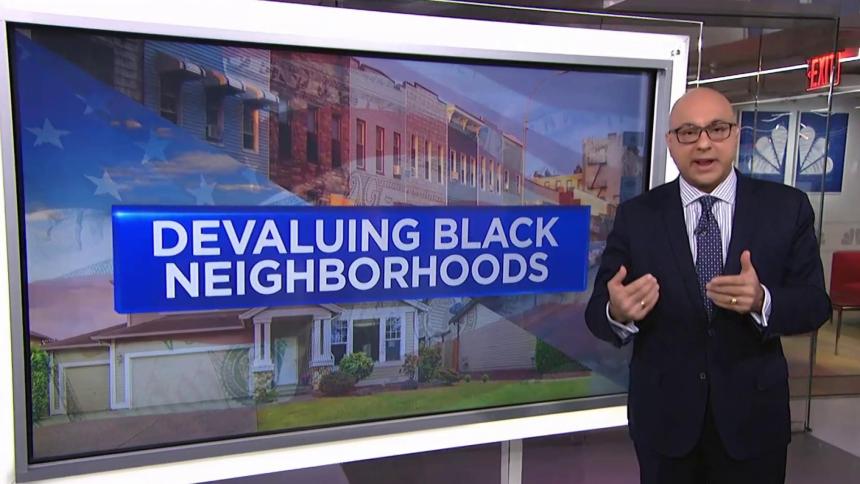
Again, the problem is bigger than Navy Federal. Industry practices are the problem. When my colleagues Jonathan Rothwell, David Harshbarger and I released our report that showed that homes of similar quality in neighborhoods with similar amenities are worth 23% less in majority Black neighborhoods than in neighborhoods with few or no Black residents, reporters, advocates and homeowners were quick to blame appraisers. However, we felt there were likely many more factors we would find when we made it through the smoke of the racial disparity.
We have filed a lawsuit alleging discrimination on behalf of two Black mortgage borrowers rejected by Navy Federal Credit Union. It is shameful that Navy Federal does not give their Black and Latino customers the same opportunities as White customers. https://t.co/hWT2YAGKYr
— Ben Crump (@AttorneyCrump) December 21, 2023
And we were right. When the Federal Housing Finance Agency made appraisal data public, allowing researchers to see how much appraising matters in the value difference, we saw that, after adjusting for characteristics of homes and neighborhoods, appraisal transactions in majority-Black neighborhoods are 1.9 times more likely to be appraised under the contract price than homes in majority-white neighborhoods, representing 20% of the value gap.
The problem is not just the individual appraiser; it’s also the subjective nature of the price comparison approach. We can diversify the appraisers and still get similar results. The Biden administration and HUD, through its Property Appraisal and Valuation Equity interagency taskforce, created an action plan to address various components of appraisal bias, but there are many more factors to consider that contribute to the value gap.
We should demand data that will help us more accurately identify racism and allow us to innovate the systems that we may be wrongly deeming race neutral. We should approach the racial disparities in who’s getting approved for mortgages the same way. That is, we should demand data that will help us more accurately identify racism and allow us to innovate the systems that we may be wrongly deeming race neutral. Such innovations can come from understanding the conditions and experiences of Black and Latino borrowers. For example, not only should Navy Federal know that past discrimination can be a reason that Black and Latino borrowers show up with less cash in hand, a credit union made up of so many government workers and veterans should account for applicants’ military background and know that income is a much better predictor of whether borrowers will stay in their home. If a credit union can’t recognize this, then who can? As a membership organization, Navy Federal can lead the way in creating new products that show an understanding of the people it serves. It can show its commitment to change through the development of new loan products that respond to some of the disparate impacts that are reflected in racial disparities. In the wake of recent news, we want to reaffirm our commitment to fair lending practices and doing right by our members. pic.twitter.com/m7u2KICQuu They could offer, for example, an innovative insurance product that homeowners can draw on to make their mortgage payments when they experience a disruption to their income or face unexpected expenses. Such a product would enable homeowners to stay current on their mortgages, decrease delinquencies, defaults and eventually foreclosures, and make homeownership more sustainable. They could make refinancing more attractive, too. A 2023 study by the JP Morgan Chase Institute revealed that Black, Hispanic, and lower-income borrowers had the lowest refinancing figures when compared to Asian, white and higher-income borrowers. Higher interest rates and even the threat of variability in interest rates certainly discourage people with lower wealth and incomes from refinancing or getting a mortgage. The best response would be from the industry as a whole in the form of new mortgage products and practices. However, if there were mortgage products that offered automatic refinancing adjustments, then low wealth borrowers, including Black and brown people, would be encouraged to get mortgages and grow wealth. The news of Navy Federal Credit Union and the racial disparities CNN found should sound an alarm. Navy Federal and its peers shouldn’t shy away from it. It’s in the interest of their members for them to explain the racial disparities CNN found. However, the best response would be from the industry as a whole in the form of new mortgage products and practices that replace the vestiges of our segregated past that are very much legal, accepted and in everyday use.
Andre M. Perry
Andre M. Perry is a senior fellow at Brookings Metro, a scholar-in-residence at American University, and a professor of practice of economics at Washington University. A nationally known and respected commentator on race, structural inequality, and education, Perry is the author of the book “Know Your Price: Valuing Black Lives and Property in America’s Black Cities.” 

