




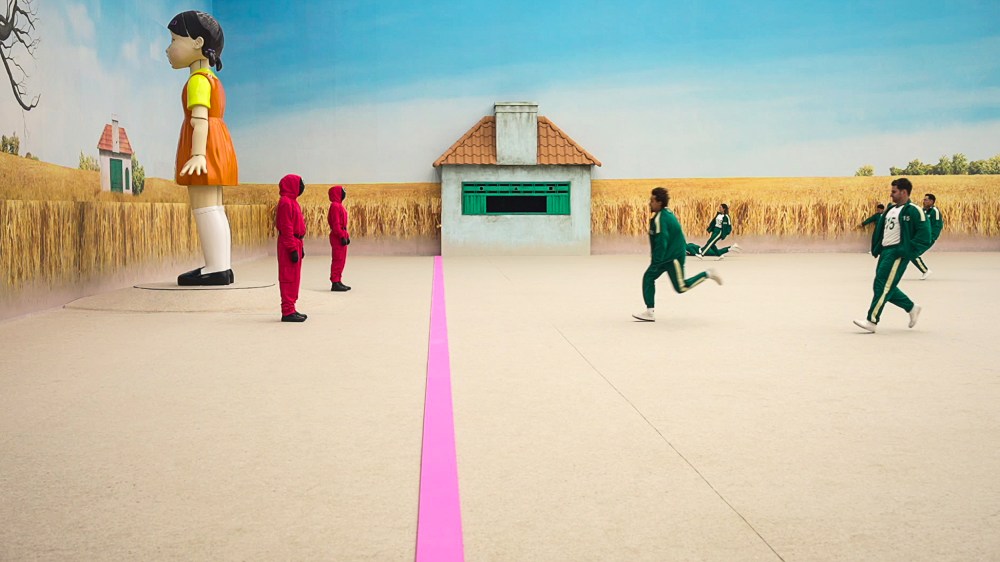
“Squid Game: The Challenge,” whose final episode is out Wednesday, is currently the most-watched show on Netflix in the U.S this week. It is the reality-TV version of the 2021 scripted Korean hit “Squid Game.” Much like in the show, contestants in “The Challenge” duke it out against one another in a series of cutthroat and disorienting games for a chance to win $4.56 million. Watching it, you can’t help but think the show’s creators are equal parts inspired and sick.
Watching it, you can’t help but think the show’s creators are equal parts inspired and sick.
The scripted series, in which those eliminated from the ruthless game are killed, is a damning critique of the so-called social darwinism of late-stage capitalism, the exaltation of money and the concomitant zero-sum construction of relations that such a system demands. This is symbolized by the enormous, transparent piggy bank that hovers above the contestants’ living quarters and upon which those contestants gaze with longing. Because with each elimination more money is added to the piggy bank, every contestant is literally worth money. Again, an apt metaphor for ruthless capitalism.
However, because “The Challenge” features real people, many of whom are in dire financial straits and are desperate for the money, the show loses its ability to offer any meaningful critiques. In this case, as contestants longingly look up at a real-life version of the piggy bank and connive to get one another eliminated, we are immersed in the sad reality of the dehumanizing system we’ve created. The show celebrates the worst facets of late-stage capitalism, which privileges money above all else, even, or especially, at the expense of community and human connection. The premise of the show exploits many of the most vulnerable members of society, who have suffered from a lack of social safety nets, and it fetishizes their struggles.
As on “Squid Game,” each “life” on “The Challenge” is worth money. With each elimination, $10,000 drops in the piggy bank, producing a range of responses from contestants. Some embrace the dehumanization. “For me, everybody is just money,” one contestant shrugs. Others appear more conflicted. Referring to the number of contestants, another one says, “We want those numbers to go down, but we forget why they’re going down.”

“The Challenge” has a kitschy and slightly painful start: Eliminated contestants have fake blood bags explode under their shirts, imitating a sniper shot to the torso, à la the original version, and they are required to play dead. Before one is invested in any of the players, the whole thing feels a bit like the campy lovechild of a first-person shooter video game and a pantomime. But as the audience becomes more invested in the contestants and we learn of their often heartbreaking stories of financial distress, the stakes feel higher. For example, one contestant has a disabled young child and he and his wife struggle, financially, to plan for their child’s future, including funding the support they’ll need after he and his wife are gone. Another spent a lot of his childhood unhoused and wants to make ends meet for his own family.


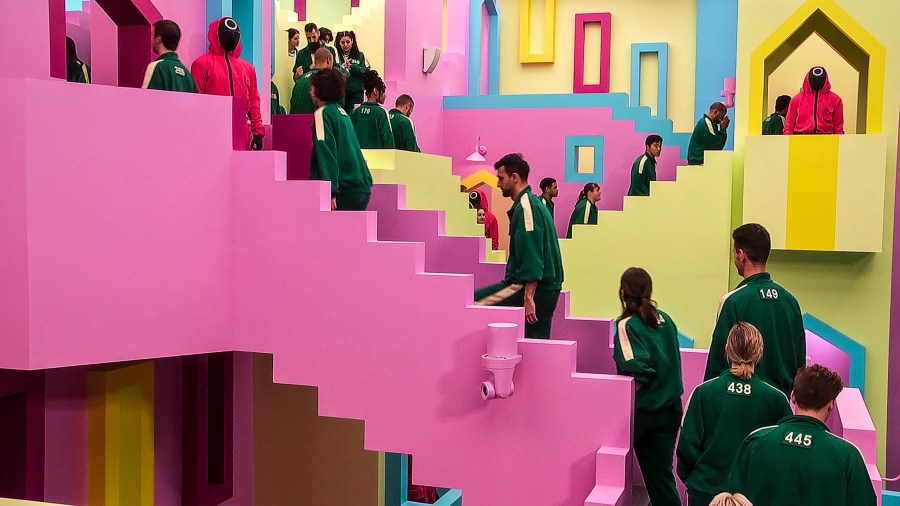
If anything, this show is unwittingly making a commentary on the brutalization of society, or the theory that legitimized violence begets more violence. The so-called games the contestants play often require psychological violence, and then there’s the enactment of actual death once a contestant is eliminated. It’s all symbolic of a winner-take-all system that exists in the real world. As MSNBC columnist Zeeshan Aleem wrote in October, recent research shows that, shockingly, the difference in life expectancy in the U.S. between those with and without college degrees is almost a decade. “Social inequality isn’t just leading to diverging quality of life for people in different social strata. It’s killing us,” Aleem noted.
The toll of ruthless capitalism on our mental health is manifested in shaking, weeping, panic-stricken contestants, some who even fight the urge to vomit under the stress. In one of the final stages of the show, we see the women are outnumbered nearly 2:1 by men, which in and of itself creates emotional distress for the women who are competing. The “competition” and the implicit creation of social order that ensues unsurprisingly favors men, many of whom volunteer themselves for leadership positions or unilaterally make decisions for the group through coercion, but under the guise of democratic decision-making.
The so-called games the contestants play often require psychological violence, and then there’s the enactment of actual death once a contestant is eliminated.
“[T]he mental health effects of other axes of power, like racism, sexism, colonialism, and imperialism, cannot be fully understood without attending to their historically contingent forms under capitalism; likewise, capitalism’s mental health effects cannot be understood without attending to these other axes of power,” Jerzy Eisenberg-Guyot and Seth J. Prins explain in “The impact of capitalism on mental health: An epidemiological perspective,” a chapter in the Oxford Textbook of Social Psychiatry.
The original “Squid Games,” with its fictional, dystopian world, offered us a needed critique of the barbarity of unfettered capitalism. Placing it in the real world, however, only seems to normalize, encourage and even celebrate the worst facets of our economic and political systems. So, while it makes for a gripping show, because the reality-show version inverts the point of the original show, the franchise has completely lost its way.

Noor Noman is a writer focused on culture, race and LGBTQ issues.