




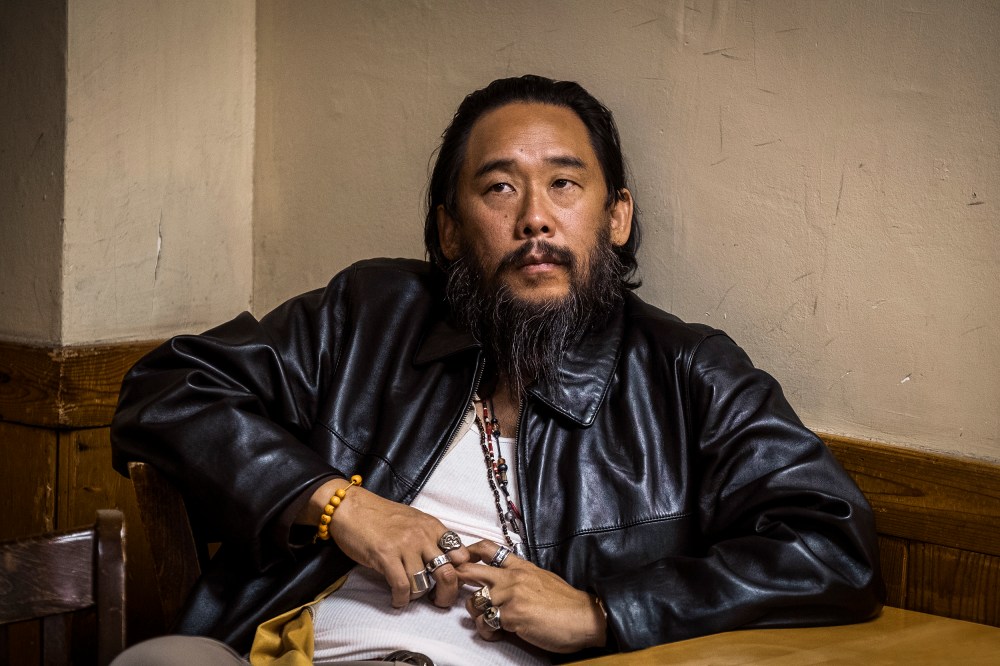
The Netflix and A24 series “Beef,” a global sensation about two people whose road rage feud gets out of hand and precipitates respective existential crises, has catapulted to be one of Netflix’s most-watched shows around the world since its April 6 release. The show found critical acclaim from the outset. And then it found controversy.
Even a fictional rape story is enacting its own form of violence, playing into and reinforcing values in which dominance is lauded and rape is one manifestation of this zero-sum construction of relations.
Last Thursday, writer and artist Meecham Whitson Meriweather and journalist Aura Bogado both posted a resurfaced excerpt from a 2014 episode of the podcast of David Choe, who plays a role in the Netflix show, in which Choe told a story in graphic detail about forcing a massage therapist into sexual acts. On the episode, Choe joked that this made him “a successful rapist.” At the time, Choe issued a statement in response to backlash: “I never thought I’d wake up one late afternoon and hear myself called a rapist. It sucks. Especially because I am not one. I am not a rapist. I hate rapists, I think rapists should be raped and murdered.” Adding it was part of his “art,” he said, “If I am guilty of anything, it’s bad storytelling.” A 2021 New York Times profile reported Choe chalked the scenario up to “performance art,” said it was fictional and denied he had raped anyone.
Some “Beef” fans have been outraged since the clip resurfaced and have demanded accountability from the production. Instead, the show’s creator, producers and other actors, including stars and executive producers Ali Wong and Steven Yeun, have remained silent about the matter. By Sunday, Twitter had removed the clip of Choe and locked Meriweather’s account after Choe filed a Digital Millennium Copyright Act notice. (Choe complained that the clips had been posted “without our consent.”)

These responses — silencing in various forms — are completely in keeping with the rampant rape culture that allowed Choe’s career to flourish after he made such vile statements nearly a decade ago. Whether it was “performance art” is beside the point. The fact that Choe described raping someone in detail and remained unscathed for so long speaks to a culture in which rape and sexual assault are normalized, even encouraged. He was commissioned for a huge mural in Manhattan’s Lower East Side in 2017, which the art world protested to no avail (his street art is what helped him amass a $200 million fortune for painting Facebook’s first headquarters in 2005). His recent visibility in “Beef” means collective outrage has been activated — but only when a certain threshold has been passed.
ya know the principals involved w #BEEF @netflix aren’t doing the #aapi community any favors right now by trying to hide/mute what David Choe did instead of investigating and holding him accountable — and themselves if they knew
— Marie Myung-Ok Lee / UGC Creator (@MarieMyungOkLee) April 18, 2023
At its root, this controversy foregrounds two major issues with the #MeToo movement. The first has to do with how we value survivors of sexual assault: In Choe’s story, the survivor of the assault was a Black woman who, as a massage therapist, is most likely from a lower socioeconomic class or at least possesses less clout than a world-famous artist/entertainer. “We are socialized to respond to the vulnerability of white women,” says activist Tarana Burke, founder of the #MeToo movement. “[There’s a] stark difference in what it takes to get attention around Black women and girls.” The second is that we are very often willing to normalize rape culture, of which rape fantasy is a huge component, even while stopping short of condoning actual rape.


How else do we explain or understand the horrifying rape statistics? One in 5 people assigned female at birth experience attempted or complete rape, while over 80% report having experienced sexual harassment or assault, according to the National Sexual Violence Resource Center. Rape and sexual assault are the natural conclusions of a culture in which sexual violence is normalized and glorified, from music to TV to podcasts to porn.
Even a fictional rape story is enacting its own form of violence, playing into and reinforcing values in which dominance is lauded and rape is one manifestation of this zero-sum construction of relations. “Recognizing this, it becomes important to construe rape culture in terms of sexual power that has been historically entrenched and culturally validated: the kind of sexual power that tacitly condones rape as an explicitly sexual expression of dominance,” communications professor and writer Meenakshi Gigi Durham explains in her book “MeToo: The Impact of Rape Culture in Media.” She writes: “[Rape] encompasses a range of sexually aggressive behaviors that sustain sexual power relations and reinforce an individual’s sexual violability as a result of social classification.”
Understanding rape culture through this lens, it is all the more relevant that the survivor in Choe’s story is a Black woman. Dismayed fans of “Beef,” Wong and Yeun want answers about whether those involved with the show knew about this clip at the time of casting.
Just as relevant is how those involved respond to this now. In disavowing Choe and his comments, they have an opportunity to subvert the status quo, of which rape culture is an enormous part. In doing nothing, as they have thus far, they, too, are culpable, like Choe, of normalizing and celebrating the idea of raping someone. And the longer they stay silent, the more harm they will do.

Noor Noman is a writer focused on culture, race and LGBTQ issues.