




Last month, nonbinary teenager Nex Benedict was found dead at his home one day after a fight with three classmates at his Oklahoma high school. Nex’s parents report that Nex, who used he/him and they/them pronouns, was the target of intense bullying by classmates in the months before his death. This month, the Department of Education announced it was investigating the school district’s handling of sex-based harassment.
Benedict’s death is a sobering reflection of the increasingly hostile climate young LGBTQ Americans face. Most of the coverage on this has focused on red states where politicians are seeking to roll back the rights of LGBTQ Americans, especially the trans and nonbinary community. But the harms are visible nationwide. A recent report on Gen Z Americans from the Public Religion Research Institute (where I am the CEO) finds that Gen Z adults who identify as LGBTQ report experiencing far more hostility than their straight counterparts.
Many Americans may struggle to understand why our country is experiencing this backslide in LGBTQ rights, after years of growing acceptance.
Moreover, our latest data shows that in the past year, Americans have become less supportive of LGBTQ nondiscrimination protections and same-sex marriage, and less opposed to allowing religiously based refusals of service to LGBTQ Americans. Yet our report also shows that despite the hostility they face and their deep distrust of American institutions, queer Gen Zers also maintain a strong sense of resilience.
Many Americans may struggle to understand why our country is experiencing this backslide in LGBTQ rights, after years of growing acceptance. As others have documented, this strategy, including a flurry of legislation restricting transgender rights and discussion of LGBTQ topics in schools by state legislatures and school boards, is part of a concerted effort by conservative activists. They realize that while most Americans support same-sex marriage and nondiscrimination protections for LGBTQ individuals, attitudes on gender identity and transgender rights are far more divided. As a result, far-right groups have fought to remove materials and curriculum from public schools and libraries that feature gay and transgender people.
Social conservatives have a long history of activism in schools that focuses on perceived threats to America’s children — much of it linked to sexual politics. These activists are alarmed not only by younger Americans’ greater propensity to identify as LGBTQ, but also at the country’s larger acceptance of LGBTQ Americans, including those who are transgender or nonbinary. Last year, PRRI found that Gen Z Americans are nearly twice as likely as older Americans to have a close personal relationship with someone who uses gender-neutral pronouns. Gen Zers are also far more likely than older Americans to say they’d be comfortable learning that a friend was transgender or uses gender-neutral pronouns.


The far right’s efforts have themselves generated a backlash among parents who support LGBTQ rights, but LGBTQ advocates note that these campaigns create a hostile, even terrifying, environment for young, queer Americans. Last year, we asked Americans the extent to which they have personally faced hostility and discrimination in the past few years. Gen Z adults were consistently more likely than older generations to have personally experienced hostility or discrimination on numerous fronts, including their gender, gender expression or sexual orientation. Among LGBTQ Americans, half of LGBTQ Gen Zers report experiencing discrimination based on sexual orientation, compared to just 10 percent of straight Zoomers. Close to half of LGBTQ adults (45 percent) also report facing hostility and discrimination based on their gender or gender identity, compared with just 17 percent of straight Gen Z adults.
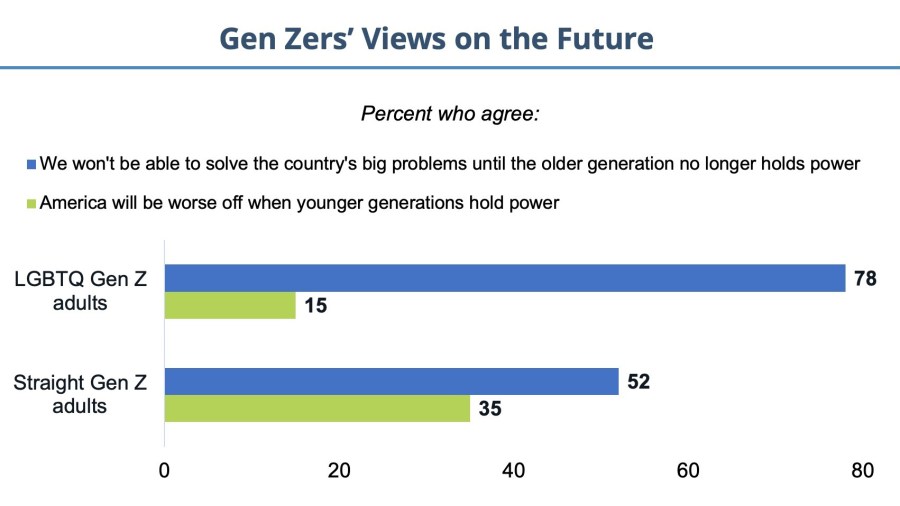
Like other studies, we find that Gen Z Americans distrust a wide array of societal institutions, from the federal government and organized religion to the police and our justice system. This distrust is even stronger among LGBTQ Gen Zers. It is little wonder, then, that while 52 percent of straight Gen Z adults say we won’t be able to solve the country’s big problems until the oldest generation no longer holds power, that figure jumps to 78 percent of LGBTQ Gen Z adults.
Despite the struggles young LGBTQ Americans face — and their strong distrust of institutions —they remain resilient and determined to change the country for the better. We asked Americans in our survey about their engagement in politics in the past year. Whether their involvement was online (signing a petition, posting on social media about issues they care about, or encouraging others to be politically active) or in person (attending rallies, volunteering for a group of cause, or attending rallies), LGBTQ Gen Z adults are far more actively engaged than their straight counterparts.
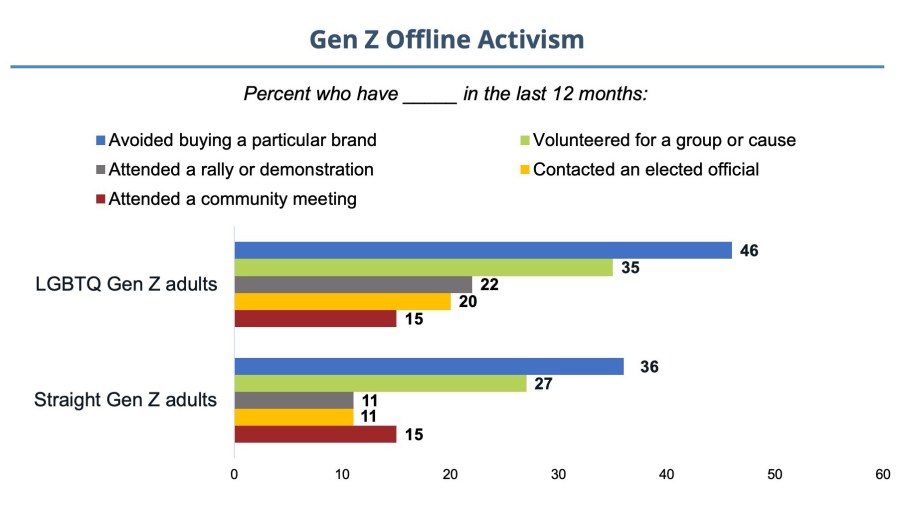
Rather than passively accept political attempts to suppress their rights and their dignity, our survey shows that many LGBTQ adults are not shying away from political activism. The death of Nex Benedict, while revealing the brutal and frightening world that queer young Americans are facing, may also ignite even greater activism among this generation.

Melissa Deckman
Melissa Deckman, Ph.D., is the CEO of the Public Religion Research Institute and a political scientist who studies the impact of gender, religion, and age on public opinion and political behavior. Her forthcoming book, "The Politics of Gen Z: How the Youngest Voters Will Shape Our Democracy" (Columbia University Press, 2024), examines the influence of gender and sexuality on Gen Z’s political behavior.