




Since April the state legislature in North Carolina, which has a Republican supermajority, has passed a flood of extreme legislation that includes restricting women’s access to reproductive health care, targeting trans students and prohibiting the discussion of race during hiring decisions for state jobs.
We have this deluge of Republican-sponsored bills because the dam that was Democratic Gov. Roy Cooper’s veto was breached by Rep. Tricia Cotham.
All the above can be considered culture-war legislation designed to distract North Carolinians from lawmakers’ refusal to pass a living wage for the nearly 50% of the state’s workforce paid less than $15 an hour, their refusal to expand Medicaid for more than the half a million people who would benefit, their threats of massive education cuts and their threats of more voter suppression legislation, despite their previous efforts being overturned in the courts.
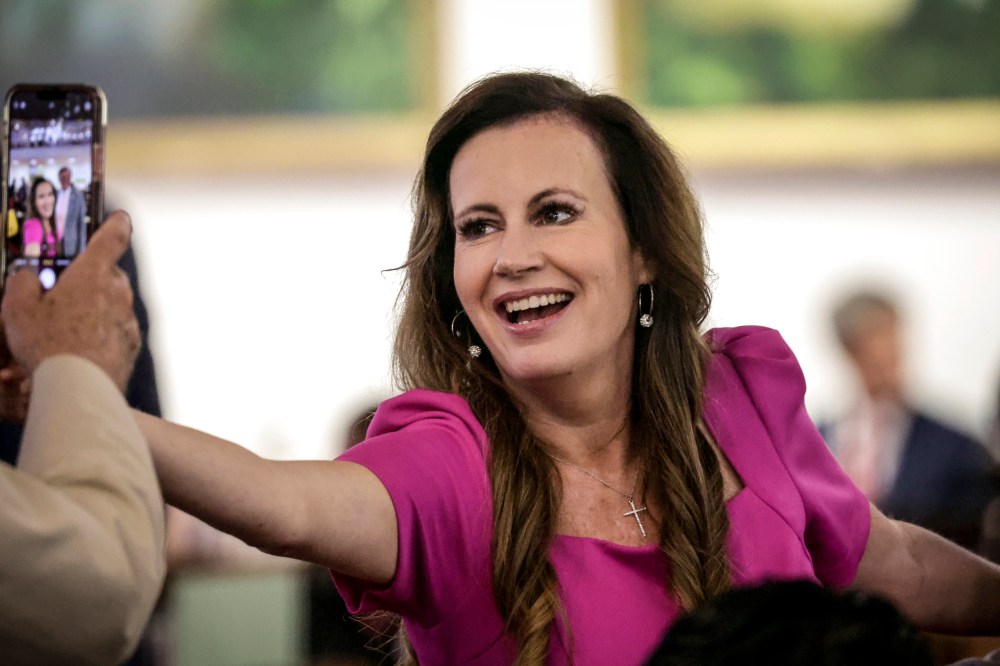
We have this deluge of Republican-sponsored bills because the dam that was Democratic Gov. Roy Cooper’s veto was breached by state Rep. Tricia Cotham, who was elected last year as a Democrat in a solidly Democratic district and then switched to the Republican Party after she was elected.

The New York Times reports that Cotham was encouraged to run by North Carolina’s Republican speaker of the House and the state’s Republican majority leader and that she was backed by groups that almost exclusively support Republican candidates. The New York Times, citing interviews with Cotham’s allies and former allies, says she had felt alienated from the Democratic Party and didn’t feel sufficiently supported. Whatever her reasons for flip-flopping, Cotham’s decision has affected millions of North Carolinians. But she would never have had the power to make such a consequential decision if it were not for the much bigger betrayal of representative democracy in North Carolina.
The extremists who currently control the Republican Party were able to win a supermajority in North Carolina because of a gerrymander of state House and Senate districts that, disappointedly, was approved by a Department of Justice run by then-Attorney General Eric Holder. Republicans took control of all three branches of government in North Carolina and used that power to block Medicaid expansion, deny North Carolinians unemployment insurance, and pass another flood of extreme bills, including an omnibus voter suppression bill.
She would never have had the power to make such a consequential decision if it were not for the much bigger betrayal of representative democracy in North Carolina.
As the president of the state’s NAACP, I helped launch Moral Mondays in North Carolina and invited Democrats, Republicans and independents to come together to challenge this abuse of power. We won in court, and the gerrymandered maps that Republicans used to gain power have been repeatedly struck down. Maps that were in place in 2022 were, according to Princeton University’s Gerrymandering Project, relatively fair. And, at least temporarily, it allowed Democrats to prevent the supermajority by one seat, but there’s power in incumbency, and, thus, the election also demonstrated the long-term effect of efforts to undermine democracy.
There was an even split in the state’s congressional elections: seven Democrats and seven Republicans were elected. Cooper won re-election as governor, but Republicans held onto large majorities in both the state House and Senate. And then Cotham switched parties.
After a decade of politics played on a field tilted against their best interests, it appears that it’s hard for many communities in North Carolina to imagine better. Fewer than 52% of registered Democrats voted statewide in North Carolina in November 2022. Among independents, turnout was less than 45%. Only 24% of registered voters under 25 showed up at the polls. Clearly, many people — especially younger and unaffiliated voters — have been convinced their vote wouldn’t make a difference. Maybe because for so many years it didn’t make as much of a difference as it should have? A decade of extremists abusing power has taken its toll, but Democrats also have to take responsibility for not offering a powerful alternative to the culture-war narrative the Republicans are putting forth and take responsibility for not investing in candidates who could speak to issues that would motivate inactive voters to turn out. Democrats also have to take responsibility for not offering a powerful alternative to the culture-war narrative the Republicans are putting forth. In the 2016 election after our Moral Mondays activities help brand Pat McCrory as an extremist, he became the only Republican governor in the country to lose his re-election bid. Republicans also lost control of the state Supreme Court and the attorney general’s office. A new majority emerged in North Carolina when a movement gave people a clear narrative and a reason to show up on Election Day. If we are to turn the tide, not just in North Carolina but across the United States in 2024, we cannot be satisfied with narratives that blame extremism on the decisions of a single individual like Tricia Cotham. In politics, there will always be people who will flip-flop and betray the voters who vested them with power. But transformative change is possible when moral fusion movements clarify what’s at stake for all of us and elect governing majorities that are committed to the policies most people want. We must never forget that, frustrating as they may be, we are not captive to the compromises of elites. We the people have the power to come together, change the conversation, and re-order the calculus of what is possible in our public life.
The Rev. Dr. William Barber
The Rev. Dr. William J. Barber II is founding director of the Center for Public Theology and Public Policy at Yale Divinity School. With Jonathan Wilson-Hartgrove, an Assistant Director at the Center, he is the author of “White Poverty: How Exposing Myths About Race and Class Can Reconstruct American Democracy.” 


