




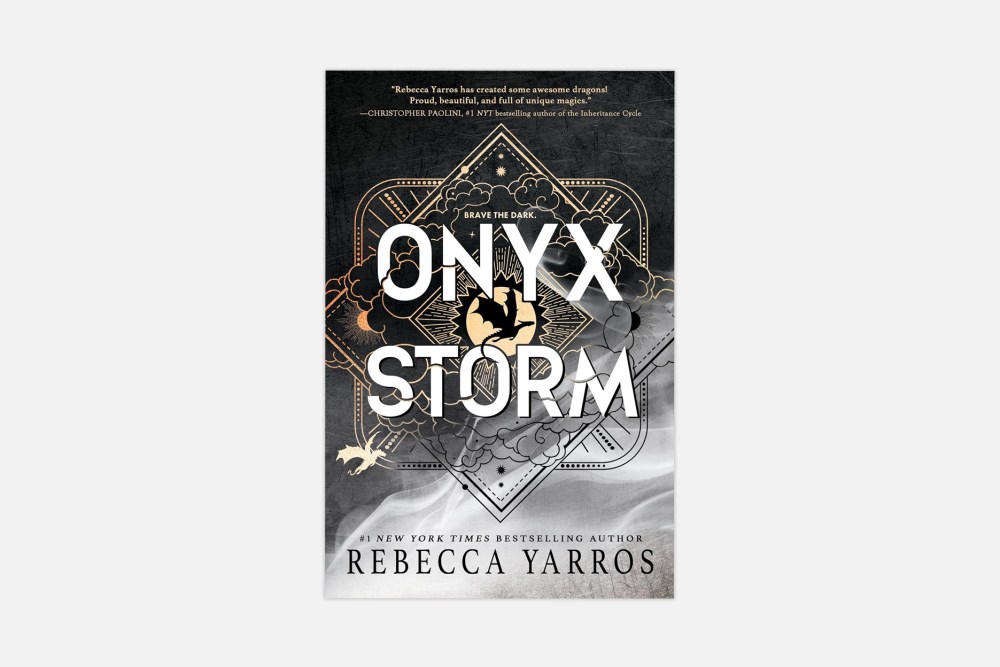
Rebecca Yarros was already a prolific romance novelist by the time she approached her publisher, Entangled, about “Fourth Wing.” Yarros envisioned a “romantasy” epic set at Basgiath War College in the kingdom of Navarre, complete with dragon-riding warriors, an enemies-to-lovers storyline, assassination attempts, magic and telepathy, a love triangle, a commanding mother and a young protagonist who overcomes her own physical disadvantages to become the most powerful figure in the book. “Fourth Wing” would go on to sell close to 2 million copies globally in its first six months, en route to becoming a cultural phenomenon.
Yarros’ runaway success is emblematic of a dramatically shifting literary landscape.
This week, the third installment of the Empyrean Series, “Onyx Storm” finally hits store shelves. The second installment ended on a gripping cliff-hanger, adding to the anticipation. Eager fans attended midnight release parties and stood in long lines to try to score copies at their local Target. Entangled didn’t release any copies of the book early. Believe me, I asked.
Yarros’ runaway success is emblematic of a dramatically shifting literary landscape. Along with titles like “A Court of Thorns and Roses” by Sarah J. Maas, these romantasies are part of a broader movement of novels subverting the traditionally male-centric fantasy genre.
Yarros and Maas are technically part of a literary canon defined by 20th-century classics like J.R.R. Tolkien’s “The Lord of the Rings” and Frank Herbert’s “Dune.” These novels were written by men, and seemingly, for men. There are virtually no women of significance in Tolkien’s Middle-earth. English literary scholar Catherine Stimpson once described the women who did exist as “either beautiful and distant, simply distant, or simply simple.” “Dune,” which is enjoying a surge in relevance following the blockbuster new adaptation, depicts even the most powerful women in the novel as submissive. (I’m aware that context is important, and some “Dune” fans may argue the influence of the Bene Gesserit undermines this thesis; if so, that’s an exception that proves the rule.)
But 70 years after Tolkien’s first “Lord of the Rings” book was published, the literary industry — readers, publishers and authors — is dominated by women. A 2023 study published by the National Bureau of Economic Research found that women publish more than half of all novels today, and that they sell more books than the average male author. Enter contemporary romantasy.


These books are not just feminist retoolings of older, patriarchal classics: they have their own Hero’s Journey and, critically, lots of female-centric sex. The tropes are well-trodden, to the point that plagiarism accusations have become surprisingly fraught. But the formula works.
Many stories include a poor or sheltered girl, othered in some capacity, then placed in an unusual environment. There are love interests who begin as enemies, tests, allies, betrayals, and then an ordeal. After overcoming that challenge, there is the way home, followed by a moment of resurrection. BookTok has developed its own literary motifs to explore these themes: “grumpy sunshine” relationships, protagonists who are “overpowered,” and “one bed” plot devices. Sexy books are called “spicy.”
There is no shame in these moments of intimacy. Pleasure, particularly for the women characters, is the point.
And again, unlike Tolkien, sex is a bedrock of the plot. Scenes are multiple pages long, detailed, and focused on the women. There is no shame in these moments of intimacy. Pleasure, particularly for the women characters, is the point.
Yarros’ books are notable in another way: Violet, our protagonist, exhibits many of the symptoms of Ehlers-Danlos Syndrome, a genetic connective tissue disorder that can result in loose joints, joint pain and stretchy skin. Yarros has been open about her and her sons’ diagnoses. While it hasn’t yet been textually confirmed that Violet suffers from EDS, overcoming her physical weakness, including frequently dislocated limbs, is central to the series. And Yarros dedicated “Iron Flame” to those with EDS, colloquially called “zebras,” writing: “To my fellow zebras. Not all strength is physical.”
This is more than a book club. This is about being part of a community. Women post on Reddit about Violet; they make videos on TikTok; they meet for weekly Empyrean series book clubs; they talk about Xaden Riorson and telepathy and dragon warfare over glasses of white wine. Rebecca Yarros hasn’t just created a sexy tale about dragon riders; she’s created a loyal, intense and empowering collective. By women, about women, and for women.

Hannah Holland
Hannah Holland is a producer for MS NOW's "Velshi" and editor for the "Velshi Banned Book Club." She writes for MS NOW.