




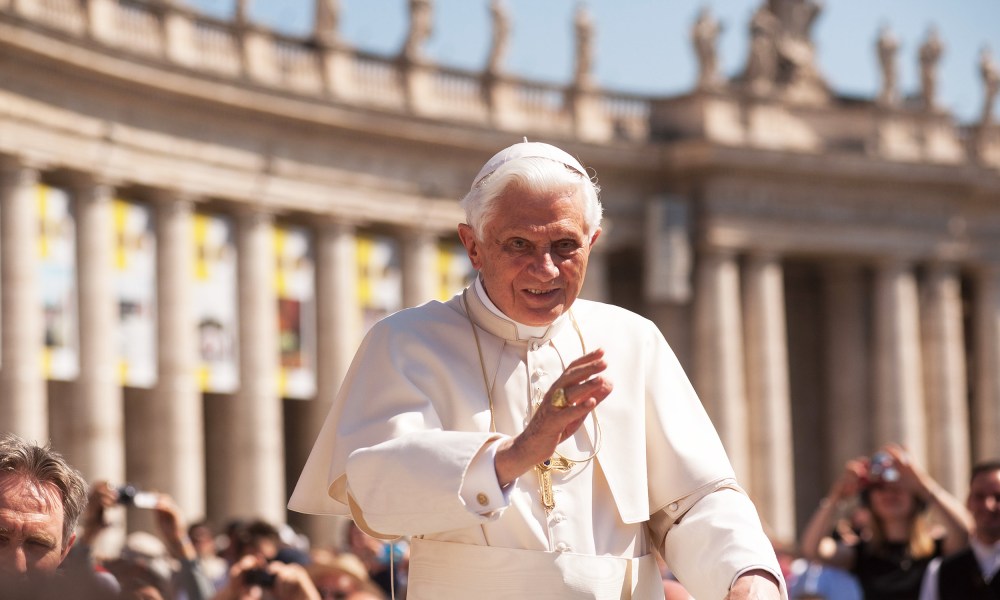
The burial of Pope Emeritus Benedict XVI does not mark the end of the struggles between conservatives and moderates within the Catholic Church. In fact, it may be the beginning of their intensification.
For traditionalists, the pope emeritus represented solid Catholic doctrine, defense of the Catholic faith against the encroachments of the world and modernity and a steadying hand in troubled times
For traditionalists, or “trads” to those in the know, the pope emeritus represented solid Catholic doctrine, defense of the Catholic faith against the encroachments of the world and modernity and a steadying hand in troubled times. His conservative outlook on Catholic belief, faith and theology earned him the nickname “God’s Rottweiler.” To liberals who align more with Pope Francis and to those outside Catholicism, Benedict represented rigidity and restrictions. For both groups, his death is a watershed moment.
Outsiders may wonder why this is so. After all, after a series of regrettable circumstances, Benedict’s tenure ended with a resignation. His own butler’s stealing papal documents concerning corruption at the Vatican and leaking them to the press got its own scandalous name: “Vatileaks.” Although Benedict was the first pope to meet with sexual abuse survivors, during his papacy the church’s sexual abuse scandal continued to disrupt the church. And last year, nine years after he’d retired as pope, Benedict himself was accused of having mishandled sexual abuse cases during the 1970s and the 1980s when he was the archbishop of Munich. Ever the scholar, he also offended Muslims by quoting a 14th century Byzantine emperor’s insult of Islam. Some people claiming to defend Islam attacked churches in response to Benedict’s speech, and Benedict said he was “deeply sorry” that Muslims had taken offense.

While not all of Benedict’s papacy was problematic, his reputation for rigidity is among the reasons his legacy will be contested. During his time as head of the Congregation for the Doctrine of the Faith, which is the branch of the church that manages doctrine and practices, liberal theologians were condemned.


Despite all the above, Catholic conservatives in the U.S. and around the world regarded Benedict as the true holder of Catholic belief and tradition. No doubt his scaled-down funeral will disappoint them. But his 2006 spiritual testament will no doubt encourage them. In part, it said: “Stand firm in the faith! Do not let yourselves be confused! It often seems that science — the natural sciences on the one hand and historical research (especially exegesis of Sacred Scripture) on the other — are able to offer irrefutable results at odds with the Catholic faith.”
Benedict will, in death, remain the touchstone for the conservative movement within the Catholic Church
As a Catholic who many times found myself at odds with Benedict’s theological edicts and punitive reprimands as the head of the Congregation for the Doctrine of the Faith, I realize that in death, his doctrinal beliefs will become stronger for many who saw him, and not his successor, Pope Francis, as the “real” pope. While I do not think he will immediately be made into a saint, as Pope John Paul II was (wrongly, in my opinion), Benedict will, in death, remain the touchstone for the conservative movement within the Catholic Church.
Pope Benedict XVI’s most important and longest-lasting contribution to the Catholic Church was not his theological rigidity, his writings or his intellectual prowess. It was his wisdom to recognize his own limitations. By resigning the papacy, he created a different historical path and gave the church permission to consider that the Vicar of Peter can, in fact, retire to a quiet life of reflection. In his death he has, once again, restored the church to a historical status quo: one and only one pope. Though he’s gone now, for the faithful who loved Benedict, it is his vision of the church, and not Francis’ vision, for which they will continue to fight.

Anthea Butler is a professor of religious studies and Africana studies at the University of Pennsylvania.