




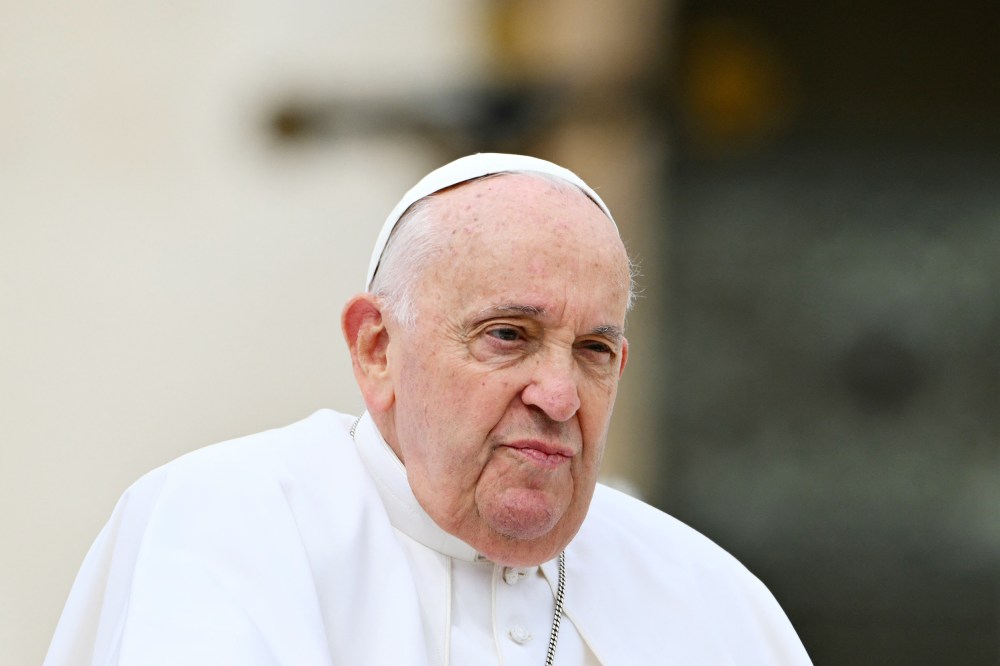
Listening to Pope Francis‘ television interview with CBS News’ Norah O’Donnell was a refreshing relief from the retro and reductive Harrison Butker commencement address at Benedictine College, where Butker suggested that women were at their best as mothers and that there was much disorder in the church. Butker should run the hourlong discussion on a loop at home and study it. He might learn a few things about what Catholic teaching really is.
The interview also provided important insight into how Francis can sometimes appear to be shifting church teachings on issues like homosexuality while carefully parsing the line between church teaching and pastoral care.
Pope Francis’ conversation with O’Donnell was not simply an interview. It was a deftly framed master class in the tensions between Catholic beliefs and practices, as opposed to backward pre-Vatican II ideals conservative American bishops have been promoting. The interview also provided important insight into how Francis can sometimes appear to be shifting church teachings on issues like homosexuality while carefully parsing the line between church teaching and pastoral care.
In response to O’Donnell’s question about criticisms from conservative American bishops, Francis said a conservative is one who clings to something and does not want to see beyond that. It is, in his words, a “suicidal” attitude.
Given the hardening of conservatives and bishops in America toward Francis, one might consider this interview to be a direct and pointed way for him to bypass the American bishops and speak to both Catholics and the broader American public directly. Francis’ interview and open, warm personality stand in stark contrast to the rigid, moribund, stale affect of bishops of the U.S. Conference of Catholic Bishops, who are more concerned with appearing to be an arm of the Republican Party.

In a “60 Minutes” interview and then an hourlong interview on CBS News, Francis spoke on a wide variety of topics, including Israel and Gaza, immigration, homosexuality, climate change, women’s roles in the church and sexual abuse. While these may seem to be standard issue questions for the pope, what the line of questioning allowed Francis to do was (sometimes pointedly, sometimes subtly) reframe the attacks against him by American conservative Catholic clerics and their followers.
For instance, one of the big takeaways was Francis’ clarification of same-sex blessings. At the time this was announced in December, speculation swirled about whether it meant that Catholic doctrine regarding same sex marriage was changing. Francis pointedly said that this was a blessing for the individuals involved and not for the unions of same-sex couples. He said: “What I allowed was not to bless the union. That cannot be done, because that is not the sacrament. I cannot. The Lord made it that way. But to bless each person, yes. The blessing is for everyone. For everyone. To bless a homosexual-type union, however, goes against the given right, against the law of the church. But to bless each person, why not? The blessing is for all.”


The reiteration that this is a blessing for individuals, not unions of two individuals, is to silence critics and remind priests and others who have been doing blessings of what pastoral blessings are.
This clarification will be a comfort to some and a sadness to others. After all, there have been some of these same-sex blessings for years, done by priests on a quiet basis. The reiteration that this is a blessing for individuals, not unions of two individuals, is to silence critics and remind priests and others who have been doing blessings of what the proper pastoral blessings are.
The pope’s interview followed his recent rejections of surrogacy and gender-affirming surgery. However, he commended O’Donnell on her carefully framed question about women who cannot have children, for whom surrogacy would seem to be the only answer. Like his answer about same-sex blessings, the pope was strong in the ways he spoke about surrogacy being against the teaching of the church, but he also took a pastoral approach and showed that he is aware of the ways women and their families wrestle with this particularly fraught issue.
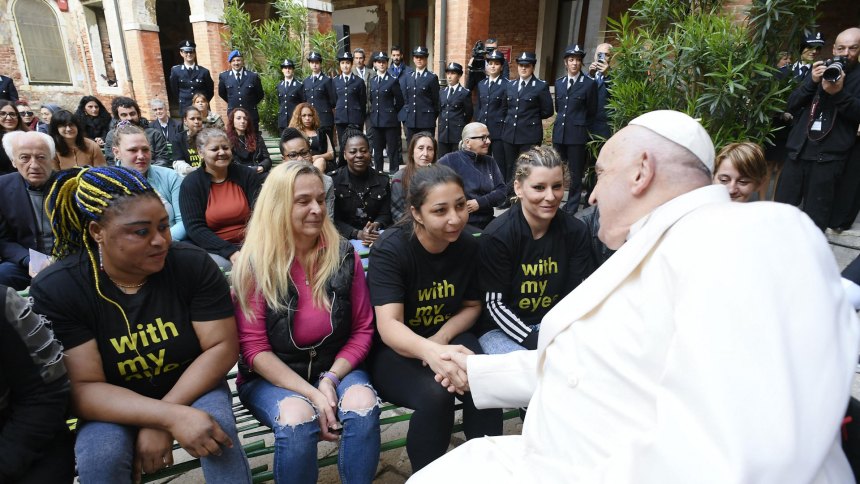
This interview reveals the tension between Pope Francis’ practice and church teachings. It is very difficult at times for outsiders and conservatives to understand his nuanced way of dealing with teachings versus the real-life experiences of people, wherever and whoever they might be. This became very clear in how O’Donnell asked him about his washing of the feet of female prisoners during Holy Week and his ministry to trans people in Rome. His manner of openness and willingness to move between groups that church doctrine has had limited engagement with show that he is trying to bridge the gaps in a church that is declining in America.
O’Donnell reportedly tried for a decade to get an interview with Francis. It is most likely not a coincidence that he gave her one during yet another polarized election year when Catholic voters will play an important part. Not only is having American Catholics hear the pope’s voice instead of the voices of conservative American bishops important, but it is also a salvo in the culture wars of the 2024 election. Listening to the pope expound on Catholic teaching that some Catholics disagree with, while showing his humanity and care for every human being, was more uplifting than a fossilized Kansas City Chiefs kicker’s giving a retro commencement speech that would have been just fine in 1954, not 2024.
CORRECTION (May 22, 2024, 12:53 p.m. ET) A previous version of this story misspelled the first name of the CBS anchor who interviewed Pope Francis. She is Norah O’Donnell.

Anthea Butler is a professor of religious studies and Africana studies at the University of Pennsylvania.