




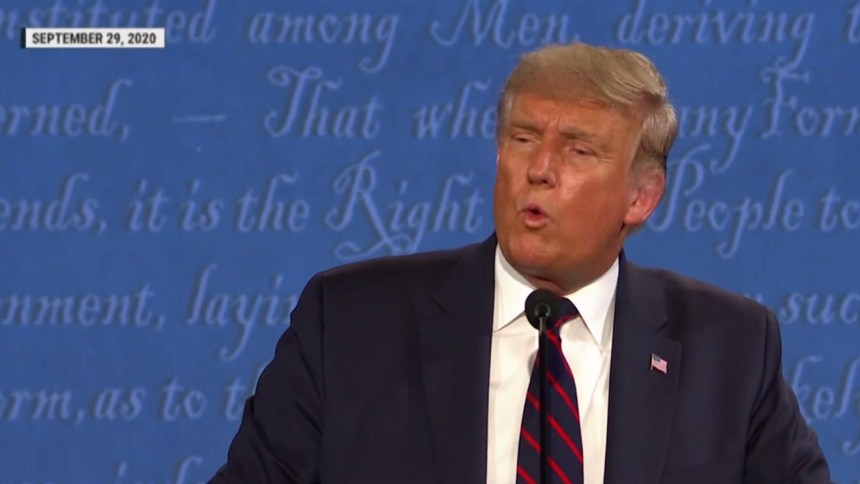
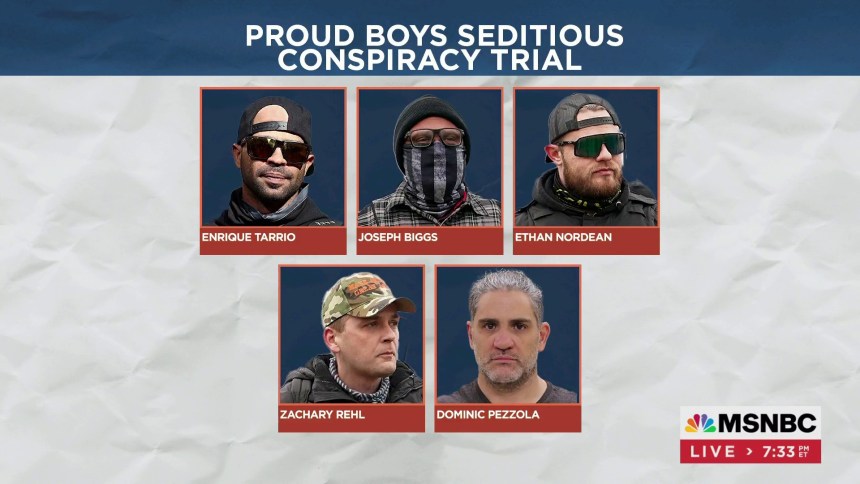
Members of the Proud Boys organization, including chairman Henry “Enrique” Tarrio, are on trial on charges of, among other things, being involved in a seditious conspiracy designed to violently overthrow the government or forcibly resist the laws of the United States. And they have decided to call in their defense a most unlikely witness: former President Donald Trump. Why in the world do the defendants think it would be a good idea to put Mr. “Stand Back and Stand By” on the stand? Well, The New York Times reported that defense lawyers “are hoping to elicit testimony from Mr. Trump that could persuade the jury that he, rather than their clients, instigated the crowd that stormed the Capitol on Jan. 6.”
As a former career prosecutor, I believe that Trump would do far more harm than good to the Proud Boys’ prospects of an acquittal. If called as a witness, it is extremely unlikely Trump will say anything about encouraging an attack on the Capitol on Jan. 6. To the contrary, Trump might try to convince the jury that he never said or suggested the Proud Boys or anyone else should storm the Capitol, so the Proud Boys are wholly responsible for their decisions to do so.
Given recent history, it’s clear Trump is not afraid to invoke his Fifth Amendment rights.
Putting trial tactics aside, though, major constitutional impediments make it unlikely Trump will testify at the Proud Boys’ trial. To be sure, the Constitution guarantees every defendant in a criminal trial the right to compel the testimony of witnesses that the defendant believes can offer evidence helpful to their case. The Sixth Amendment provides, “In all criminal prosecutions, the accused shall enjoy the right . . . to have compulsory process for obtaining witnesses in his favor . . .” The presiding judge, U.S. District Judge Timothy Kelly, has not yet decided whether he will approve the subpoena for Trump.
But assuming he does, it may turn out to be a hollow victory for the defendants. Trump is the target of a criminal investigation being conducted by Special Counsel Jack Smith. Smith was appointed by Attorney General Merrick Garland on Nov. 18, 2022 to investigate “whether any person or entity violated the law in connection with efforts to interfere with the lawful transfer of power following the 2020 presidential election or the certification of the Electoral College vote held on or about January 6, 2021 . . .” Given Trump’s potential criminal exposure in Smith’s investigation, the ex president inarguably has a Fifth Amendment right against self-incrimination. Specifically, the Fifth Amendment provides, “No person shall . . . be compelled in any criminal case to be a witness against himself . . .”

In the unlikely case we see Trump placed under oath and testify at the Proud Boys trial, the prosecutors would be able to cross-examine him — a prime opportunity to develop testimony that could be used in the future against Trump, in the event he is indicted for crimes in connection with the insurrection. But given recent history, it’s clear Trump is not afraid to invoke his Fifth Amendment rights. Indeed, he recently pled the Fifth more than 400 times when questioned under oath as part of a fraud investigation of him, his organization and some of his adult children, brought by New York Attorney General Leticia James.
Once this battle of the constitutional rights — the Sixth Amendment right to compel a witness to testify vs. the witness’s Fifth Amendment right not to incriminate himself — is teed up, how is it typically resolved? Well, the defendants do not have the ability or the authority to override a witness’s invocation of the privilege against self-incrimination, so the only way out would be for prosecutors to grant Trump immunity, extinguishing his Fifth Amendment privilege.
It’s quite possible that the Proud Boys’ lawyers expect Trump won’t testify.
This is a circumstance that I encountered many times as a prosecutor. Typically, the judge will ask the prosecutor if the government is inclined to grant the witness testimonial immunity. Assuming the prosecutors are not so inclined — a safe bet when it comes to Trump — the judge will announce that, given the separation of powers doctrine, he has no authority to order the executive branch to immunize a witness. Doing otherwise would represent an unconstitutional intrusion on prosecutorial discretion. Accordingly, the judge will discharge the subpoena and Trump will never take the witness stand.


Some might observe that it feels unfair that Trump’s Fifth Amendment right against self-incrimination trumps (sorry) the defendants’ right to compel testimony in their defense. Not to worry, as there are some evidentiary workarounds.
For example, let’s say the defendants want to put Trump on the stand to question him about his speech on the Ellipse on the morning of Jan. 6, in an attempt to prove that Trump incited the crowd to attack the Capitol. If Trump pleads the Fifth, that might seem to make Trump’s speech inadmissible as hearsay (an out-of-court statement offered in court to prove the truth of the matter asserted in the statement).
But there is still a way for the defendants to introduce Trump’s speech at trial. The defendants can argue that Trump’s words on Jan. 6 are not technically hearsay because they are not being offered to prove the truth of what he was saying (that their votes were stolen and the election was rigged). Rather, the defendants can argue that they seek to put those statements before the jury to show the impact they had on those who heard them, regardless of their veracity. This is one way a judge could allow some of Trump’s statements to be admitted as evidence even in the absence of his testimony.
It’s quite possible that the Proud Boys’ lawyers expect Trump won’t testify. Defendants will often make arguments they suspect they will lose, in an effort to build into the trial judicial rulings that they will later argue on appeal. And it is a consequential decision for a judge to deprive a defendant of his Sixth Amendment right to compel a favorable witness to testify because that witness alleges he has a privilege to assert. So this effort to subpoena Trump may be little more than the defendants attempting to create and preserve an issue on appeal.
But before that appeal, we have the current trial. We will know soon enough how Judge Kelly will rule on this issue and whether a former president might take the witness stand in the trial of those accused of attempting to overthrow our government. If the defendants hope their inspirational leader will save them, they will likely be disappointed.

Glenn Kirschner
Glenn Kirschner, a former assistant U.S. attorney for Washington, D.C., is an NBC News and MSNBC legal analyst.