





The 18-year-old accused of shooting 13 people, 10 fatally, at a Buffalo, New York, grocery store Saturday was, according to a manifesto he appears to have written, motivated by a global white supremacist extremist conspiracy theory called the “great replacement.” The theory falsely argues that global elites are orchestrating demographic changes via immigration in order to consolidate power and replace white populations with multicultural societies.
Authorities say he researched ZIP codes in his state with a high percentage of Black residents, and officials said he drove hours to Buffalo to execute his plot, which he livestreamed on a gaming platform.
A conspiracy theory called the “great replacement” argues that global elites are orchestrating demographic changes to replace white populations with multicultural societies.
Black shoppers and employees mostly were killed and injured in the shooting, part of a wave of violence rooted in that same conspiracy theory that has terrorized members of historically marginalized communities globally for over a decade. The attack followed mass shootings targeting Jews, Muslims and Latinos across the country and world that were motivated by a belief in the “great replacement.”
The ease with which this single conspiracy theory has been mobilized against a wide range of victims and targeted groups — Muslims, Jews, Latinos and, now, Black Americans — demonstrates just how many people feel threatened by demographic change and are easily persuaded by manipulative rhetoric about it.
In the U.S., antisemitic and white supremacist claims had long warned of an impending, orchestrated “white genocide” rooted in manipulative rhetoric about low white birth rates, immigration, abortion and false statistics about violence against white people. In Europe, a conspiracy theory called “Eurabia” falsely suggested that Muslim elites were trying to expand the caliphate through immigration and demographic change, warning that Muslims will eventually force Christians to convert or assume subservient roles.


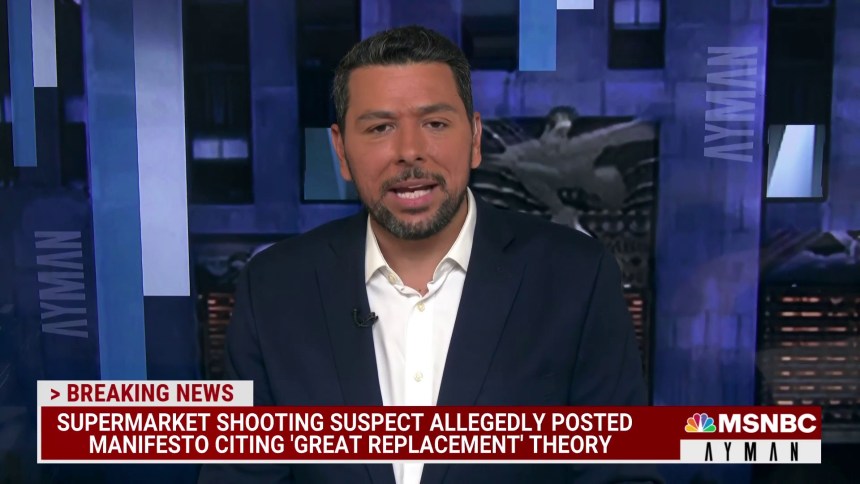
Now together under the overarching framework of the “great replacement,” this unifying conspiracy falsely claims there is a global, elitist plot to eradicate white, Christian civilizations that will lead to whites’ extinction or loss of power. In online spaces, the conspiracy circulates widely in the form of text-based chats, memes, videos and other propaganda, often using scientific racism — which uses false data on issues like IQ or poverty rates to make eugenicist arguments about racial differences or “population quality” — and dehumanizing anti-immigrant rhetoric to call for a violent defense against a dystopian future. In these calls, mass violence is seen not only as means to an end, but a preferred solution. Violent actors who take up the cause are celebrated in white supremacist extremist circles as heroic martyrs who will inspire others to act — to preserve and defend whiteness against an invasion of immigrants, Muslims or Jews who they claim will eradicate or replace white nationals, Christians, Americans or Europeans.
The conspiracy theory is so powerful as a mobilizer of violence in part because it can easily be directed toward any demographic group seen as a threat to white people. I’ve previously written about how the theory has led to killings in Norway, Pittsburgh; Christchurch, New Zealand; Poway, California; and El Paso, Texas. The Buffalo shooting appears to be the latest in a series of such attacks motivated by conspiracy theories falsely arguing that global elites are deliberately replacing white people with racial and ethnic minorities and immigrants.
Make no mistake: The “great replacement” is not a conspiracy theory that lives only in the dark underbelly of the internet.
Make no mistake: The “great replacement” is not a conspiracy theory that lives only in the dark underbelly of the internet. It has been widely shared and touted by mainstream politicians and by personalities such as Fox News’ Tucker Carlson. As I described in a recent column, Carlson alludes to that conspiracy when he says Democrats are orchestrating “demographic replacement” to gain political power. A French presidential candidate and a U.S. member of Congress have also recently publicly referred to replacement.
In the days to come, we will see a lot of finger-pointing: at the shooter’s parents, at law enforcement, at the social media companies that host and amplify hate and propaganda, and at the pundits and politicians who mainstream it. There will be calls for better content moderation on social media, for digital literacy tools to reduce vulnerability to propaganda and disinformation, for better investments in prevention and preparedness.
We need all of this, and more. But none of it will matter if we ignore the racist, dehumanizing and white supremacist belief systems that enable people to embrace “great replacement” conspiracy theories in the first place. Our failure to address the foundational nature of white supremacy here and internationally ensures that the next attack motivated by the “great replacement” is already a foregone conclusion.

Cynthia Miller-Idriss is an author and expert on extremism.