





UPDATE (August 3, 2024, 11:20 a.m. ET): On Saturday, Simone Biles won gold in the women’s vault, bringing her total of Paris Olympic gold medals to three, with two more events to go.
The allure of gymnastics has always been in the jaw-dropping leaps and flips and twists. The sport has evolved considerably over the decades, with those flips and twists becoming even more difficult — and more impressive. We are living through a truly historic era of innovation. And no surprise: Simone Biles, the GOAT, the most decorated Olympic gymnast, and perhaps athlete, of all time, is at the helm.
The sport has evolved considerably over the decades, with those flips and twists becoming even more difficult — and more impressive.
On Saturday, after leading Team USA to a gold medal in the women’s team final and earning a second gold in the individual all-around competition, Biles looks to add to her Paris haul on the vault. On Thursday, Biles helped secure her all-around gold with a Yurchenko double pike, which has become known as the Biles II. She is the only woman who has ever completed that skill in a world competition. It truly feels magical to watch her complete the Biles II with such power and grace.
And therein lies one of the secrets to Biles’ immense success. Because besides the numerous titles and sustained dominance in the sport for over a decade, Biles is set apart by the degree to which she surpasses the competition. She does not win by tenths or even a single point but by multiple points. At the U.S. Olympic trials, she won by over 5 points, the rough equivalent of nearly six falls. Theoretically, this means Biles could have fallen half a dozen times and still beat the 2020 Olympic champion, Sunisa Lee. Biles is truly in a league of her own.

But how is this possible?
The answer is simple. Biles performs some of the hardest skills in the world and continues to complete increasingly harder ones, including some that no one else can do. Biles’ difficulty puts on her on a completely differently level; a new starting point means a new end point.
And, under the current scoring system, she’s rewarded for it.


A major 2006 change to the gymnastics scoring system has allowed for and encouraged athletes to push for difficulty. Under the current code of points, the execution score (E-score) of 10.0 remains in place, but the difficulty score (D-score) has no cap. What this means is gymnasts no longer have equal scoring potential. It’s like making the 3-point shot into a 4-point shot if it’s made from the top of the key; Caitlin Clark would have a higher scoring potential than her competitors because she can execute a more difficult shot.
But here again, Biles highlights what makes her so incredibly special. The 27-year-old is not simply doing the hardest tricks, she does them with exquisite execution, which allows her to be incredibly consistent. Her technique, power and precision are together essential to her ability to do what no one else can do, but it also means that her timing is nearly perfect, and her execution scores are consistently strong. When you add that together — the unmatched levels of difficulty, striking execution and rock-solid consistency — you have a gymnast who is for all intents and purposes unbeatable. And that’s what we have in Simone Biles.
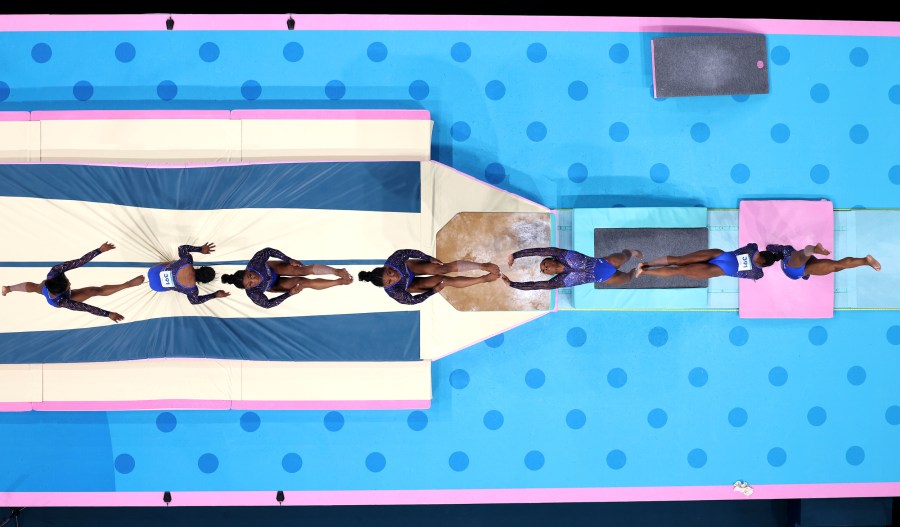
Don’t get me wrong — there are event specialists who can top Biles on a single apparatus.
For example, Kaylia Nemour, who is competing for Algeria, boasts a 7-point start value on the uneven bars (compared to Biles’ 6.4) and Brazil’s Rebeca Andrade is perhaps the closest rival to Biles on the vault and floor events. In fact, during the all-around final this week, Biles made a crucial error on the uneven bars that opened the door (however lightly) for Andrade. In the end, Biles’ stellar beam and floor routines landed her on top, with Andrade taking silver. But it was a reminder that even GOATs are human.
Now, we will get to see more of that head-to-head competition in the individual event finals over the next few days, starting with vault on Saturday and ending with the balance beam and floor exercise on Monday. The world’s very best event specialists will be pushing the limits for the chance to bring home gold. But don’t count Biles out — ever. No matter the event, she exudes the qualities that make viewers fall in love with this sport — the irresistible joy and awe of watching a gymnast do high-flying, jaw-dropping tricks with beauty and ease.What a gift to be able to sit back and enjoy the greatness.

Onnie Willis Rogers
Onnie Willis Rogers is a former UCLA gymnastics champion and a professor of psychology at University of Chicago. Her research focuses on human development, diversity and equity and education.