




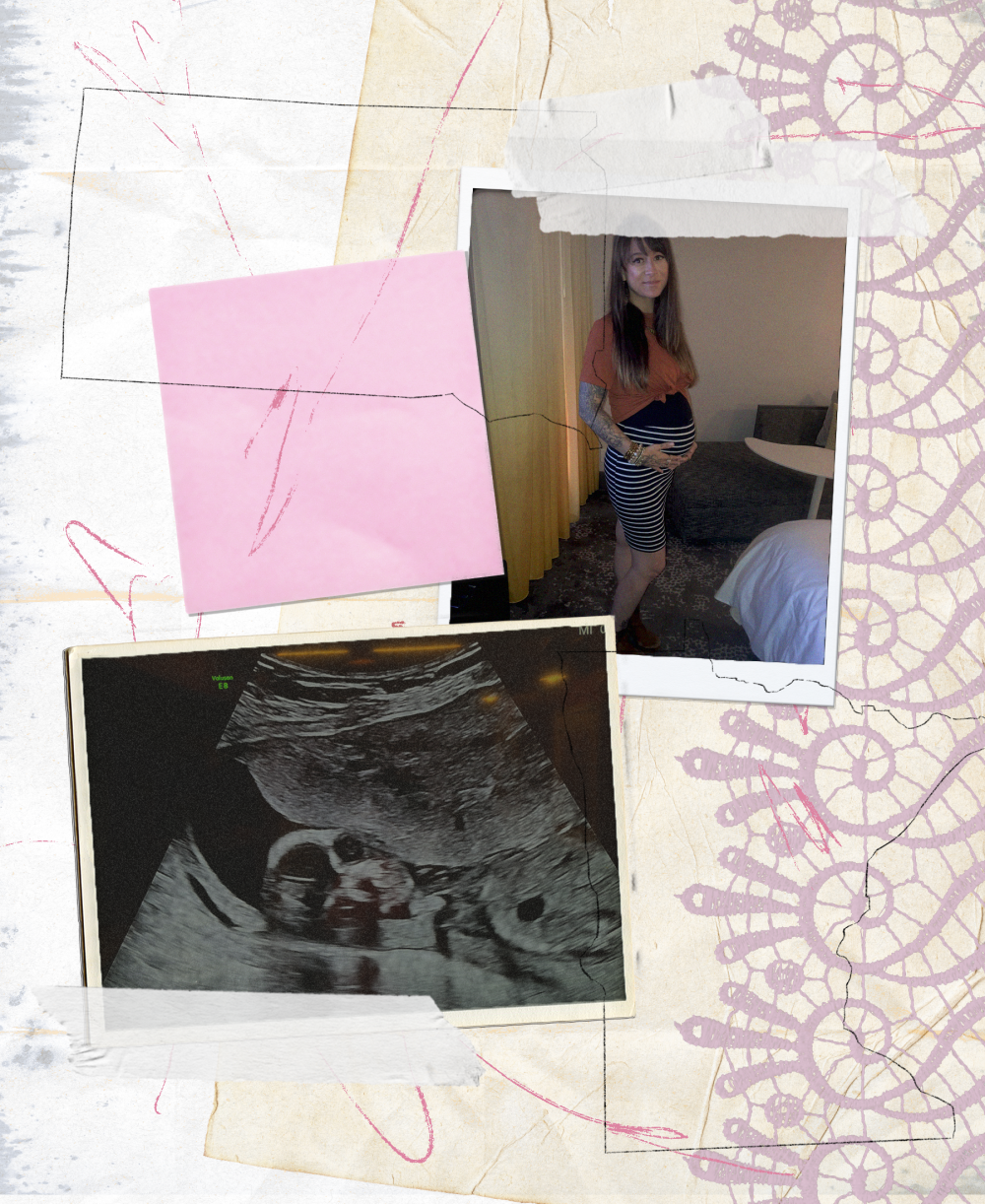
This article is part of a special series called “One in four: How abortion access shapes America.”
As I write this, I’m waiting for my doctor to call me back and likely schedule me for yet another prenatal visit that will require a 40-some-mile drive through winding, rural roads across state lines to my obstetrician’s office.
As I’ve written before, I know from my own pregnancy history that complications can lead to requiring abortion care, for a variety of reasons, and that I need those protections even for this pregnancy that my family and I are happily anticipating. Which is why living in a state where abortion is severely restricted is so risky.
I’ve tried writing this article several times. I’ve requested multiple extensions from my editor, somehow convincing myself I’ll feel better in a few hours, or maybe tomorrow, or maybe the day after that. I’ve had to stop, then start, then stop again — to throw up, call my physician, lay down, take another round of medication or simply breathe through a series of painful contractions.
My husband and I had calculated how many miles stood between me and the nearest OB-GYN in Minnesota, where abortion access is protected.
When asked if I’d be willing to detail what it’s like to travel out of state for routine prenatal care, I immediately said yes — perhaps naively. Lending my voice to the sea of women who have come forward to share how post-Roe abortion bans have impacted their pregnancies, their families and their lives was, and is, a no-brainer.
But the realities of being a working mother of two navigating a high-risk pregnancy in South Dakota, where a near-total abortion ban has pushed OB-GYNs out of the state and left those behind afraid to treat their patients, has made even the most run-of-the-mill tasks — and certainly writing, my livelihood — difficult. On certain days, it’s been impossible.
When every far-too-early contraction, every nauseating trip to the restroom, every infection, could require hourslong drives and Tetris-like child care maneuvers, your life becomes a series of unwinnable calculations. When even common, slightly annoying prenatal appointments are taxing, you can’t help but do the mileage math in your head and feel pre-emptively defeated. When even the ultrasounds that provide answers and relief are time-consuming and exhausting, you start to quantify even your own mental, emotional and physical well-being.
I made those calculations before moving to South Dakota in July, long after the state banned abortion immediately after the Supreme Court overturned Roe v. Wade, with no exception for rape or incest. I knew that moving to the rural town of Madison to be closer to my grandfather — who has Alzheimer’s and who has subsequently broken both his hip and his arm, requiring multiple surgeries — meant that as a pregnant woman I would be at the mercy of a vague abortion ban exception that has proven difficult and dangerous to implement.
I, along with my husband, calculated how many miles stood between me and the nearest OB-GYN in Minnesota, where abortion access is protected. Could I, while contracting, puking, maybe even bleeding, drive to Pipestone Medical Center an hour away from our home, if I needed to? But even with the knowledge that my husband would be gone for four weeks at a time for work, the drive felt feasible when faced with the alternative — a doctor refusing to treat me until I was dying “enough,” and with no one there to advocate on my behalf.
Of course, what I didn’t consider were all the unforeseen calculations that can accompany a pregnancy. Gestating another human being is, by definition, a major medical event, fraught with unpredictable complications and challenges even when you’re a relatively healthy 37-year-old.

I never considered the possibility that one evening I would be standing in my kitchen one minute, then nearly falling to the ground the next. That entire day I felt “off” — my stomach tightening constantly from what I brushed off as Braxton Hicks contractions while my head ached and my throat clenched in an attempt to keep another wave of nausea from sending me to the nearest toilet. After finally putting my two sons, 10 and 5, down for bed at a semi-reasonable school-night hour, I became so lightheaded I could no longer focus. I began to faint.
At 9:00 p.m., I calculated how I could possibly drive myself to the hospital a state away if I could barely stand. I made a mental note of who I could call, who would be able to come watch my sons and for how long. What if a few small sips of soup + a bottle of water + a detailed account of my contractions = a few more hours at home? Could I drive to the hospital tomorrow? Could I bring my computer and work on this draft through hourslong stress tests and blood draws and urine samples and an uncomfortable vaginal exam, and could they promise I’d be finished in time to pick my boys up from school?


I’ve made many of those same calculations since, when I’ve had to go in for another pre-labor stress test, or endure another exam to determine what has been causing my intense contractions. I’m making those calculations today, as I attempt to finish what feels like a woefully inadequate description of what being pregnant in an abortion-ban state is like, as I wait for my doctor to call me in to help get my premature labor contractions, nausea and vomiting under control.
I’m playing out the worst-case scenario in my head, planning possible routes not to the nearest hospital, but to the nearest hospital in the nearest state where abortion is legal.
I’ll once again decide who will pick up my sons — thankfully, because he’s home, my husband — and if I’ll need to call out of work tomorrow. I’ll hope that this can all be mitigated from home and save me yet another tank of gas and lonely drive to a state I do not call home.
Even when things are “normal” and I feel physically capable of driving to visit my grandfather in the hospital, or watching my cousin’s children, or taking a much-needed family trip when my husband is home, I’m playing out the worst-case scenario in my head, planning possible routes not to the nearest hospital, but to the nearest hospital in the nearest state where abortion is legal. If I’m in western South Dakota, I can go to Wyoming. If I’m closer to the center of the state, it’s best to just drive back to Minnesota. And if I have to go to a South Dakota hospital, who can I call who will fight for my right to live; to return to my two sons; to be seen as a human being and not an “earthen vessel” or a glorified “host”?
There’s another reason I insist on writing my story, even from a hospital bed or an exam room. It’s the eyebrow-raising and doubt from others, including members of my own family, as to why all of this is even necessary.
When my grandmother tells me: “Well, if you feel that’s what you need to do,” after I explain how South Dakota’s abortion ban is harming pregnant women, and why I need to travel elsewhere for prenatal care, I know I have to keep talking, even through another wave of nausea.
When my aunt and uncle, who live in Minnesota, regurgitate the outright lie that babies are being “aborted after birth,” or consider me to be just a hysterical liberal who is operating out of fear and not the realities of a post-Roe America, I know it’s wise to pack my computer as I drive to the hospital for another prenatal visit.
When women have to be bleeding in hospital parking lots or mourning the loss of their fertility for the harm abortion bans cause to be taken seriously, I know that even when I tell myself my situation isn’t “that bad,” it is still worth telling.
Because for every story like mine, there are thousands that are never heard; that are stifled by a series of lose-lose decisions and buried by a mountain of piling bills and late-night hospital stays and school pickups and second jobs and devastating medical emergencies that are survived not in a moment but after a lifetime of healing.
It is only because my pregnancy is, while high-risk, not catastrophically complicated that I’m able to document what this is like for me. I’m a woman of privilege who can afford to access the prenatal and birth care I need and deserve, administered by physicians who do not fear criminal prosecution for simply upholding their Hippocratic oath. And as such, I plan to keep writing about it.

Danielle Campoamor
Danielle Campoamor is a freelance journalist who has been published in Teen Vogue, Harper's Bazaar, CNN Opinion, Playboy, Newsweek, BuzzFeed and Marie Claire, among others.