




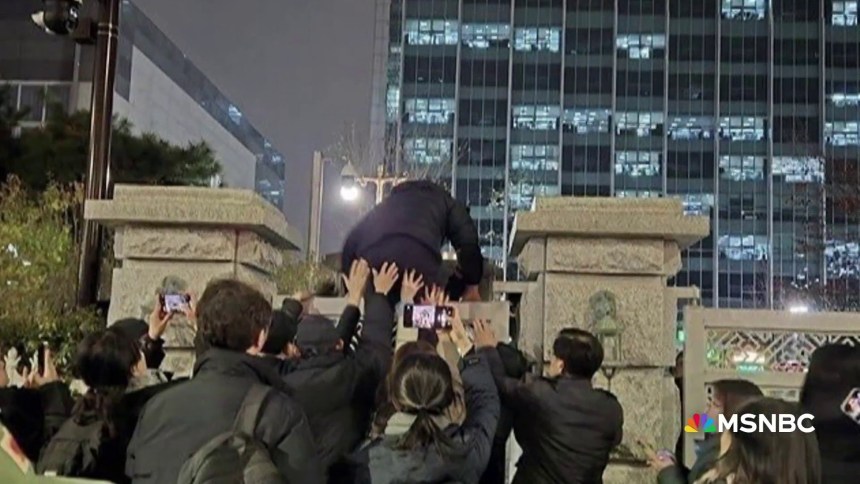
On Wednesday, South Koreans woke up to the unbelievable news that, overnight, President Yoon Suk-yeol had declared martial law. The act was swiftly overturned by the National Assembly. Once again, institutional guardrails against authoritarianism held firm and democracy prevailed, at least for now.
Nevertheless, this quasi-coup attempt has baffled most experts. Despite some early warnings, this had been widely considered unthinkable in South Korea. The opposition parties hold an absolute majority in parliament, and citizens — though often leaning conservative — are known for their staunch resistance to authoritarian rule. There are still details to untangle, but trying to understand this unexpected political upheaval may offer some valuable implications for other countries with a presidential system, including the United States.
Trying to understand this unexpected political upheaval may offer some valuable implications for other countries with a presidential system, including the United States.
One clear factor in this week’s events is Yoon’s deep unpopularity. The president has been mired in a series of corruption and abuse-of-power allegations since he was narrowly elected in 2022. Calls for special prosecutors have been widespread, both to investigate Yoon and his wife, first lady Kim Keon-hee.
Combined with catastrophic economic conditions and numerous diplomatic missteps, these allegations have steadily eroded his support. In recent months, his approval ratings have generally hovered around 20 percent. By early 2024, talks of impeachment had already begun simmering in political podcasts frequented by opposition lawmakers.
A more immediate blow to Yoon’s presidency came with the revelation that a broker working behind the scenes had allegedly tampered with various public opinion polls, possibly influencing the outcomes of primaries leading up to the latest parliamentary elections and calling into question the very foundation of the Yoon government’s legitimacy. Many Koreans also drew a parallel between Yoon and former President Park Geun-hye, who was impeached for — ironically — corruption and abuses of power involving the undue influence of a confidante.
It seems reasonable to assume — though far from certain — that a politically cornered Yoon decided to gamble on declaring martial law. A long shot, such a move also carried enormous risks. Indeed, 190 members of the National Assembly — including 18 from Yoon’s own ruling People’s Power Party — convened almost immediately after the announcement to unanimously pass a resolution demanding the lifting of martial law, precisely as inscribed in the Constitution. Thus the power grab lasted barely three hours before democratic institutions crushed it, functioning as they were designed.
Thankfully, both the military and the protesters demonstrated remarkable self-restraint. Troops were dispatched to the National Assembly, reportedly to prevent the vote and arrest key lawmakers. Yet, opposition party members and groups of citizens effectively resisted these efforts by physically blocking soldiers from entering the building. Any bloodshed could have escalated the crisis uncontrollably. Instead, the most notable act of violence involved spraying troops with fire extinguishers. In some video footage, soldiers appeared to apologize to the protesters.


Reports suggest that many of the rank-and-file officers on the ground were not even fully aware of the specifics of the orders. Most in the presidential office were kept in the dark. Few real coups are mounted with this level of preparedness and competence.
The fallout is sure to continue. The president’s interference in the party’s operations during the latest election fractured its cohesion, marginalizing several high-profile figures, including party leader Han Dong Hoon. These members openly expressed their dissatisfaction with Yoon following the election. To be clear, the opposition Democratic Party, with its absolute majority, could have annulled the martial law on its own. But instead, the ruling party joined forces with the opposition. At that point, the writing was very clearly on the wall. And in the likely event of an impeachment vote — which requires 200 to pass — these anti-Yoon members within the ruling party will undoubtedly play a pivotal role.
No matter how unlikely it might seem, a politically cornered president can resort to martial law with surprisingly little initial resistance.
U.S. politicians should be following along closely. No matter how unlikely it might seem, a politically cornered president can resort to martial law with surprisingly little initial resistance. Presidents have broad discretion over military matters, underscoring the need for constant vigilance and a swift and decisive course of correction action. Bipartisan initiatives — especially those led by the president’s own party — can serve as a catalyst for this preparedness.
At the same time, institutional arrangements are no panacea. The professionalism and political neutrality of the military are indispensable in safeguarding against such abuses of power. South Korea’s experience this week highlights the importance of preserving this independence at all levels. Finally, self-restraint is not limited to the military. While organized citizens have acted as the ultimate bulwark against autocratizing governments, their effectiveness often hinges on their own discipline in avoiding violence.
South Korea’s ability to overcome this unprecedented attempt represents its democratic resilience. But the details reveal that it was a terrifyingly close call — and multiple factors had to go right. The event serves as a powerful reminder that democracy is never guaranteed, and why it demands unwavering vigilance and deliberate efforts to preserve it.

Byunghwan Son
Byunghwan Ben Son is an associate professor of the Global Affairs Program and director of Asia-Pacific and Northeast Asian Studies at George Mason University. His comments have appeared in media outlets like Bloomberg, AFP, and Times Higher Education.