




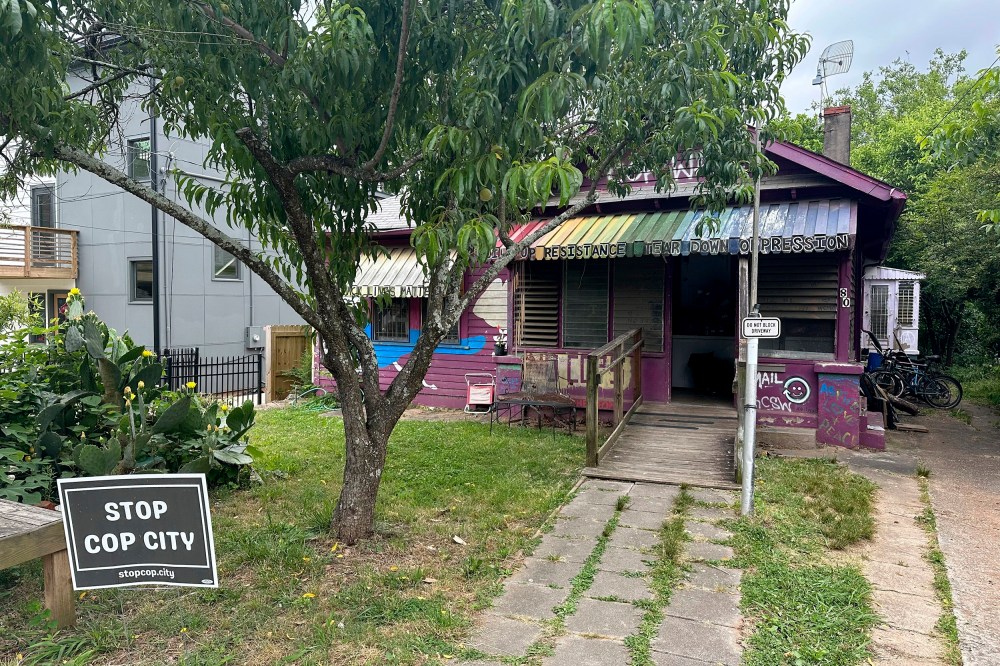
Early Wednesday morning in a residential area of southeast Atlanta, a SWAT team showed up with riot gear and rifles. The Georgia Bureau of Investigation and the Atlanta Police Department arrested three organizers associated with the Atlanta Solidarity Fund, a local bail fund that, since 2016, has offered legal support and help in covering bail to those who exercise their First Amendment right to protest. The Atlanta Solidarity Fund had also helped bail out those arrested for protesting the proposed creation of a $90 million Public Safety Training Center, which opponents have dubbed Cop City.
The Atlanta Solidarity Fund had helped to bail out those arrested for protesting the proposed creation of a $90 million, corporate-backed Public Safety Training Center, which opponents have dubbed Cop City.
Fiercely resisted by many Atlanta residents but backed by corporations and politicians across the spectrum, Cop City would not only further train police in urban warfare tactics by offering a mock city to train in, but the construction of the proposed 85-acre facility would help to destroy a precious forest of 381 acres in a majority Black area of southeast Atlanta.
Atlanta activists had seen these arrests coming. In February 2023, Marlon Kautz of the solidarity fund warned that Georgia prosecutors were building a criminal case against activists opposed to the project.
Those predictions came true Wednesday when the SWAT team raided the home of Kautz, Adele Maclean and Savannah Patterson, and carted them to jail on charity fraud charges that experts have denounced as fabricated. A Wednesday tweet from the Atlanta Solidarity Fund characterized the arrests as “an attempt to cut off protestors from legal aid” and said, “We remain unafraid and stand strong in fighting to protect civil liberties.”
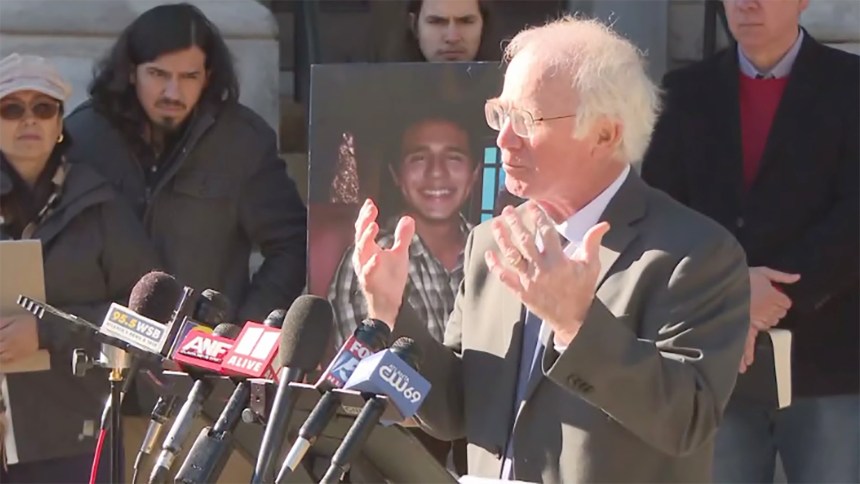
At Friday’s bond hearing, Don Samuels, an attorney representing the three who were arrested, said, “My real concern here is if you look at these warrants … of what they’ve done with the money that prompts both the money laundering and the charitable fraud, I mean, $37.11 to build yard signs. What could be more First Amendment activity than getting materials to build yard signs?”
The judge who granted bond to the defendants said that at this point in the prosecution’s case, “I don’t find it very impressive. “There’s not a lot of meat on the bones.”
In contrast, on the day of the arrests, Georgia Gov. Brian Kemp took to Twitter to announce that the state would not rest until all those involved in the “criminal organization” known as the Stop Cop City movement are “arrested, tried, and face punishment.”

Arresting bail fund organizers is just the latest strategy that city and state officials have used to criminalize dissent and to attack those of us working to stop Cop City. In January 2023, Georgia state troopers who were part of a larger joint police task force killed Manuel Esteban Paez Terán, one of many activists who had been living in the forest to defend it from devastation. Georgia state troopers opened fire on Terán, who went by Tortuguita, while Terán was in a tent, leaving 57 bullet wounds in the activist’s body despite an autopsy that suggests Tortuguita was killed with both hands raised in the air while sitting cross-legged.
Authorities have claimed without real evidence that Tortuguita first shot a state trooper, but body camera footage from an officer with the Atlanta Police Department captures him saying of troopers, “They shot their own man?,” suggesting the trooper might have been shot by another officer. Six Georgia state lawmakers, citing conflicting reports about what happened, have called for the Justice Department to investigate.
Since December 2022, police and prosecutors have charged 42 protesters with domestic terrorism for their perceived involvement with the movement — an extreme escalation that is being challenged in court as unconstitutional, and that has been denounced by human rights organizations, including Human Rights Watch, the American Civil Liberties Union, Amnesty International and the Center for Constitutional Rights. Many of those who have been charged were simply attending a music festival in the forest when they were arrested.
Others have been charged with felonies for simply handing out flyers that labeled one of the officers implicated in Terán’s death a “murderer,” leading the ACLU of Georgia to tell The Guardian in an email: “It raises serious first amendment concerns. It is also part of a broader pattern of the state of Georgia weaponizing the criminal code to unconditionally protect law enforcement and to silence speech critical of the government.”
When it comes to policing, cities often follow one another’s playbooks. And the playbook we’re seeing in Atlanta — featuring extreme police repression and anti-democratic governance — should scare everyone. City and state officials are replicating and escalating tactics often associated with totalitarian regimes: They’re weaponizing the criminal legal system to intimidate, silence and lock away critics of the government. Ironically, police and public officials are reinforcing exactly the type of repression that critics of Cop City say the facility will escalate.
Ironically, police and public officials are reinforcing exactly the type of repression that critics of Cop City say the facility will escalate.
After Wednesday’s arrests, Jocelyn Simonson, a professor at Brooklyn Law School and author of “ Radical Acts of Justice: How Ordinary People Are Dismantling Mass Incarceration,” wrote for Slate, “In what is a first in recent memory, prosecutors are openly charging people with felonies simply for being organizers within a bail collective that uses legally established procedures to post bail for movement allies.”
While it may be a first, if history tells us anything, it certainly won’t be the last. Who will be targeted next?
The arrests of the Solidarity Fund organizers holds implications for those working for justice across the country, whether for other bail funds, abortion funds, travel funds for migrants or any other mutual aid group that supports those who are criminalized or marginalized. And just as #StopCopCity activists have been charged with domestic terrorism, so too were protesters in New York City who rose up against the killing murder of Jordan Neely on that city’s subway. More broadly, multiple states have passed “critical infrastructure” and domestic terrorism laws in recent years in response to protests for environmental justice and Indigenous sovereignty.


The message behind these laws is this: If you fight for a livable future or resist oppression, you might be labeled a domestic terrorist, and prosecuted accordingly.

Perhaps most frighteningly, the severe police repression and the support for the Cop City project are thoroughly bipartisan. Despite party posturing during election season, Atlanta Mayor Andre Dickens, a Democrat, and Georgia Gov. Brian Kemp, a Republican, have worked hand in hand to criminalize the movement. Kemp has referred to protesters as domestic terrorists and Dickens has described them as “outsiders who have come here for their own political aims,” people who “want to scare and disrupt.” Both have overseen police forces sent to crush the resistance.
In January, Georgia’s Attorney General Chris Carr, a Republican, announced that his office was working with “progressive” DeKalb County prosecutor Sherry Boston, to prosecute protesters.
The Cop City project was originally championed by former mayor, and Democratic darling, Keisha Lance Bottoms, and was formally approved by the supposedly liberal Atlanta City Council. And behind Cop City is a web of corporate money — most prominently, the Atlanta Police Foundation, a private nonprofit organization with millions in corporate funding that has spearheaded Cop City and is just one of many police foundations that operate across the country. Corporate-backed fascism is unfortunately not something we can pin on a specific party.
The severe police repression and the support for the Cop City project are thoroughly bipartisan.
More broadly, the Cop City proposal itself is part of a nationwide trend of cities and states turning to increased policing amid rising inequality, mass protest, and climate disaster. In 2017, Chicago approved what organizers against it call Cop Academy. We have seen proposals for Cop City-type facilities across the country, including in Hawaii, Texas, Michigan, New Jersey and Pennsylvania. There may be a Cop City coming to a city near you soon.
What’s happening in Atlanta should terrify everyone, but it should also inspire us all. For the past two years, Atlanta residents have fought fiercely to defend the forest, identified as one of the “four lungs” of Atlanta, and to prevent further investment in policing while so many community needs remain unmet. In September 2021, there were over 17 hours of virtual public comment from Atlanta residents, with the vast majority speaking in opposition to Cop City. Since then, the movement has only grown.
While officials have pointed to incidents of property damage to paint the Stop Cop City movement as terroristic, the Rev. Matt Johnson, an organizer and faith leader, previously told NBC News that the damage followed city officials ignoring their constituents: “We’ve tried everything. We went through City Council, we’ve taken the legislative route, we’ve done tons of advocacy, we’ve sent in letters, and all we’ve been responded with is force.” When construction equipment has gone up in flames, it isn’t “just people breaking s— to be breaking s—. This [is] people who have run out of all options.”
From neighborhood associations near the proposed site and local preschool networks, to faith leaders and everyday residents, to acclaimed organizations, including the ACLU of Georgia and the Georgia NAACP, Atlantans have banded together to fight for our futures. On May 15, residents turned out for a record-breaking, in-person public comment session that lasted more than seven hours, with hundreds of residents speaking against the facility. Not one person spoke in favor.
An even greater turnout is predicted on Monday, June 5, when the Atlanta City Council is expected to vote on at least $67 million in public funding for Cop City (despite promises from Mayor Dickens that the public price tag would be only $30 million).
In the face of police repression, Atlantans are not backing down. Protesting isn’t terrorism, and solidarity isn’t a crime. But although we remain steadfast in the face of repression, it should spur everyone to continued action nonetheless: from the murder of a protester and the political prosecutions of 42 people for domestic terrorism to the criminalization of bail fund activists, officials are communicating that the Constitution doesn’t exist in our city. And while it’s Atlanta today, unless we band together, it may be your city next.
UPDATE (June 3, 10:28 a.m. ET): This column has been updated to include evidence that challenges authorities’ claim that Terán shot an officer.

Micah Herskind
Micah Herskind is an organizer and writer and has written for publications including New York Magazine, Vogue, Scalawag, Prism, Teen Vogue and Race & Class.