




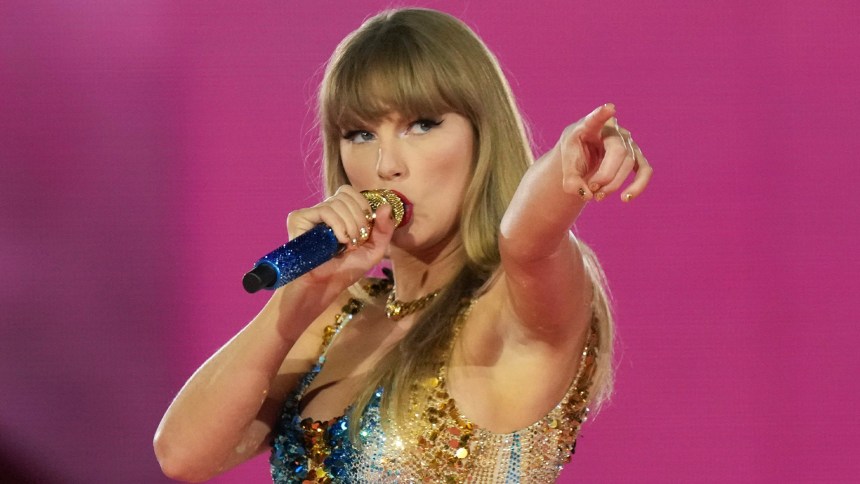
In early 2023, before the start of Taylor Swift’s mass-grossing Eras Tour in Glendale, Arizona, no one knew exactly what to expect; certainly no one knew it would be the first concert series in history to gross $1 billion or that it would contribute $4.3 billion to America’s gross domestic product. The end of the tour allows us to appreciate the transformative power of pop music and its fans, as well as the stark limits of popular culture to meaningfully change political and social institutions.
The economic ripple effect goes beyond ticket sales. Concertgoer practices of trading friendship bracelets at shows boosted sales for craft stores; fans waited in hourslong lines for coveted pieces of tour merchandise like the blue crewneck sweatshirt; and the Eras Tour movie, the highest grossing concert film of all time, allowed fans to enact the Eras Tour rituals and camaraderie at a fraction of the cost.
The cheapest tickets for Swift’s final six performances cost more than $1,400, and many of those tickets offered seats with an obstructed view of the stage.
Avid fan participation is a key driver of the Swift economy. One TikTok content creator made a detailed spreadsheet to track the length of the crowd’s ovation after each of Swift’s performances of “champagne problems.” Special rituals developed during the tour built a unique and powerful crowd solidarity, with practices like the “bejeweled dance,” “Taylorgating,” “Swiftball” (guessing the nightly surprise songs) and fans shining their cellphone flashlights throughout the performance of “Marjorie.” And this practice of what sociologists call “interaction rituals” translated into an intensely invested consumer base.
Ticket sales matter, of course. The cheapest tickets for Swift’s final six performances cost more than $1,400, and many of those tickets offered seats with an obstructed view of the stage. Better seats sold for over $8,000. One of the lessons of the Eras Tour is that fans are willing to spend large sums of money on things that bring them joy.
Swift has a multigenerational fan base, but a large contingent of her fans are millennial women. Compared to women of their parents’ generation, millennial women are more likely to have better paying jobs and more likely to live alone. This economic independence allows for greater expenditures on luxury goods and high-end experiences, a phenomenon that economist Misty Heggeness has termed “Swiftynomics.” The Eras Tour also coincided with the growth of Gen X and baby boomer “senior Swifties” and so-called “sad dads,” older men drawn to Swift’s more recent mature and melancholic sounds. For these fans, the Swiftie fandom in general, and the Eras Tour in particular, have provided a haven from life’s pressures. This search for escape is central to Swiftynomics: As activated as Swift’s consumer base is, Swifties aren’t necessarily trying to change the world, they’re trying to find joy in it.
To that point, Swift’s Eras Tour concerts bear characteristics of what the counterculture writer known as Hakim Bey termed “temporary autonomous zones” — places that create a separate reality beyond the grind of modern life. Unexpected Swifties like Liz Truss, former U.K. prime minister and leader of the Conservative Party, and Keir Starmer, current U.K. prime minister and Labour Party leader, suggest how a shared love of Taylor Swift can transcend political differences.


Still, political divisiveness and real-world traumas frequently intruded on the sanctum created by the Eras Tour and its Swifties. Swift’s decision to perform in Singapore, but not in neighboring countries, caused a brief diplomatic crisis in Southeast Asia. In August, Swift was forced to cancel her shows in Vienna because of a reported ISIS terrorist plot. In the English town of Southport, three children were murdered in a knife attack during a Taylor Swift-themed dance class. At an Eras Tour stop in Germany, police arrested a 34-year-old man accused of stalking and threatening Swift and her boyfriend Travis Kelce. In early 2024, Swift’s relationship with Kelce, a star on the NFL’s Kansas City Chiefs, fueled a series of right-wing conspiracy theories about the couple, with some speculating that Swift and Kelce were part of a secret government-sponsored effort to help re-elect President Joe Biden. Former Republican presidential candidate Vivek Ramaswamy suggested that the Super Bowl was rigged in the Chiefs’ favor to bolster Swift and Kelce’s plot.

When Swift endorsed Kamala Harris after Harris’ debate with now-President-elect Donald Trump, some thought that her endorsement could have a tangible effect on a close political race. But like Swift’s 2018 endorsement of Phil Bredesen, it showed the task of translating a passionate fan base into a reliable voting bloc remains exceedingly difficult. And still, conservative Swifties were apparently able to separate their love of Swift’s music from their political opinions.
In May, Swift added a new era to the Eras Tour. After the release of her 11th studio album, “The Tortured Poets Department,” she incorporated a new collection of songs and called it “Female Rage: The Musical.” These songs were characteristically autobiographical, focusing on failed relationships with past partners Matty Healy and Joe Alwyn. Swift fans, however, know that her songs almost always contain multiple layers of meaning. Swift’s female rage was directed at broader targets: the stalkers, the conspiracy theorists, the politicians hijacking her brand, Trump and the architects of the Dobbs decision overturning Roe v. Wade (a decision that caused Swift to “be absolutely terrified” in her words).
Fans share that rage, too. The economic power and independence of young women have allowed them to travel to distant cities and countries to experience the Eras Tour, to rejoice with fellow fans and to buy expensive merchandise, even if they do so in an era of diminishing political rights and bodily autonomy. Fandom is a haven, but it’s always a partial one. It’s a space of joy, even with threats right around the corner.
What comes after the Eras Tour is anyone’s guess, but it will surely be remembered as a cultural touchstone, on par with Woodstock or Beatlemania. The political, demographic and economic conditions that made the Eras Tour a historic phenomenon will inevitably shift, but Taylor Swift and her army of Swifties have created a new template for finding joy in an often-troubling world. Even if it doesn’t translate to fundamental change.

Brian Donovan
Brian Donovan is a professor of sociology at the University of Kansas. His research focuses on gender and popular culture in American society, and his work has been funded by the Social Science Research Council and the National Endowment for the Humanities. Donovan’s most recent book, "American Gold Digger: Money, Marriage, and the Law from the Ziegfeld Follies to Anna Nicole Smith," examines the impact of the “gold digger” stereotype in American society. He is currently researching and writing a book about the Taylor Swift fandom.