




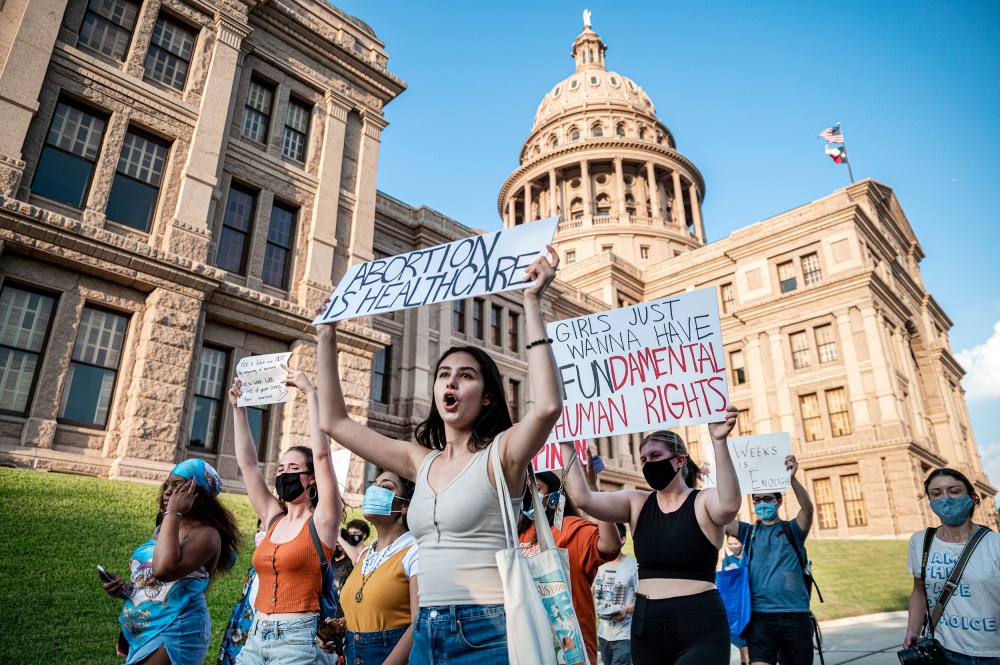
It’s been a very bad week for reproductive rights in America, with Texas and Missouri serving up a one-two punch to abortion access, providing a preview of where abortion rights are headed.
The surprising and devastating part of this story is that a majority of U.S. Supreme Court justices seems to be buying this ploy.
The Texas Supreme Court essentially ended the suit abortion providers had filed to try to halt Texas’ unconstitutional ban on all abortions after six weeks. After the U.S. Supreme Court likely concludes this summer that there is no constitutionally protected right to abortion, more red states will likely follow suit and pass copycat laws. Typically, this would mean that women with resources to travel, who live in states that outlaw abortions, would go to neighboring states to obtain abortions. But here’s the second punch: Missouri is now trying to prevent women from getting out-of-state abortions. If Missouri is successful, this would foreclose the ability of women who live in red states to have any access to abortion.
Back in September, the U.S. Supreme Court silently overruled Roe v. Wade by allowing Texas’ restrictive abortion law to remain in effect. As a reminder, Texas’ law bans all abortions after six weeks of pregnancy, which is often before many women even know they are pregnant. There are no exceptions in the law for cases of rape and incest. The law is clearly, and flagrantly, unconstitutional under the U.S. Supreme Court’s landmark 1973 decision in Roe v. Wade. There, the court held that women have a constitutionally protected right to abortion well past six weeks into a pregnancy. In 1992, the court reaffirmed but scaled back the protections afforded to women in Roe v. Wade in Planned Parenthood of Southeastern Pennsylvania v. Casey. In Casey, the court held that the states could not impose undue burdens on a woman’s ability to obtain an abortion up to the point of viability, which at the time the case was decided was about 24 weeks into a pregnancy.

Why the high court allowed Texas to keep its unconstitutional law on the books was likely for two reasons. First, the court found that because Texas’ law would be enforced by private individuals and not by members of the state government, it was just really difficult to figure out who, if anyone, could be sued to stop Texas’ law from remaining in effect. The architects of Texas’ law designed it this way to try to insulate it from judicial review. Put another way, by deputizing private individuals, instead of members of the government, such as state licensing officials, to enforce Texas’ law, the law was written to prevent federal courts from being able to stop the law from going into effect and staying in effect.
The devastating part of this tale is not so much that Texas wrote an unconstitutional law that is designed to prevent federal courts from being able to stop it in its tracks. That was, in many ways, predictable. The surprising and devastating part of this story is that a majority of U.S. Supreme Court justices seems to be buying this ploy. After agreeing to hear arguments on who, if anyone, could be sued to halt Texas’ law, the high court concluded back in December that abortion providers suing to stop enforcement of Texas’ law could only sue people who had disciplinary power over medical licensees. At the time, this was regarded as the narrowest of wins for abortion providers trying to ensure that there was some member of the state government they could sue to stop this law.
What does a post-Roe and Casey America look like? Missouri is already preparing for that world, and it is more ominous than one might think.
But then a month later, in January of this year, the court allowed the U.S. Court of Appeals for the 5th Circuit to all but ignore its own ruling. The 5th Circuit, instead of returning the case to the federal trial court to continue against the medical licensing board members, decided to send the case to the Texas Supreme Court first. And despite the protests of abortion providers who wanted to, and were entitled to, proceed with their case in federal district court against the state medical licensing professionals, the Supreme Court gave that delay tactic its blessing.
On Friday, in what is now an utterly predictable chapter of this story, the Texas Supreme Court ruled that the Texas medical licensing professionals do not have the ability to enforce Texas’ restrictive abortion law. This means they can’t be sued in a case to stop enforcement of the law. The Texas Supreme Court’s decision effectively ends one of if not the main suit designed to halt enforcement of Texas’ still, for now, unconstitutional law.
This brings us to the second reason that the Supreme Court has allowed Texas’ unconstitutional abortion law to remain in effect. The law almost certainly won’t be unconstitutional for long. In December the Supreme Court heard oral arguments concerning Mississippi’s 15-week ban on abortions. This law, while less restrictive than Texas’ law, is also unconstitutional under the current Supreme Court framework established by Roe v. Wade and Planned Parenthood V. Casey. However, given the questions asked by the conservative justices during oral arguments, and given the cavalier attitude with which the court has treated abortion rights in Texas, the outcome of the challenge to Mississippi’s law now seems unavoidably clear. Roe and Casey will almost certainly be overturned.
What does a post-Roe and Casey America look like? Missouri is already preparing for that world, and it is more ominous than one might think. Conventional wisdom dictates that women with means who live in states that have outlawed abortions will travel to states that allow abortions. This is already happening as a result of the implementation of Texas’ law, where abortion patient visits increased by 800 percent at Planned Parenthood centers in states around Texas compared with a year ago. But now Republicans in Missouri, in another unconstitutional move, are trying to prevent women from crossing state lines to obtain an abortion. A proposed law provides that anyone who assists a resident of Missouri in obtaining an out-of-state abortion can be sued by any private citizen. Here we see Missouri trying to use Texas’ blueprint of outsourcing enforcement of an unconstitutional law to make sure no one can be sued to halt that law. The problem, for now, is that the law would contravene the Constitution by allowing Missouri to pass a law that would affect behavior outside its borders. Let’s imagine that California outlaws wearing red on Wednesdays (and let’s also imagine for a moment that this law isn’t preposterous and illegal). California could not then also outlaw its residents from wearing red on Wednesdays when they visit Arizona. Even if this Missouri law passes, let’s assume for now that the Supreme Court will not allow Missouri to upend our understanding of state sovereignty. Missouri could still win by having its unconstitutional law on the books for months while the court sorts out the “complex and novel” questions raised by Missouri’s decision to copy Texas and outsource enforcement of its law to private individuals. We are now in a place where conservative states are attempting to outlaw abortion, and at least one conservative state is trying to do so outside its own boundaries. Two years ago, this might have seemed like a fever dream. But now, with a conservative Supreme Court majority that appears not particularly concerned with overturning established case law, all of this could soon become reality. Like I said, this has been a bad week for abortion rights in America. And there’s a very good chance that we may be repeating that statement for at least the next decade.
Jessica Levinson is a Loyola Law School professor and MS NOW columnist. 


