





This week’s Democratic National Convention has breathed life and hope into this current election cycle and taught lessons that have left so many of us newly energized for the months and years ahead. But no one could have imagined that a 17-year-old boy, with an unbridled display of pride for his father, would show the nation precisely what it looks like when a child has been raised with a healthy model of masculinity.
As Minnesota Gov. Tim Walz highlighted his family’s struggles with infertility during his speech accepting the Democratic nomination for vice president, his son, Gus, stole the show. Gus, through tears and cheers, gave his father a standing ovation and pointed toward the stage while yelling, “That’s my dad!”
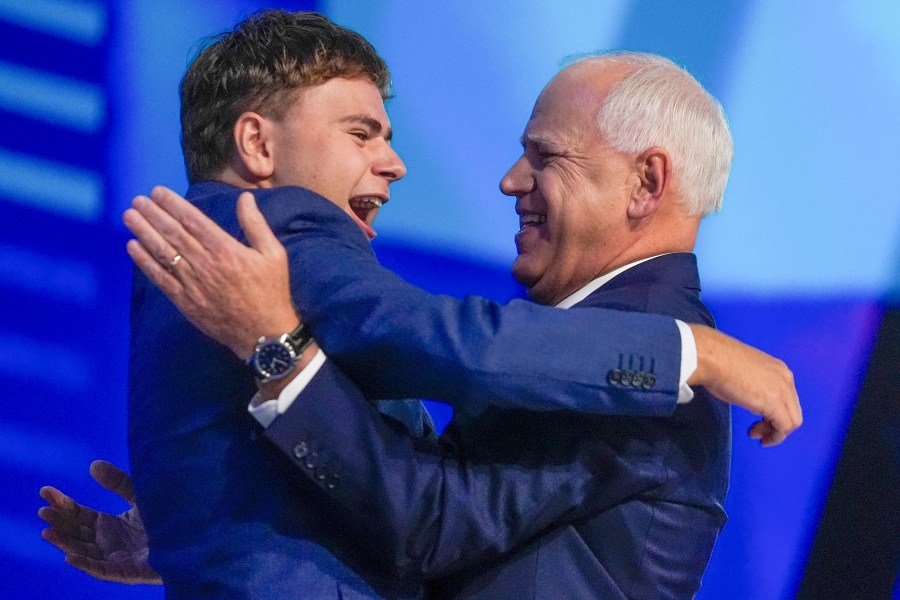
Predictably, social media lapped it up. My own heart melted as I read those posts.
However, there’s unfortunately another side to social media — another side to society overall. It’s the one that pathologizes boys and men who dare to express tender emotions. Indeed, people on this side came out in droves to belittle the special moment Gus publicly shared with his dad. Conservative media pundit Ann Coulter weighed in on the exchange in an ill-advised attempt to lob back a description that Democrats have effectively affixed to today’s Republicans.
"To prove that people like me aren't the weird ones, I — a 62 year-old woman — am going to bully a 17-year-old for crying out of love for his father" pic.twitter.com/DEcSTNVeMv
— Eric Levitz (@EricLevitz) August 22, 2024
I’m sad for Coulter and others who’ve come out of the woodwork to mock Gus expressing love for his father. One is forced to assume that Coulter, and those like her who made remarks too awful to mention, are unfamiliar with the deep, unbridled love and joy that was on display between father and son. Jealousy, they say, breeds contempt.
The exchange between Walz and his son is meaningful for reasons bigger than them and bigger than politics. When I was a public school teacher, I was surrounded by boys who were socially conditioned to use profanity and their fists to express emotion. I saw first-hand how the behavioral issues that emerged in my classroom and school were a product of boys who were not allowed to feel the full range of emotions available to human beings. They certainly were not allowed to feel tender, more vulnerable emotions publicly. Profanity and fists took precedence over tears, hugs and even kindness, almost every time.
Remarkably, such belligerent displays also took precedence over joy. Every teacher probably has a story about seeing a boy who chose aggression to display happiness. I remember seeing a boy shove another boy into a wall when the principal announced a snowstorm was coming and school was closing early. To be clear, the boy doing the shoving was happy at the news.


As a career educator, I continue to witness boys conditioned to display a toxic, aggressive version of masculinity. It’s the kind exemplified by the sort of brazen selfishness, cruelty and misogyny that was amplified during Donald Trump’s term as president. The only appropriate response to adult men who know of no other way to be men is pity.
Sadly, many boys today behave no differently from the way boys behaved when I was a child in the 1980s and ’90s. Crying remains verboten, even if, we’re hearing the worst of the internet say, those tears accompany giving one’s own father a deeply emotional display of love and joy.

In a brief amount of time, Walz has offered us a clear alternative to the subpar, and I dare say pathetic, “masculine” identities that have historically been available to boys and men. Walz shows us that men can be hunters, fishermen and football coaches while also championing reproductive rights and advocating for the humanity of LGBTQ folks. A man can be a decorated veteran and legislate for free feminine products in schools. A man can fix a car and teach his son that there exists a joy and pride so deep that the only thing a boy can do is clap and cry.
Walz and his wife, Gwen, raised a joyful son. The result of their raising him that way is a young man who knows that healthy boys aren’t afraid to cry and they’re not afraid to show love.
There’s a lot at stake in this election — perhaps more at stake than any other election in American history. I might be naive, but I wonder if Vice President Kamala Harris and Walz, and the examples set by their families, have the power to change how we think about boys and men. I hope that their efforts create more joyful opportunities to usher in conversations about a new, healthier and sustainable masculinity.

Christina Wyman
Christina Wyman is an author and teacher living in Michigan. Her latest novel is “Breakout.” Her debut novel, “Jawbreaker,” was a Publishers Weekly Best Book of 2023.