





Donald Trump became a part of history Thursday when a Manhattan jury’s 34 guilty verdicts made him the first former president to be convicted of felony crimes. While falsifying business records in order to cover up a hush money payment to a woman who says she slept with him is among the least scandalous things Trump has ever done, we should all welcome the verdict as a sign of democratic health. It’s a warning to powerful politicians across America: No citizen is above the law, and no amount of social cachet can render you immune to accountability.
But to view Trump’s conviction as a game changer for the 2024 election would be a mistake. It would be tremendously risky for Democratic leaders or voters to bank on Trump’s forthcoming sentence or on the stigma of a felony conviction to keep Trump from winning the White House again. The only surefire way to ensure that doesn’t happen is the old-fashioned way: crafting a better message, out-fundraising, out-organizing and out-mobilizing.
The image of Trump as a jailbird might seem like political poison for him, but he may never be sentenced to incarceration.
Fortunately, President Joe Biden is already delivering that message. Immediately after the verdict, his campaign released a statement that urged voters to remain vigilant and engaged in the political process: “Today’s verdict does not change the fact that the American people face a simple reality. There is still only one way to keep Donald Trump out of the Oval Office: at the ballot box.”
In the run-up to the verdict, there was a lot of drama and suspense around whether Trump would be convicted. The case that Manhattan District Attorney Alvin Bragg brought against him was based on a relatively novel theory of the law — and was far from a slam-dunk case in the eyes of many legal experts. Trump’s conviction by a jury of his peers understandably generated a lot of amazed excitement. It’s rare to see a power-hungry billionaire — who not only routinely skirts the law but also makes a mockery of it — be convicted of felonies and face possible jail time. But Thursday’s sign of civic health won’t necessarily translate to a political win for Democrats.
The image of Trump as a jailbird might seem like political poison for him, but he may never be sentenced to incarceration, and even if he is, he’s not likely to serve time before Election Day. Trump’s sentence is scheduled to be handed down by New York state Judge Juan Merchan on July 11. His sentence could range anywhere from a fine to up to four years in prison. (One middle-ground possibility is that he’s placed under home detention.) But in all likelihood, Trump is unlikely to end up behind bars before Election Day because, as my colleague Jordan Rubin explains, he’s likely to appeal, and that’s unlikely to be sorted out before Election Day. Even in the improbable event that Trump is given the maximum sentence and incarcerated before then, many legal scholars believe there is no provision in the Constitution that prevents Trump from remaining a presidential candidate or even serving as president while imprisoned. (In the early 20th century, Socialist Party leader Eugene Debs garnered about 3% of the national vote share while imprisoned for violating the Espionage Act with his anti-war rhetoric.)


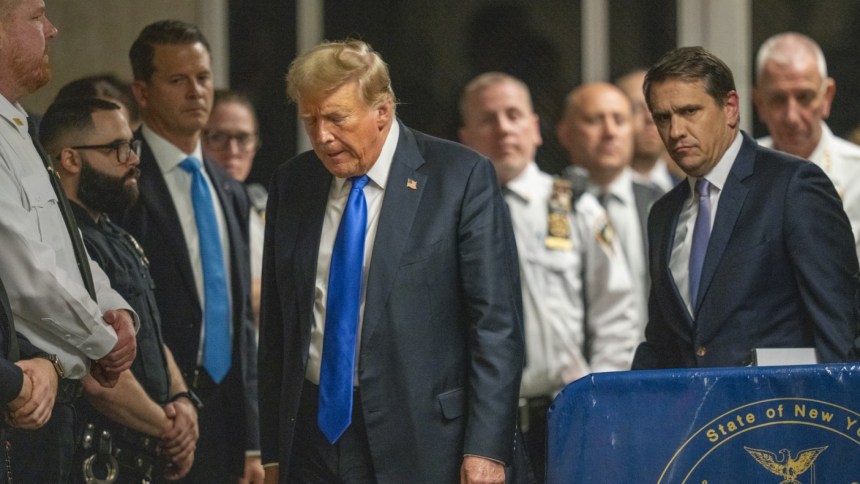
The political ramifications of Trump’s conviction, then, would not be tied to him being physically put in a jail cell but rather the stigma associated with running for president as someone recently convicted of felonies (alongside his three other criminal cases, none of which seems likely to see trial before Election Day). There’s no modern precedent for this kind of scenario involving a major-party candidate, so it would be unwise to issue predictions. But polling data since last year has consistently found that Trump’s indictments had somewhere between a small to nonexistent effect on support for him. (Polling has also shown that voters viewed Trump’s hush money case as less serious than his other criminal cases.) And while we have yet to see what polling looks like after news of Trump’s conviction really sinks in, snap polling suggests a similar trend. The big question is how much the conviction could hurt Trump’s standing among independents, who seem more likely than Republicans to care about Trump’s legal woes. We will likely have a clearer sense of where they stand after Trump’s sentencing in July. But it’s risky to assume it’ll hurt him enough to decisively reduce his vote share in the swing states that will determine the election — and where he has consistently led for months.
We also cannot yet account for whether the Republican backlash over the verdict could increase turnout to higher levels than without the verdict. Less than 24 hours after the verdict, Trump’s campaign already boasted raising over $30 million from Republican supporters. Republican lawmakers have nearly universally condemned the verdict and presented it as a sign of a republic in crisis. Right-wing pundits are depicting the verdict as a sign of a deep-state conspiracy and impending civil war. Snap polling data shows a much higher proportion of Republicans saying they’re more likely to vote for Trump because of the verdict than the share who say they’re less likely to vote for him because of it. Will conservative voters really receive this as a watershed moment, and will this sense of alarm remain strong until November? If so, it is conceivable that some right-of-center Americans who were heretofore unmotivated could view voting as a way to express anger against what they perceive as a state conspiracy against the right. That uptick doesn’t need to be large — it only needs to match the number of voters who might defect from Trump on the basis of his conviction for him to remain competitive.
On the level of messaging, it seems reasonable for Biden to bring up Trump’s conviction and his various ongoing criminal trials when painting Trump as the lawless and corrupt figure that he is. But what’s most important to drive home is not that Trump is a Bad Person because he broke the law but that his lawlessness is tied to his vision for the future of America — an authoritarian society in which a strongman uses the law to shore up his own power, repress dissent and crack down on only the kinds of crimes he personally disapproves of.
Could Trump’s conviction be a significant factor in tipping the outcome of the race in favor of Biden? It’s possible. But the stakes are far too high and Trump has too long of a record of resilience in the polls to assume this race should be treated as anything but a traditional political contest.

Zeeshan Aleem is a writer and editor for MS NOW. He primarily writes about politics and foreign policy.