




Fox News host Bret Baier asked the assembled collection of Republican would-be presidents on the debate stage Wednesday night if they would support former President Donald Trump as the GOP nominee if he is convicted in any of the four criminal cases against him. Every hand eventually went up save two, a pair of former governors tucked away at stage right: Chris Christie of New Jersey and Asa Hutchinson of Arkansas.
The two have forged a lonely path in the 2024 primary season by representing the minority of Republicans who prefer to see Trump anywhere but on next year’s ballot. With Trump’s commanding lead in the polls, and Christie and Hutchinson languishing in the single digits in Iowa, it may seem odd to suggest that they might stand the best chance of keeping Trump from regaining the White House. But that may be the case, thanks to a Reconstruction-era addition to the Constitution.
As Republican candidates for president who say they believe Trump is unfit for office, one or both of them should sue to keep him off the ballot.
Section 3 of the 14th Amendment states, in brief, that no person who previously swore to support the Constitution but then “engaged in insurrection or rebellion against the same, or given aid or comfort to the enemies thereof” can be allowed to hold any federal or state office. As Republican candidates for president who say they believe Trump is unfit for office, one or both of them should sue to keep him off the ballot.
During Wednesday’s debate, Hutchinson noted that he said more than a year ago that “Donald Trump was morally disqualified from being president again” because of the role he played in the Jan. 6, 2021, attack on the U.S. Capitol. “More people are understanding the importance of that, including conservative legal scholars, who say he may be disqualified under the 14th Amendment from being President, again, as a result of the insurrection,” Hutchinson said. “And so obviously, I’m not going to support somebody who’s been convicted of a serious felony, or who is disqualified under our Constitution.”
The conservative legal scholars Hutchinson referred to include William Baude, a University of Chicago law professor, and Michael Stokes Paulsen, a professor at the University of St. Thomas School of Law. They wrote an upcoming law review article that not only lays out why Section 3 of the 14th Amendment is still in effect, despite Congress granting amnesty to Confederates in the late 19th century, but also why the section disqualifies Trump.
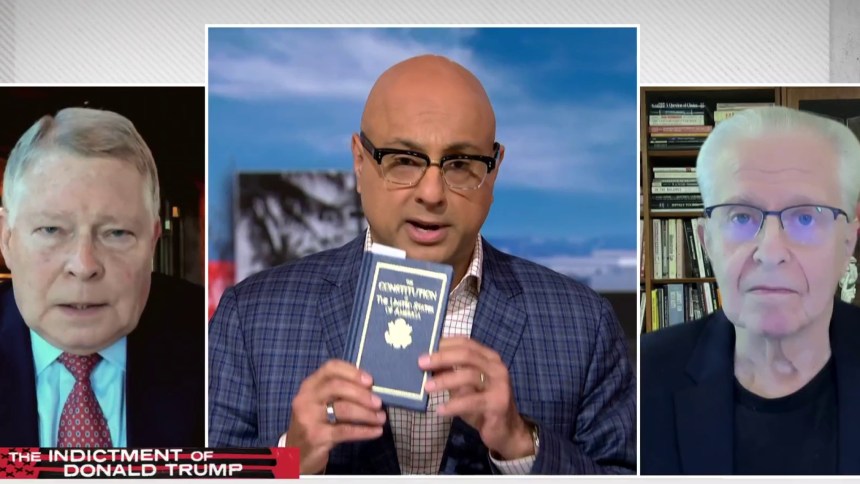
Since the draft version of their article was published on SSRN earlier this month, more voices have joined Baude and Paulsen’s, including that of J. Michael Luttig, a former federal judge on the U.S. Court of Appeals for the 4th Circuit, and Laurence Tribe, an emeritus professor at Harvard Law School. Luttig and Tribe argued in The Atlantic that “this provision of our Constitution continues to protect the republic from those bent on its dissolution.” The question is how to take that legal analysis from theory into practice. It’s one that’s going to have to be answered quickly, as the first challenge to Trump’s eligibility was filed in a South Florida federal court Friday.

Steven Calabresi, a law professor at Northwestern and Yale and co-founder of The Federalist Society, has suggested that a candidate, specifically Christie, take the lead: “Chris Christie is legally injured by Donald Trump’s name being on the ballot,” Calabresi wrote this month in The Volokh Conspiracy, a libertarian-leaning legal blog. “They draw from some similar voters. Christie should sue, if necessary, to get Trump’s name off the ballot.” I’d expand Calabresi’s call for Christie to sue to include Hutchinson as well, especially since he seems to be well aware of the arguments in favor of Trump’s disqualification.
From there, the case is likely to rocket up to the Supreme Court, where it’s anybody’s guess how the supposed originalists in the majority would react to an argument that would have such major ramifications on the Republican Party. But even without a suit from either of the two candidates, the court will likely hear a case on the matter soon enough. Baude and Paulsen argue that Section 3 is “self-executing,” meaning that there’s no need for any sort of criminal conviction or action from a legislature to put it into effect. That would mean, for example, that even though special prosecutor Jack Smith hasn’t charged Trump with insurrection-related crimes, officials could still cite the 14th Amendment as a reason to keep him off the ballot.
Even though special prosecutor Jack Smith hasn’t charged Trump with insurrection-related crimes, officials could still cite the 14th Amendment as a reason to keep him off the ballot. During an appearance on MSNBC’s “Deadline: White House” Wednesday, Michigan Secretary of State Jocelyn Benson stressed that any decision made on the 14th Amendment option would be taken carefully and with respect to the law and that she’d seek an opinion from the state’s attorney general “when the time is right.” (It seems worth noting that Michigan Attorney General Dana Nessel has filed criminal charges against several participants in the “fake electors” plot in the state, a key component in several of the cases against Trump.) Benson also seemed wary of the pitfalls of officials being able to unilaterally determine who does and doesn’t qualify for the ballot in a way that might skirt due process. Luttig and Tribe see an answer to those concerns in “the wisdom of judicial decisions,” as there’s no way that somebody doesn’t sue the second an election official rules that Trump is ineligible. The nonprofit group Free Speech for People, which served as counsel in the attempt to block former Rep. Madison Cawthorn (R-N.C.) from running for office in 2022 because of his support of the insurrection, has launched a campaign to persuade secretaries of state like Benson to keep Trump off the ballot. And the Trump campaign is already gearing up to challenge in court any ruling that finds he’s disqualified. For that matter, a suit could also come once an official determines that he is eligible. As for who would kick off that process, Luttig and Tribe predict such a legal challenge could come from “someone with the standing to do so, whether another candidate or an eligible voter in the relevant jurisdiction.” It’s likely that a group like Citizens for Responsibility and Ethics in Washington, which is even now preparing to file litigation looking for a ruling on Trump’s disqualification, would be involved with assisting any voters looking to file suit. But as candidates, Christie and Hutchinson — the two Republicans who aren’t praising Trump while running against him — would be perfect. If they go through with it, now is the time for them to begin to marshal their forces and draft their briefs. Because the further we drag into the primary season, the greater the likelihood that one or both men drop out of the race and lose their standing as candidates running against Trump. Given that none of their fellow candidates seem likely to pick up the torch and run with it, now is the time to cite the Constitution and hold Trump to account.
Hayes Brown is a writer and editor for MS NOW. He focuses on politics and policymaking at the federal level, including Congress and the White House. 

