




Free speech is under siege in America at a level not seen since the McCarthy era. President Donald Trump has launched a multipronged attack on speech rights designed to help him wield authoritarian power and chill dissent against his right-wing political agenda.
The response from Democrats and progressive institutions has been shockingly feeble. Democrats’ objections to Trump’s assault on free speech have been slow, quietly articulated and laden with caveats. Several universities have already complied with Trump’s diktats. And while plenty of progressive activists and commentators have expressed dismay over the fate of pro-Palestinian activist Mahmoud Khalil, the broader attacks on the cardinal democratic right of free speech haven’t served as the kind of central rallying point one might hope for at a time of creeping authoritarianism.
Here’s a key reason: Trump is using some of the left’s own tools against itself, and it doesn’t know how to fight back.
The president is weaponizing the logic of “safe spaces,” an idea once championed by progressive activist circles, to suppress free speech. He has also made use of many Democrats’ belief in the “Palestine exception” to free speech — the position that certain forms of criticizing Israel should be censored or outlawed. Using these two distinct ideas, he’s able to exploit the left where it is weakest on speech rights and norms.
The left has an opportunity to re-establish itself as a champion of principled and robust free speech rights.
Much of the progressive left has viewed free speech claims as a tool of centrists or the right for the past decade or so. This was always misguided, but Trump’s particular exploitation of “safe spaces” has exposed a particularly dangerous vulnerability for progressive activism. And many liberals and Democrats have long been comfortable with censorship of pro-Palestinian speech, which is coming to haunt them now.
The left has an opportunity to re-establish itself as a champion of principled and robust free speech rights to protect against further democratic erosion. Conversely, if liberals and progressives allow their support for speech rights to remain contingent on political convenience, they’ll never be able to form the pro-democracy front that’s badly needed in this moment.
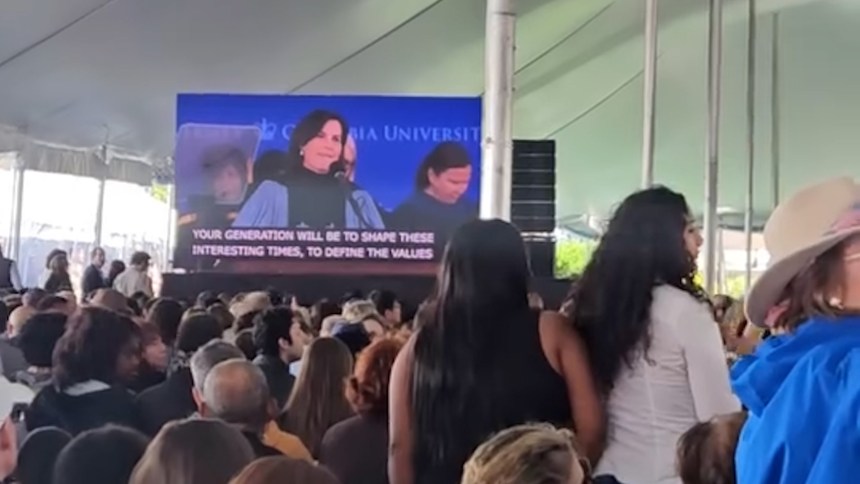
The centerpiece of Trump’s censorship agenda is a crackdown on speech critical of Israel, under the dubious pretext that pro-Palestinian speech from immigrants and protests at universities is tantamount to antisemitic harassment or support of Hamas. Most recently, Trump is attempting to block Harvard from enrolling international students after accusing the university of failing to address antisemitism on campus. And skittish universities are withholding diplomas and banning from campus student commencement speakers who denounce what they describe as genocide in Gaza. This is where the assault on free speech is starting, but it’s not likely to be where it ends.
The dangers of safetyism
In the 2010s, many young progressive activists on and off college campuses embraced “safetyism” — an umbrella term that I’ll define in this article as a cluster of concepts that maintain that safety is about not just protection from physical violence but also about protection from mental and emotional discomfort and distress. Under safetyism, words can be considered violent.
Within this constellation of ideas, “safe spaces” are about not physical protection but rather the carving out of space for affirmation, support and solidarity for people from marginalized groups.

The concept of “safe spaces” dates to the gay liberation and feminist movements in the 1960s, but in the 2010s it had a new moment with a broader range of meanings and absorbed elements of the era’s general cultural turn toward mental health awareness and sensitivity, such as avoiding “triggering” content. While affinity groups and attentiveness to trauma can be good things, “safe spaces” also evolved into a cudgel against free speech norms and practices.
Safe spaces were cited in many high-profile censorship-related incidents on college campuses in the 2010s, including various guests’ being uninvited from speaking events; Yale faculty member Erika Christakis’ resignation following a campus firestorm over an email she sent arguing students should have the right to wear potentially offensive costume; and Wesleyan College students’ attempts to defund the student newspaper for publishing an op-ed critical of the Black Lives Matter movement. Safe space arguments also contributed to the ouster of offenders from professional activist spaces within the left and were invoked to shape coverage at The New York Times. In many of these cases, political speech was deemed objectionable or censored under the banner of keeping spaces safe.
Some of the reaction to this activist scene was hysterical and overstated the power of these activists. But the ideas were real and influential in liberal and progressive spaces, and the transformation of the meaning of safety was always misguided and an ominous development for attitudes toward speech. It also happened against the backdrop of a broader liberal complacency about protecting free speech from powerful institutions and figures — at the time, many in the scene were unconcerned by the idea of big tech companies such as pre-Elon Musk Twitter censoring content, for example.
Even though the safetyist activists weren’t part of some totalitarian project, efforts to render political language as violent are the kind of thing that totalitarian governments use to crack down on speech. And we’re seeing the danger of how that can play out.
As Brown University political scientist Alex Gourevitch explained in a trenchant essay in Boston Review, safetyism has since been successfully appropriated by reactionaries and their allies to suppress student movements criticizing Israel. Data indicates that nearly all pro-Palestinian student encampments and demonstrations that took place from Oct. 7, 2023, to May 2024 were nonviolent and that they focused on calls for changes to Israeli policy toward Gaza and university divestment from Israel. But activist critics of the pro-Palestinian movement and alumni networks invoked safetyist rhetoric and codes to pressure university administrations to quash them; private lawsuits against Harvard, for example, cited complaints describing keffiyehs as provocations and student anxiety about protests as “scary” for nonspecific reasons in making the case that the campus was a hostile environment, according to Boston Review.
Under safetyism, psychological distress served as a pretext for brutally repressing pro-Palestinian protests.
Under safetyism, psychological distress served as a pretext for brutally repressing pro-Palestinian protests, often with the assistance of police against nonviolent protesters, and generating a significantly greater arrest rate than during the antiwar protests against the Vietnam War. That is not to deny the reports of antisemitic harassment of Jewish students and disruptions of academic life at universities, which don’t necessarily fall under protected speech. But there is no evidence that those were common or defining aspects of pro-Palestinian demonstrations, nor does their existence explain the severity of the crackdowns. (And notably, harassment of pro-Palestinian protesters wasn’t addressed in the same way by universities.)
At Columbia University, the epicenter of the pro-Palestinian movement, the administration disciplined students through an administrative apparatus developed in 2022 that promoted “holistic well-being” and “inclusion” and represents a moral-therapeutic and safetyist outlook on discipline. The administration seemingly calculated that it could punish students more quickly and with less possibility for pushback than if it used another code of conduct at the university developed in the wake of the 1968 protests against the Vietnam War, which had aimed, according to Columbia University law professor David Pozen, to “secure a wide berth for political expression and to stave off content- or viewpoint-discriminatory administrative responses.”
Since taking office in January, Trump has turbocharged safetyist repression of one of the most important social justice movements of our time — and used it to try to control universities themselves.
He immediately set his sights on Columbia University, accusing it of neglecting to crack down on antisemitism and violating Title VI of the Civil Rights Act of 1964, which requires universities that receive federal funding to weed out discriminatory “harassment” and “hostile environments” on their campuses. Despite its own sustained attention to antisemitism on campus and draconian crackdowns on protests, Columbia caved to Trump’s threats.
When I asked Pozen whether Columbia’s embrace of safetyism to quash pro-Palestinian protests made a Title VI violation claim more potent, he said, in an email, that it could be indirectly relevant in that “what is deemed to be harassing or hostile within the meaning of Title VI depends in part on prevailing norms and expectations” and that “those norms and expectations have, by and large, become increasingly intolerant of offensive speech in recent years.” He continued: “In other words, the law of Title VI at universities is linked to campus culture. And if that culture becomes more fixated on students’ emotional safety, then Title VI may come to cast a wider net.” (Pozen added that he personally didn’t think Columbia could fairly be deemed to be in violation of Title VI, for which it is very difficult to establish liability and which requires demonstrating that students are unable to participate in educational programs because of harassment.) It is plausible, then, that universities that have embraced safetyism have primed themselves to fear Title VI claims in a way that they otherwise would not have, and to make them more inclined to preemptively make concessions. This is a big deal: Trump has warned scores of universities that they may be investigated for Title VI claims. And academia is one of the most critical sources of dissent and demonstration in a democracy. Safetyist norms have also conditioned progressive activists to respond with a lack of ease in any situation involving multiple co-existing claims of mental distress or histories of oppression, as is often the case with activists surrounding the Israeli-Palestinian conflict. It is clarifying, instead, to stand staunchly for free speech and then to focus on the political and moral substance of the ideas at hand. It doesn’t matter where one stands on the Israel-Palestinian conflict, or whether one thinks that pro-Palestinian protesters sometimes say offensive or bigoted things (which in some cases they do, just as many pro-Israeli protesters do). The point is that the redefinition, as Gourevitch put it, from “the right to be safe as a right to feel safe” is a hazard to free speech. The other major tool for curtailing free speech that has purchase outside the right is the “Palestine exception” to free speech in America. Censorship and stigmatization of pro-Palestinian positions have prevailed across many institutions in American life for many years even prior to Hamas’ Oct. 7 war crimes against Israel. After the attacks, censorship exploded across many institutions generally populated by liberals and considered to have ostensibly liberal values, such as academia, the news media, Hollywood and literary institutions, which at times expelled people who expressed pro-Palestinian positions or voiced criticism of Israel. Democrats are in a trap of their own making. The Democratic Party, in many cases, supported the suppression of pro-Palestinian protests. In Congress, many Democratic lawmakers supported a Republican resolution conflating anti-Zionism with antisemitism, even though Zionism is a political movement, not a religion, and there is a long history of Jewish anti-Zionism. Democrats have also widely supported legislation aiming to muzzle the Boycott, Divestment and Sanctions movement against Israel, attempting to suppress the same political tactic that many Americans used to pressure South Africa to end its apartheid regime. Democrats also refused to allow pro-Palestinian activists speak at the Democratic National Convention while allowing pro-Israeli activists to do so, as President Joe Biden backed what human rights experts and genocide scholars have described as genocide in Gaza. The roots of this exception to free speech are complex. Some of it can be attributed to the U.S.’ commitment to protecting Israel as a strategic beachhead in a region of tremendous economic importance for the U.S. (which has also been metabolized culturally as defending a frontier of “Western civilization”). Some of it is a proxy for bigoted anti-Arab sentiment, in which Palestinians are dehumanized as barbaric and undeserving of human rights. Some of it is an uneasiness with siding with a cause that has some antisemites among its ranks or a discomfort with criticizing a state that has served as a place of refuge for a historically persecuted people. Whatever the reasons, the effect is that in liberal and Democratic circles, free speech has an asterisk when it comes to criticizing Israel. Trump has exploited that hole, wedging himself into it aggressively in a way that puts Democrats on their back foot as the administration polices immigrant speech critical of Israel to kick immigrants out of the country. Democrats’ defenses against Trump’s overreach in cases such as his attempt to deport Mahmoud Khalil have been clumsy and mealy-mouthed, lest they come across as sympathetic to his cause. Democrats are in a trap of their own making. They would find it far easier stand up for Khalil’s free speech rights without fear of supporting his positions if they hadn’t spent so much denying that free speech extends to this issue — and denying the humanity of Palestinians. To be sure, Democrats and progressives aren’t solely or primarily to blame for the severity of the current free speech crisis. Trump wanted to find a way to use the power of the state to restrict speech, and he’s using any tool or concept or wedge issue he can get his hands on. But the fact that large swathes of the left have been inconsistent on free speech is significant — it goes a long way toward explaining why the left is divided and weak on the first major free speech tests of this era. And it should inspire a reckoning and re-evaluation of the left’s commitment to free speech, which ought to become ferocious, uncompromising and alive to the real stakes as the U.S. experiences democratic backsliding. If you want to defend the right to express unpopular or unfavored speech, you must defend it when it’s speech you find abhorrent (as long as it’s not a call for violence or deliberate defamation). Anything else isn’t free speech.
Zeeshan Aleem is a writer and editor for MS NOW. He primarily writes about politics and foreign policy. 

The exceptions break the rule
