





Former President Donald Trump loves a good slogan. And he might well use the adage a “strong offense is the best defense” to describe his legal team’s last-ditch effort to head off his pending federal indictment related to his retention of classified documents at Mar-a-Lago.
Timothy Parlatore, an attorney who represented Trump until he resigned in May, recently predicted that Trump’s lawyers will file a motion to dismiss any indictment.
Timothy Parlatore, an attorney who represented Trump until he resigned in May, recently predicted that Trump’s lawyers will file a motion to dismiss any indictment in the documents case based upon claims of prosecutorial misconduct. When defense lawyers level claims of illegal conduct by law enforcement to shift the focus away from their clients’ behavior, it can suggest the clients’ actions are increasingly indefensible. (The special counsel’s office declined to comment on Parlatore’s allegations.)
That’s a sign of desperation.
The alleged misconduct seemingly has at least two themes, at least according to Parlatore. First, he has asserted that the Justice Department’s successful efforts persuading a federal court to set aside attorney-client privilege claims were improper. Parlatore told CBS News that he was “stunned” when questioned in his grand jury appearance about information he says was protected by attorney-client privilege.
However, special counsel Jack Smith’s aggressive challenge to claims that Trump lawyers were shielded by attorney-client privilege from testifying and providing documents was upheld by a federal district court and affirmed on appeal. The attorney-client privilege assertion was rejected by the courts under the so-called crime fraud exception, which strips the privilege if communications were made in connection with possible criminal activities.

The fact that federal courts approved the questioning of Trump’s lawyers seems an impenetrable defense to any claim that this action constituted prosecutorial misconduct.
Second, Parlatore told MSNBC’s Lawrence O’Donnell on Wednesday night that Trump lawyers may have told Smith in a meeting on Monday that “misconduct committed by Jay Bratt and his team in bringing the [documents] case to this level” would be a reason not to indict Trump. At least some of that alleged misconduct, according to Parlatore, focuses on Justice Department counterintelligence chief Jay Bratt’s team’s obtaining a search warrant for Mar-a-Lago in August. Parlatore claimed that Trump, under the presidential records law, had two years to review documents shipped from the White House to Florida before being required to send presidential papers to the National Archives.
Once again, such a hypothetical misconduct claim falters because a federal magistrate judge authorized the search warrant. (And that warrant led to the discovery that Trump continued to retain classified and other official documents, despite his lawyers’ claims to have complied with an earlier subpoena for those documents.)
Parlatore explained that he was speaking out now to rebut public speculation that he resigned because of his own legal problems, statements that he told O’Donnell were “completely false” and “professionally damaging.”
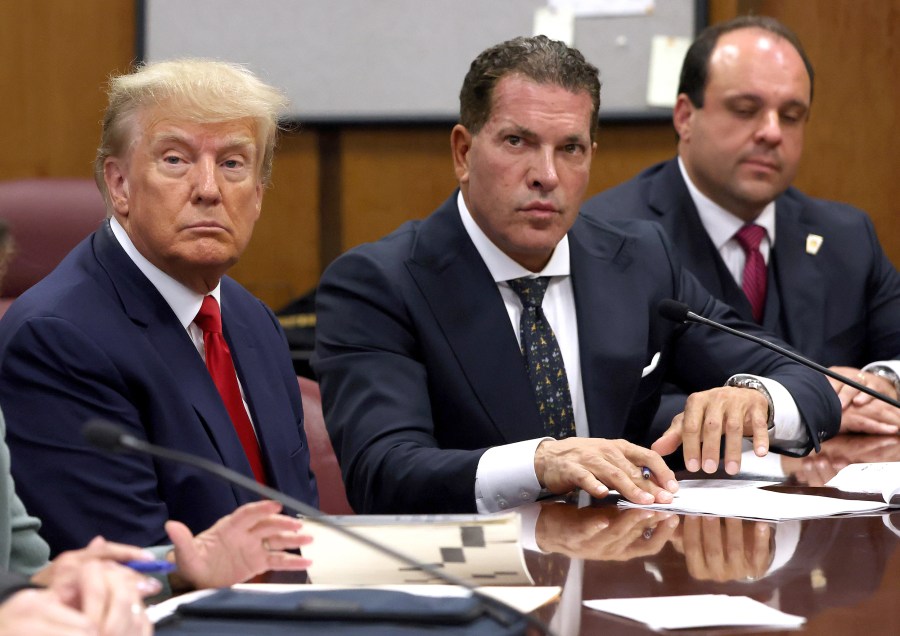
While prosecutorial misconduct theoretically can result in derailing an otherwise appropriate criminal prosecution, this defense rarely succeeds. The U.S. Supreme Court in 1981 ruled that even when law enforcement engages in misconduct, “absent demonstrable prejudice, or substantial threat thereof, dismissal of the indictment is plainly inappropriate, even though the violation may have been deliberate.”


The respective merits — or lack thereof — of these potential defenses did not stop Trump from taking his legal theories to the court of public opinion. On Truth Social, he ranted about the behavior of the prosecutors, urging an investigation into many “ALL TOO OBVIOUS WRONGDOINGS & CRIMES TAKING PLACE AT DOJ & THE FBI.”
This post also (and unsurprisingly) seemed to be spreading a conspiratorial theory that Justice Department prosecutors tried to “bribe and intimidate” a defense lawyer representing a witness by offering the lawyer an “important judgeship.”
Trump’s reference resembled new claims made by Trump lawyers, first reported by The New York Times, that a federal prosecutor had “brought up” that lawyer’s municipal judgeship application, which Trump lawyers believed was a “veiled threat.” A spokesman for Smith had no comment about the incident.
Ranting on social media about alleged government misconduct is one of Trump’s favorite pastimes.
On one hand, ranting on social media about alleged government misconduct is one of Trump’s favorite pastimes. On the other hand, ranting on social media about alleged government misconduct will not get any indictment tossed out by a federal court.
Even though threadbare claims of prosecutorial misconduct have scant chance for success, the Trump legal team seems likely to press them. What other options do they have when the reported charges of conspiracy to obstruct justice, illegal retention of classified documents and violations of the Espionage Act seem so powerful?
While a good offense may be the best defense, a flimsy offense sends a message of impending trouble.

Michael Conway
Michael Conway was counsel for the House Judiciary Committee in the impeachment inquiry of President Richard Nixon in 1974. In that role, he assisted in drafting the committee's final report to the House in support of the three articles of impeachment adopted by the committee. Conway is a graduate of Yale Law School, a fellow of the American College of Trial Lawyers and a retired partner of Foley & Lardner LLP in Chicago.