




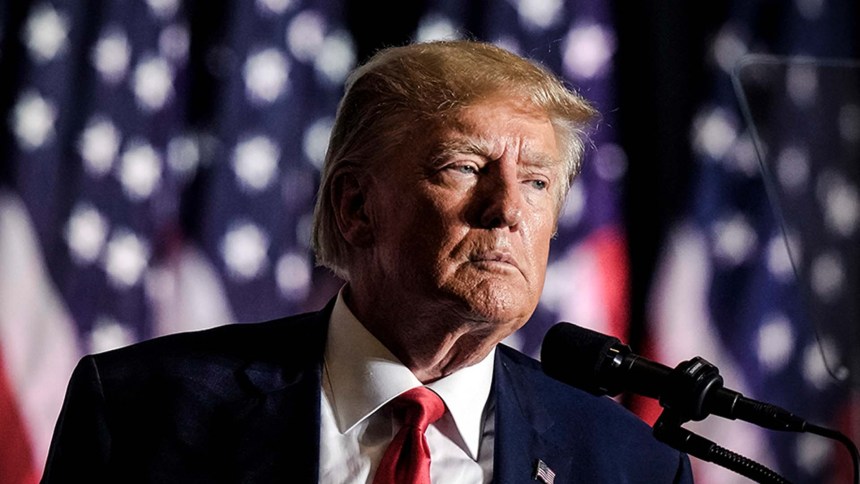
Because everything that Donald Trump does is steeped in denial of reality, when NBC News’ Kristen Welker asked him whether he worries about going to jail, he responded, “I don’t even think about it.”
The notion that the former president doesn’t think about jail is about as believable as his not thinking about attention. The guy’s entire identity is predicated on self-preservation; I’d imagine not being incarcerated probably tops that list.
Trump has, of course, pleaded not guilty in every indictment and maintains all of the prosecutions are politically motivated. But regardless of whether or not he thinks about going to jail, the fact is that he probably should.
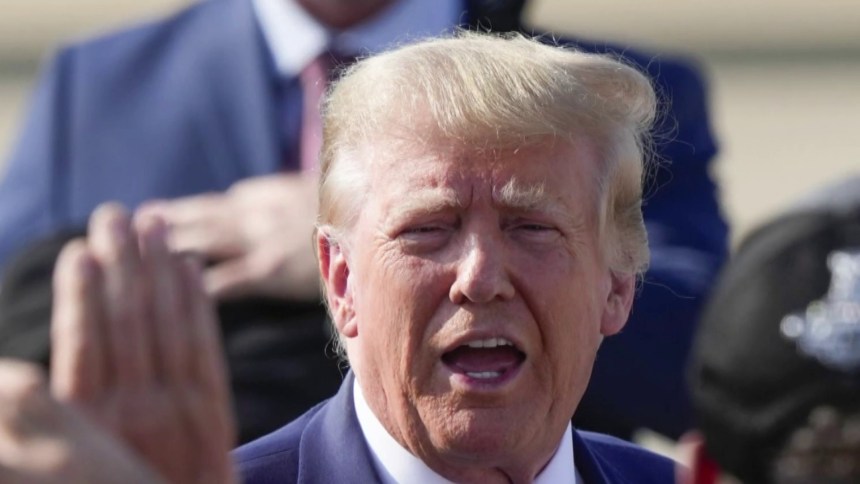
First of all, there’s now precedent for incarceration in this very scheme, and particularly on charges of obstructing Congress. Former Proud Boys leader Enrique Tarrio was sentenced to 22 years in prison for orchestrating the attack on the U.S. Capitol on Jan. 6, 2021. And if Tarrio was sentenced for a scheme that was executed in support of Donald Trump, then shouldn’t the guy pushing that effort suffer the same punishment? Or worse? Former chief of the Dept. of Justice’s Criminal Fraud Section Andrew Weissmann certainly thinks so, saying, “The idea that Donald Trump wouldn’t do at least as much time as the leaders of the Oath Keepers and the Proud Boys, to me, seems unimaginable.” (Although, to be clear, no evidence that connects Trump directly to the Proud Boys’ actions on Jan. 6 has emerged. Tarrio was also convicted on a charge of seditious conspiracy; Trump, by contrast, faces charges of conspiracy to defraud and conspiracy to violate voting rights.)


Consider, too, that the federal case in Washington, D.C., is being overseen by U.S. District Judge Tanya Chutkan. Whereas U.S. District Judge Aileen Cannon, presiding over the Florida case, was unafraid to make decisions in Trump’s interest, Chutkan seems to have no patience for humoring Trump’s antics. And nowhere was that more evident than in her response to Trump’s request for a trial date of April 2026: Chutkan chose March 2024, a mere eight weeks after the date the Justice Department requested.
Former federal prosecutor Glenn Kirschner reiterated that point, saying: “She has been one of the stiffest sentencers in January 6 cases, and I have a feeling she will hold Donald Trump accountable. … I think if the jury convicts him, I think she will hand down an appropriate sentence, it will involve prison time, and she will direct him to report to the Federal Bureau of Prisons.”
It also goes without saying that there’s no conviction without evidence — but the cases Trump is contending with have no shortage of it. Whether it’s the infamous audio recording of Trump’s phone call pressuring Georgia Secretary of State Brad Raffensperger to find 11,780 nonexistent votes or the audio recording of Trump admitting to being in possession of classified documents or the raft of fact witnesses who’ve already testified against him (like Yuscil Taveras, who oversaw the security camera video at Mar-a-Lago) or even Trump’s admitting just this weekend that he acted on his own volition while he executed the schemes he’s charged with in Washington (thereby devastating his own potential “advice of counsel” defense) — the evidence compiled against Donald Trump is already devastating and somehow still getting worse.
Taken together, we’re looking at: a precedent for jail time in connection with the broader scheme to interfere with Congress, at least one judge who is wholly uninterested in humoring his antics and a barrage of evidence that couldn’t seem more damning on its face. Trump may claim that he’s not worried about jail, but all the wishful thinking in the world isn’t going to change the potential consequences of what he’s facing right now.

Brian Tyler Cohen
Brian Tyler Cohen is a political commentator, podcast host and MSNBC contributor. He hosts one of the biggest progressive channels on YouTube, with over 2 million subscribers.