




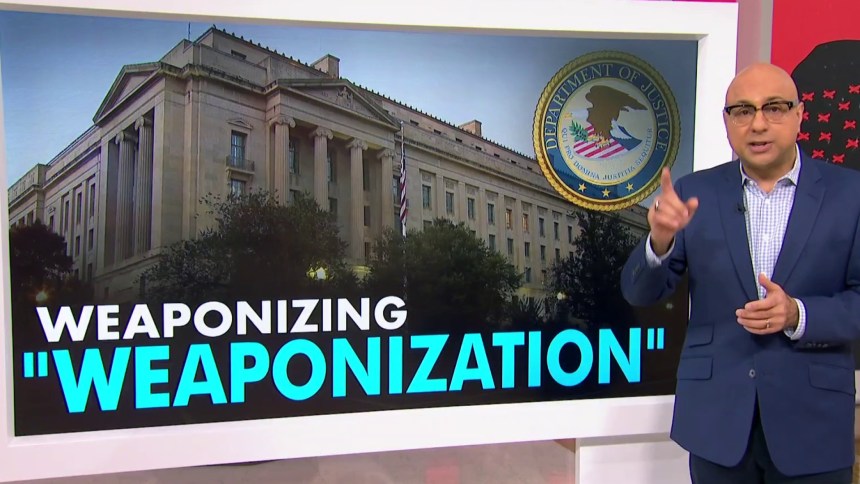
If you’re to believe the loudest voices on the right today, the supposed “weaponization” of the government against conservatives is one of the top threats facing the country. This so-called scourge is most evident, they argue, in the Justice Department and FBI’s treatment of former President Donald Trump.
House Republicans have come up short on evidence to support the idea that leftists get a pass under the current system or that there’s rampant politicization that has infected the DOJ’s processes. But a pro-Trump think tank nevertheless has a solution to this nonproblem: Make the Justice Department less independent, giving presidents more direct control of how criminal cases are conducted. It’s an absurd conclusion to draw, one that would only open the door to actual targeting of Trump’s political enemies down the line.
Throughout his presidency, Trump found himself at odds with his attorneys general and the Justice Department more broadly, particularly during the depths of the Russia investigation and in the aftermath of the 2020 election. While Jeff Sessions and William Barr insisted on following post-Watergate norms surrounding prosecutorial independence, Trump saw the DOJ as a tool that should be wielded for his own personal, political benefit. Since leaving office, his attacks on the department have been adopted by a growing swath of the GOP, with calls to defund the FBI and otherwise rein in federal prosecutors run amok.
Enter Jeffrey Clark. As an official in the Trump Justice Department, he was the sole voice at the DOJ willing to back Trump’s efforts to overturn the results of the 2020 election. For his loyalty, Trump attempted to install Clark as attorney general, reversing course only after the rest of the department’s top leadership threatened to resign in protest. Now Clark is ensconced as a senior fellow and director of litigation at the Center for Renewing America, alongside his fellow former Trump administration official turned far-right enabler Russ Vought.
In that role, Clark recently produced an analysis arguing that the Department of Justice should not, in fact, be treated as independent. Instead, Clark writes, the president should be able to exercise their will over it like any other Cabinet position, given that executive authority is vested solely in him. It goes further than the “unitary executive theory” that Barr and other conservatives have championed, claiming that any sort of check on the president’s duty to ensure that laws are executed faithfully — that is, enforcing the law — is constitutionally invalid.


That flies in the face of the current firewall laid out in Justice Department and White House counsel memos, which allow presidents to set broad policies and standards for the department but keeps them removed from the workings of individual cases. But that separation, Clark argues, has no basis in current federal law, let alone the Constitution as he posits the founders viewed it at the time. He also claims that the current system is, “in practical reality, an illusion” that frustrates the ability to hold the DOJ accountable while “the incentives of the Attorney General to try to please his boss and respond to presidential control remain and cannot be overridden.” The example he gives is that the White House counsel gave the green light for the National Archives to turn over classified material that Trump returned in January 2022 to the FBI as part of the investigation that would lead to the former president’s federal indictment earlier this month.
Setting aside the convoluted accusations of impropriety he cites there, Clark’s analysis fails even when taken at face value. He does make solid points about the flimsy nature of the divide between the Justice Department and the White House, which are based more on norms than actual law. Attempts to codify the DOJ’s independence have either failed to become law, as with the Protecting Our Democracy Act in 2021, or later been allowed to expire, as in the case of the independent counsel in the late 1990s.
Clark fails to explain how eliminating the DOJ’s independence would cure the weaponization that he and Vought claim is taking place.
But Clark either outright ignores the reasons why these norms have come about or discounts them as progressivism run rampant. It is of utmost importance that the state’s monopoly on violence in the name of the common good be carried out as part of the fair and impartial administration of justice, not at the petty whims of those who exercise it. This belief has fueled the calls for police reform from the left and is even given lip service from Trump supporters on the right. The current system is far from perfect, but the professionalism and determination to safeguard the rule of law that serve as its basis are meant to prevent the use of the Justice Department as a score-settling mechanism that petty tyrants would seek to deploy.
More importantly, Clark fails to explain how eliminating the DOJ’s independence would cure the weaponization that he and Vought claim is taking place. Under his framing, Biden has the full authority to direct Attorney General Merrick Garland to harass Republicans. If this is something that is, and should be baked into the system, it undercuts Republicans’ outrage that such targeting is supposedly occurring. And if, as House Republicans claim, the Justice Department and particularly the FBI — which has been headed by Republicans for the last several decades — has become a weapon against conservatives, I fail to see how allowing for greater political interference under a Democratic president would change that.
Trump has already been crystal clear in his desire to retaliate against his enemies if he returns to the White House. Clark and others like him seek to enable this abuse of presidential authority by arguing that it’s his prerogative to determine who should be investigated and direct his attorney general to follow his whims to a degree that even Richard Nixon failed to achieve. Their goal is not to disarm the DOJ as a weapon — it’s to make it one that can be openly carried.

Hayes Brown is a writer and editor for MS NOW. He focuses on politics and policymaking at the federal level, including Congress and the White House.