




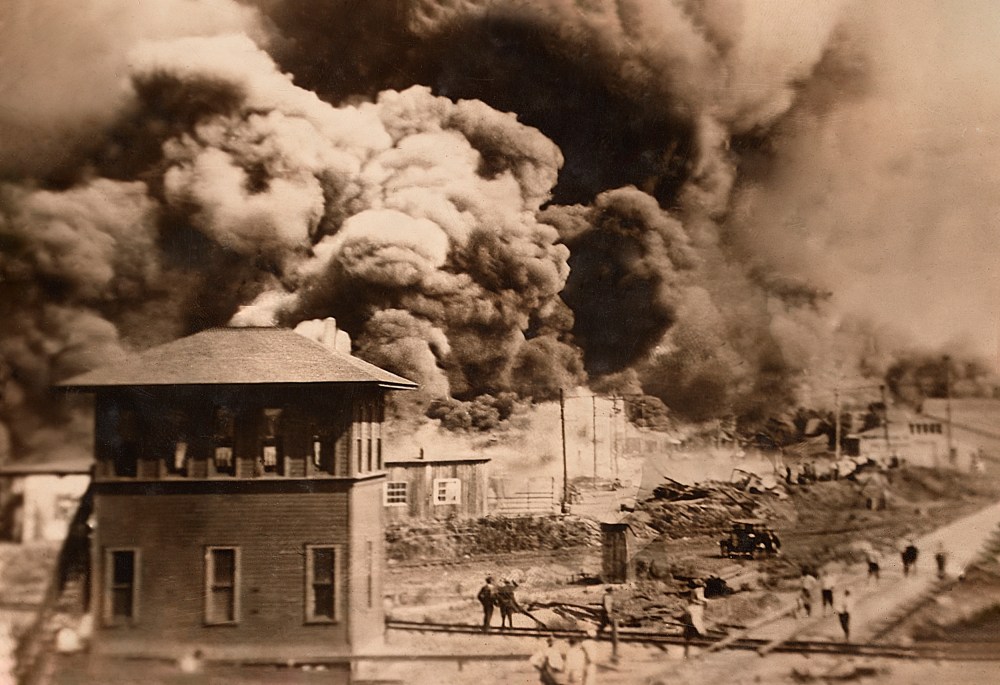
In the Supreme Court’s outrageous Dred Scott decision of 1857, Chief Justice Roger Taney denied the enslaved plaintiff’s claim for freedom with what was, in his mind, a self-evident truth: People of African descent were “so far inferior” that they possessed “no rights which the white man was bound to respect.” We’re 167 years past Scott, arguably “the worst Supreme Court opinion ever,” but its animating spirit lives on in the Oklahoma Supreme Court’s Tulsa Race Massacre decision on Wednesday. In denying reparations to massacre victims, the state high court told Black people — as they have been told repeatedly — that no matter how intense or how obvious their undeserved suffering, and no matter when they make their claim for redress, those in power can find a legal rationale to disregard it.
No matter when they make their claim for redress, those in power can find a legal rationale to disregard it.
Opponents of reparations for slavery have often made the bad-faith argument that at this point the money would be paid to people who never experienced slavery. Such cynical arguments rarely acknowledge that people who did directly experience slavery demanded reparations and were (in almost all cases) denied.
Those arguments also imply a willingness to support payments for people who did personally suffer the kind of violent racism that forced them from their homes and left them without their possessions. And yet, when survivors of just that kind of racism make just such a righteous demand, they too are rebuffed.
Viola Fletcher and Lessie Benningfield Randle are the last known survivors of the racist 1921 attack on Greenwood, a thriving Black community in Tulsa. Fletcher is 110 and Randle is 109. Another plaintiff, Hughes Van Ellis, died last year at 102.

They wanted punitive damages, a compensation fund and a scholarship for descendants of Greenwood residents who lived through that attack. And what may well be the very last attempt to force the government to pay for the violence, they sued Tulsa, Tulsa’s board of county commissioners and the Oklahoma Military Department under the city’s public nuisance statute.


The plaintiffs also specifically called out “Defendants’ exploitation of the Massacre for their own economic and political gain.” In other words, Tulsa has been selling itself to tourists and visitors as a place where people can come to learn about a white mob killing about 300 people — but those who suffered from that mob are not benefiting from what has become a historical tourist attraction.
The Oklahoma judges acknowledge that the plaintiffs’ “grievances are legitimate.” But that clause is effectively meaningless. Fletcher and Randall are still being denied.
Last year, an Oklahoma district court agreed with the city’s argument that “simply being connected to a historical event does not provide a person with unlimited rights to seek compensation.” The state’s Supreme Court ruled 8-1 Wednesday that “though Plaintiffs’ grievances are legitimate, they do not fall within the scope of our State’s public nuisance statute. We further hold that Plaintiffs’ allegations do not sufficiently support a claim for unjust enrichment, nor do the allegations sufficiently support a claim for the unauthorized use of name and likeness.”
Unlike in the Dred Scott ruling, the Oklahoma judges acknowledge that the plaintiffs’ “grievances are legitimate.” But that clause is effectively meaningless. Fletcher and Randall are still being denied. Their attorneys said Thursday that they’ll file for a rehearing with the court, but that seems like a futile act. The pair’s legal team also asked the Justice Department to open an investigation under the Emmett Till Unsolved Civil Rights Crime Act of 2007. But that act didn’t even lead to any new charges in the kidnapping and murder of Emmett Till, a crime that happened 34 years after a white mob razed Greenwood.

There’s a depressing irony to them bringing up Till, though. The 14-year-old Black boy’s killers — and there’s no need to say allegedly here because they later admitted they killed him — were tried at a time and place (1955 in Mississippi) that meant an acquittal was virtually guaranteed. But later demands for punishment for those involved in Till’s lynching and other racist murders in the South were met by pleas to let bygones be bygones.
Black people who saw their neighbors slaughtered and their possessions looted and set on fire in Greenwood would not have had any expectations of reparations in 1921. As cases such as Till’s illustrated, the next generation would not have expected reparations, either. Indeed, it appears that there is no conceivable window of time — in the last 103 years — during which a claim could reasonably be expected to succeed. Not then, not now and at no point in between.

Jarvis DeBerry is an opinion editor for MS NOW Daily. He was previously editor-in-chief at the Louisiana Illuminator and a columnist and deputy opinion editor at The Times-Picayune.