




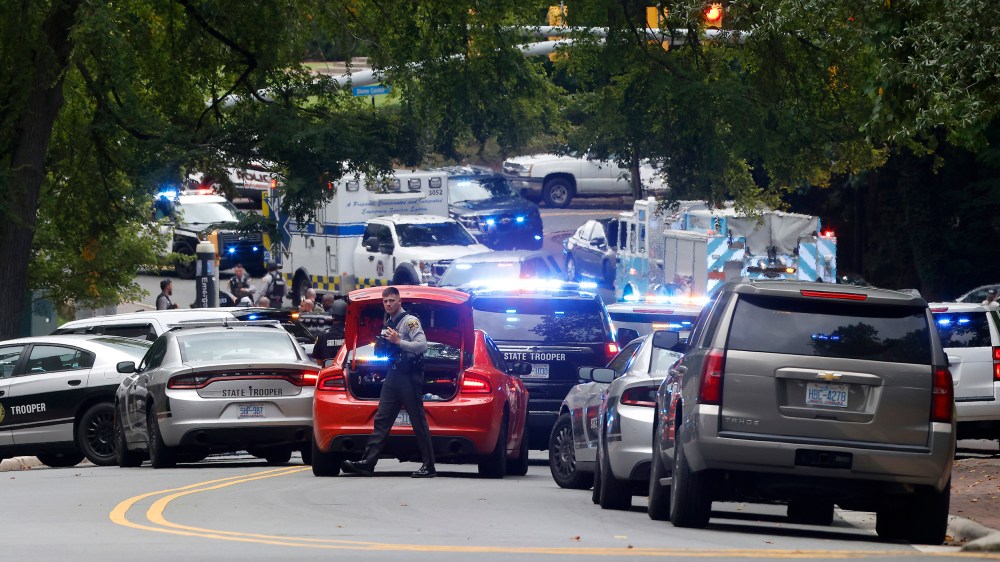
I started worrying about my daughter’s first day of seventh grade during the second week of her sixth grade year, when I first realized that her middle school wouldn’t be a great fit for her. So I spent my daughter’s first year of middle school planning to move to a public school district I believed would be better — and that was how I found myself on the receiving end of multiple calls and texts about a lockdown alert for all area schools on opening day of the new year.
Starting at 1 p.m. the district informed parents that the University of North Carolina at Chapel Hill was warning area schools about an armed, dangerous person on campus. We were told that university students had been advised to remain indoors and away from windows. We were also informed that, consequently, afternoon dismissal at elementary, middle and high schools would most likely be delayed. “Until we receive an all clear from the proper authorities,” one notification read, “we will keep all students and staff safely indoors as a safety precaution. Schools have been directed not to release students to their families at this time.”
It would be four more hours before I learned, along with the rest of the country, that a student had allegedly shot and killed a faculty member before being taken into police custody. But in the moments following those earliest alerts, I was preoccupied with how best to respond to the threat myself.
No district, no neighborhood, no academic institution is safe from the threat and the fear of gun violence.
This wasn’t my first brush with an unnerving automated alert from my child’s school. In April, an email had notified parents that a student took a handgun to school. Though the weapon had been retrieved without incident and the student had been expelled, I found it impossible not to hesitate a half-second when I unlocked the car doors at drop-off every morning thereafter.
This also wasn’t my first time being advised to remain indoors and away from windows because of an active shooter. Twenty-one years ago, long before my daughter was born, I lived in Maryland when the Beltway snipers were at large. Everyone in Maryland, Washington and Virginia spent three full weeks on high alert whenever we left our homes as more and more new reports came in that people were being gunned down at gas stations, shopping centers and various other sites on mundane errands.
On Monday, I thought about those three weeks of 2002 as dismissal time neared and I tried to decide whether I should wait at home or drive to school and sit in the car pool line, waiting for the district to deem it safe to release my daughter.

UNC-Chapel Hill is a 10-minute drive from the middle school I hoped would be a better fit for my child. Until this alert came in — before the first day of the K-12 year had even ended — I had every reason to believe my hopes were well-founded. In truth, even after this harrowing entrée, I’m still fairly confident that the district itself will offer her access to the best resources available in this part of the state.
It’s uncomfortable for me to point out that I moved to a more affluent area so that my child might have access to a level of support that was missing from her old school. I don’t relish how far above my means I had to be willing to live in order to afford housing in Chapel Hill. No family should have to uproot itself for a better academic experience. But income-based educational inequity has long been the order of the day in America.


The first day of school this year reminded me, however, that no district, no neighborhood, no academic institution is safe from the threat and the fear of gun violence. Whereas it took eight months for a gun incident to occur at my daughter’s old school, it took a scant six hours for one to happen near her new one.
My daughter, born in 2010, has lived through at least 150 school shootings nationwide.
It’s been my hope that moving so close to a top-tier public university would not only prove to be aspirational for my daughter but also make it easier for me to ensure that she’s college-tracked between now and high school graduation. Even if those hopes are realized, this week’s tragedy made clear that she will be no safer when I drop her off at college than she was this Monday, when I saw her off to her first day of seventh grade.
I ultimately made the decision to drive to school to wait until my child was released. Neither I nor any of the dozens of parents already waiting there knew whether the threat had been contained or how far the shooter might’ve been able to travel from UNC’s campus in the hours since we received that initial message. We were all on equal footing in the car pool line, all completely helpless to affect the outcome of the crisis. All we could do was hope that our children were safer inside their schools than we were, sitting outside it.
Twenty-seven minutes after normal dismissal time, my phone dinged with an update: “All clear given.” The line began to move, and one by one, parents picked up their kids, many of whom looked no worse for wear. At ages averaging 11 to 14, they’re no strangers to shooting alerts and lockdowns, either. If they’ve attended public schools for most of their academic lives, they’ve probably performed at least one active shooter drill in the last decade. They’ve lived through mass shootings at public schools and universities. My daughter, born in 2010, has lived through at least 150 school shootings nationwide.
Those numbers are only likely to increase, regardless of where we find ourselves living by the time she leaves for college.

Stacia L. Brown
Stacia L. Brown is a writer and audio producer based in North Carolina.