




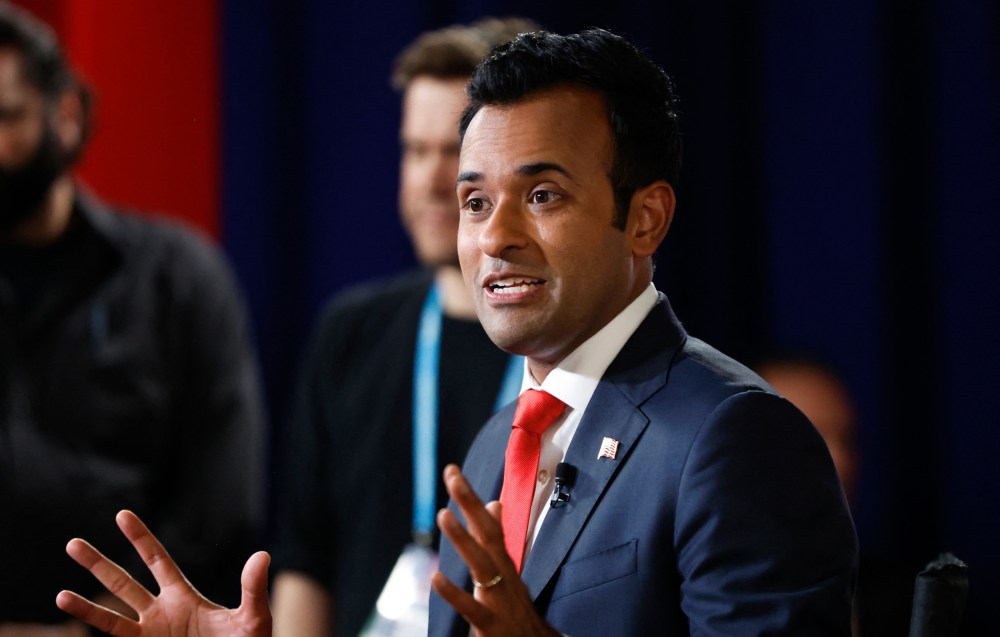
GOP presidential hopeful Vivek Ramaswamy wants to add a physical fitness section to the SAT, so that students would be scored on fitness tasks like running a mile, or doing pullups and situps. Ramaswamy is billing these physical fitness tests as a “pro-merit solution” to the inequalities created by a college admissions environment in which “subjective measures” unfairly prevail. Those who score well on math and reading exams, he explained, “tend to perform poorly on the one-mile run, and vice versa,” he posted last week on X (formerly Twitter).
Ramaswamy is recycling an outdated assumption that pursuits of mind and body are at odds.
In a presidential contest that (so far) has featured one unapologetically preening personal fitness performance after another — plus more barbs about age and fat jokes than usual — it’s refreshing to hear a candidate foreground fitness as policy rather than solely as an opportunity to flex (although Ramaswamy does that, too). And fairness in admissions, especially in light of the end of affirmative action, is important, as is physical fitness in an era of youth sedentariness. But Ramaswamy’s plan to make fitness a high-stakes admissions category — and calling that a “pro-merit solution” — amplifies the worst aspects of both contemporary fitness culture and historical physical education policy.
First, like a promise that six minutes of situps or a few cups of flat-belly tea a day can give you washboard abs, Ramaswamy’s premise is false. Not only is it not “a fact” that success on the SAT’s math and reading sections are inversely correlated with speed on a mile run, but data suggests the opposite is likely true (this precise correlation has, understandably, not been studied). Physical activity is actually linked to better academic (and mental health) outcomes. Ramaswamy is recycling an outdated assumption that pursuits of mind and body are at odds, rather than mutually reinforcing. It’s a strange, old idea to trot out, especially since a holistic understanding of the interconnectedness of mind-body wellness is one of the few ideologies on which our polarized populace can agree.

By framing a high-stakes fitness test as “pro-merit,” Ramaswamy buys into the illusion that physical fitness is a unique bastion where only the deserving triumph — a truly level playing field where hard work is all that matters (in contrast to the unfair world of test-prep tutors and legacy preferences). This myth of self-reliance echoes the general celebration of bootstrapping individualism that is common among conservatives, but Ramaswamy also amplifies an idea especially prevalent among fitness boosters of all political stripes. “It’s just you and the open road,” so many running ads announce. “The difference between success and failure is in who shows up,” spin instructors call out in class. “You’ve either got results or excuses,” early-morning Instagram admonishes. These are alluring ideas to sell gym memberships and sneakers — and while it is unquestionably true that it takes willpower, regardless of your socioeconomic position, to commit to regular exercise, the cold corollary of this outlook is that if you fail to get fit, you have only yourself to blame.

This is important because it is not the case, as Ramaswamy suggests, that fitness pursuits represent an egalitarian corrective to the unfair world of academics. In fact, poor people of color are less likely to exercise regularly; are more likely to suffer from obesity, diabetes and hypertension; and their kids are also less likely to participate in athletics or physical activity. This is not because they lack hustle but because exercise is just as structured by inequality as other realms, like housing and food, in which we discuss it more often. Control over your schedule and home and work spaces, access to parks and pools, safe streets and even tree cover that can make the difference of several degrees: These circumstances all condition how hard it is to get out and exercise more profoundly than whether one can afford a gym membership or pay youth sports fees (both are exceptionally privatized in the U.S.). Practically superhuman, mediagenic stories of fitness transformations by prisoners and super-busy stay-at-home moms might suggest that anyone can exercise this consistently and successfully if they just want it badly enough, but those narratives tend to underplay how much less “motivation” and “hustle” are required for those of means.


These ideas die hard. As we learn more about structural inequality, it has become less intellectually acceptable (or at least more obviously ignorant) to argue that meritocracy is working. (Even a Republican candidate like Ramaswamy clearly acknowledges that the SAT is not as “objective” as its boosters long touted.) Yet we are only starting to grapple with how these dynamics pertain to, and exacerbate, fitness inequality. As a professor and a fitness professional, I see this all the time: My generally socially aware students understand the wealth disparities between Black and white Americans as a function of centuries of discriminatory policy rather than a lack of ambition or talent, yet they are far more likely to call lack of physical fitness the result of “personal choice.” Making a fitness test part of the SAT will only entrench such ignorance.
Making a fitness test part of the SAT will only entrench such ignorance.
Making fitness more central to education, however, and even to admissions — beyond the broken system of elite sports recruitment — is a fantastic idea. And if Ramaswamy is serious about this (and hopefully other candidates take note), he has other presidential examples and counterexamples to learn from. Dwight Eisenhower and John F. Kennedy celebrated physical fitness for young people as integral to a healthy society and as a path to helping young people realize their full potential. Notably, JFK contrasted fitness with competitive sports: Inclusivity in movement rather than elite programs was the priority, as the latter encouraged less athletically inclined kids to sit on the sidelines, afflicted with “spectatoritis.” The point of such policy was to encourage a lifelong habit of exercise and recreation, especially for kids who were unlikely to play quarterback or be a prima ballerina. Almost every president since has had some sort of youth fitness policy platform. And the Obama White House’s Let’s Move initiative was uniquely energetic in making inclusive exercise a top priority, as Kennedy did; although 50 years later, it focused on urban communities of color as opposed to white suburbanites.
Candidates should absolutely take inclusive fitness seriously, and should emphasize the importance of public recreation facilities and physical education programs. Yet Ramaswamy seems to have taken the worst of these presidential precedents: Eisenhower narrowly defined fitness as a means to a single end (military preparedness), JFK chided “soft Americans” for betraying their civic duty with flabbiness, and the Obama agenda stopped short of codifying the robust exercise, nutrition and mental health infrastructure that was so obviously needed by the 2010s.
As students return to school this fall and the candidates elaborate their platforms, Democrats and Republicans alike should elevate equal access to exercise at school and beyond as a national priority — not because it will help the fastest or most flexible students get into college, but because we should all have the opportunity to exercise on our own terms.

Natalia Mehlman Petrzela
Natalia Mehlman Petrzela is Professor of History at The New School in New York City. She is the author of two books, most recently "Fit Nation: The Gains and Pains of America's Exercise Obsession," and is currently a Carnegie Fellow, working on a new book about education and political polarization.