




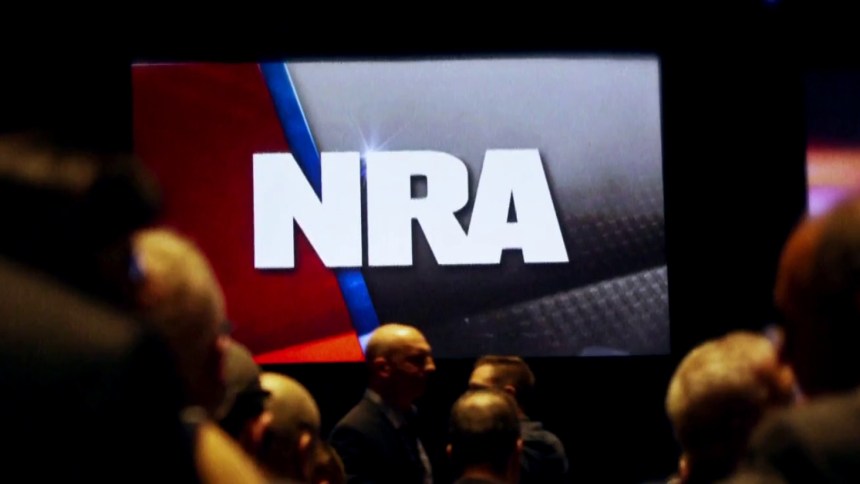
National Rifle Association Executive Vice President Wayne LaPierre’s civil trial on charges of corruption, brought by New York State Attorney General Letitia James, began Monday. Last week, citing health problems, the influential executive announced he’ll step down at the end of this month.
For those invested in establishing a limitless access to the gun consumer market, LaPierre was worth every penny.
James accuses LaPierre and other NRA officials of using the nonprofit organization as a “personal piggy bank” by drawing millions from members’ dues for lavish shopping sprees and luxurious vacations. They’re unlikely to admit as much today, but for those invested in expanding gun rights and establishing a limitless access to the gun consumer market, LaPierre was worth every penny. He was worth every Zegna suit, every Bahamas junket and even more. When it comes to making America the unparalleled gun country it is today, nobody outdid LaPierre’s lobbying, certainly not in the last three decades and perhaps not throughout U.S. history.
LaPierre’s resignation brings to a close an extraordinary era of growth for America’s most powerful consumer lobby, one during which the nation’s already unequaled gun stockpile doubled. When he assumed control of the NRA in 1991, there were somewhere in the neighborhood of 200 million guns in the U.S. Today there are more than 400 million. LaPierre helped supercharge the gunning of America, even as he and the NRA skillfully blamed America’s gun problem on everyone but themselves.
Beyond the alleged corruption, LaPierre will be remembered for many things, including his ignominious rhetoric. After the disastrous 1993 federal siege on the Branch Davidian compound in Waco, Texas, he described federal agents as “jack-booted thugs” and “armed terrorists.” Former President George H.W. Bush, a lifetime NRA member, resigned from the organization in disgust. After a gunman murdered 20 children and six adults at Sandy Hook in 2012, LaPierre called for the arming of school staff and infamously asserted that “the only way to stop a bad guy with a gun is with a good guy with a gun.”
LaPierre’s legacy includes political triumphs, such as cementing the relationship between the NRA and the Republican Party, making the two almost synonymous today. He pushed the national gun rights behemoth to spread its absolutist commitment to gun ownership globally, supporting the establishment of affiliates across the world and lobbying to crush a United Nations-led effort to draft an international treaty to limit small-arms proliferation in the 2000s.
But his most significant legacy will be as America’s most influential and successful consumer lobbyist, leading the charge to make gun consumerism an everyday part of the American cultural landscape.
One NRA board member said LaPierre had the “backbone of a chocolate éclair.”
How did he do it? By all accounts, LaPierre is a flawed, if eccentric, character. In his 2021 book “Misfire: Inside the Downfall of the NRA,” journalist Tim Mak describes a “remarkably weak-willed” leader “driven by fear and anxiety,” an “awkward egghead type” who is “easily bullied and doesn’t have the ability to make firm commitments.” One NRA board member said LaPierre had the “backbone of a chocolate éclair.”
As Mak details, LaPierre grew up in Virginia in a house without guns — to this day, he looks awkward and uncomfortable with a rifle in his hand — and worked for the Democratic Party out of college. The NRA hired him to lobby Democratic legislators in the late 1970s, at a moment when the gun rights organization was transitioning to a more aggressive anti-regulation posture. It was a rapid upward trajectory from there for LaPierre, who in 1991 assumed the role of executive vice president and began leading the NRA’s day-to-day operations. (The office of NRA president has always been a ceremonial one.)
Despite being something of a well-known weirdo, however, he was, as Mak describes him, a “skilled lobbyist and strategic thinker.”

Before LaPierre, the NRA’s most transformative leader had been Harlon Carter, who had the backstory to match the organization’s new aggressive political ambitions in the 1970s. (As a teenager, Carter had shot and killed a Mexican boy he claimed had tried to steal his mother’s car, and he spent a career in the U.S. Border Patrol in the Southwest.) In the 1970s, he watched anxiously as a rising gun control movement started to gain traction, and he and other hard-liners believed the NRA didn’t counter the threat fervently enough. He and a cohort of gun rights true believers seized control of the NRA at its annual convention in Cincinnati in 1977. “The previous administration was singing an uncertain song,” Carter said after Cincinnati. “We are fighters around here.”


The awkward, eggheaded LaPierre did not fit the mold of a fighter, but he learned to become one. Early in his tenure, the NRA suffered the twin defeats of the 1993 Brady Bill, which mandated background checks on gun purchases, and the 1994 Assault Weapons Ban, which prohibited the sale of various military-style firearms and restricted magazines to 10 rounds. The gun rights community condemned the NRA for failing to prevent the bills from passing.
Learning from the defeats of the 1990s, LaPierre would, in the 21st century, set the NRA steadfastly against any proposed gun regulations.
On the far right, new extremist groups emerged, lumped together as the “militia movement,” organized to defend against an imagined future federal initiative to confiscate arms. In 1995, Timothy McVeigh bombed the Alfred P. Murrah Federal Building in Oklahoma City, killing 168 people. LaPierre and the NRA tried to distance themselves from the militia movement, but they also learned that the organization could harness that kind of bellicose antigovernment spirit and inject it into its own efforts to lobby for fewer restrictions on the consumer gun market.
Learning from the defeats of the 1990s, LaPierre would, in the 21st century, set the NRA steadfastly against any proposed gun regulations. It didn’t matter how many mass shootings took place, how many children were killed. He became the impresario of rhetorical distraction, talking in abstract terms about freedom or “law-abiding citizens” while keeping gun dealers busy. Tragedies were never about the guns. They were about mental illness or video games. After Sandy Hook, LaPierre blamed “Obama’s budget,” among other things. Saying the most ridiculous, despicable things in the aftermath of tragedy became LaPierre’s brand.

And it was an effective one: For every conversation about arming teachers or censoring video games, we turned away from talking about the stockpiling that was happening just up the road. The weeks after the Sandy Hook shooting, for instance, saw one of the greatest spikes of gun sales in U.S. history. LaPierre mastered the clumsy misdirection, making him the greatest showman NRA members’ dues could have bought.
LaPierre was there when the NRA and the gun sellers needed him most — from the Brady Bill and the Assault Weapons Ban, from Oklahoma City to Columbine and Sandy Hook, from the “Obama bump,” when gun sales jumped after the election of the first Black president, to the “Trump slump,” when they crashed with the victory of the most pro-NRA president yet.
Over the course of 30 years, tragedy after tragedy should have brought with it, as it did elsewhere, the most minimal and common-sense of regulations. Instead, Americans now live in a country with more guns than people. Call it Wayne’s world.

Andrew C. McKevitt
Andrew C. McKevitt is John D. Winters Endowed Professor of History at Louisiana Tech University and the author of "Gun Country: Gun Capitalism, Culture & Control in Cold War America," published by The University of North Carolina Press.