




Dire headlines about inflation are masking one of the biggest economic shifts in the U.S. labor market: After decades of decline, the American labor movement is showing signs of revival. With support for unions increasing, workers have more power as they request better pay and workplace benefits — and this could have a significant impact in reversing the long-standing trend of sluggish wage growth and low job quality for workers, despite increasing productivity and economic growth.
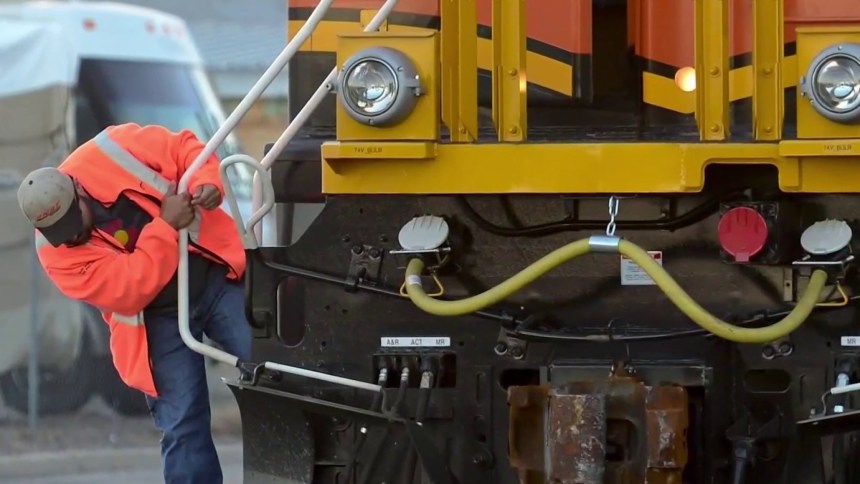
That revitalized feeling of empowerment is clear when you look at one of the most vital sectors of the U.S. economy: the railways. After a dramatic late-night bargaining session in September to prevent the shutdown of already fragile supply chains, railroad workers in the Brotherhood of Maintenance of Way Employes Division last week rejected the tentative deal that had been negotiated.
The long-term decline of organized labor has been nearly perfectly inversely correlated with the rise of income inequality in the United States.
The long-term decline of organized labor has been nearly perfectly inversely correlated with the rise of income inequality in the United States. Unions went from a peak density of 30% to 35% of workers covered by a collective bargaining agreement in the 1940s to 1950s to a low of less than 10% by the 2010s. As that happened, inequality measurements skyrocketed. The economic evidence has only bolstered the argument that unions successfully increase wages, offsetting the ability of employers to undercut wages and keep job quality low.
The ability of unions, and workers generally, to successfully bargain for better workplaces rests on their ability to withhold that which creates value (i.e., their own labor) through striking. While capital — like the tools they work with and their physical workplaces — are a critical part of production, all value is created by workers. When workers withdraw their labor in striking, businesses are forced to acknowledge that workers create value to be shared. This aligns with standard economic theory that purports that workers should be paid equal to the value (which economists call the marginal revenue product of labor) that they create in a healthy and competitive economy.
Yet, as the power of unions declined, this also led to a decline in the frequency, size and power of strikes. Strikes started declining at large firms beginning in the mid-1970s and began declining across the board in the mid-1980s. The PATCO strike in 1981, where President Ronald Reagan fired 11,000 striking air traffic controllers, was a major deathblow, solidifying anti-worker business tactics like firing workers and hiring replacement labor in managing work stoppages.
Other factors also limited the power of strikes, including institutional changes like the Taft-Hartley Act of 1947, which placed restrictions on strike activity, and limited funding for the National Labor Relations Board. There have also been structural changes in the economy that reduced the power of organized labor, like outsourcing within workplaces of various tasks and services in a phenomenon called the fissuring of the workplace.
Taft-Hartley’s provisions that classified secondary boycotts and picketing as unprotected activities have made it harder to strike when staff is spread across establishments and establishments have workers employed by many firms. Technically, the law says you cannot picket outside another business besides your direct employer. So, for example, if a group of office cleaners were striking against their employer for subpar wages and poor working conditions, they could not picket in front of the office buildings they clean, because those buildings are owned and operated by another business.


There has also been an industrial shift in the U.S. economy. There are fewer workers in the once-union-strong goods-producing sectors like manufacturing, compared to the dominant service sector. The service sector has traditionally had lower rates of unionization, forcing the labor movement to rebuild in a difficult terrain.
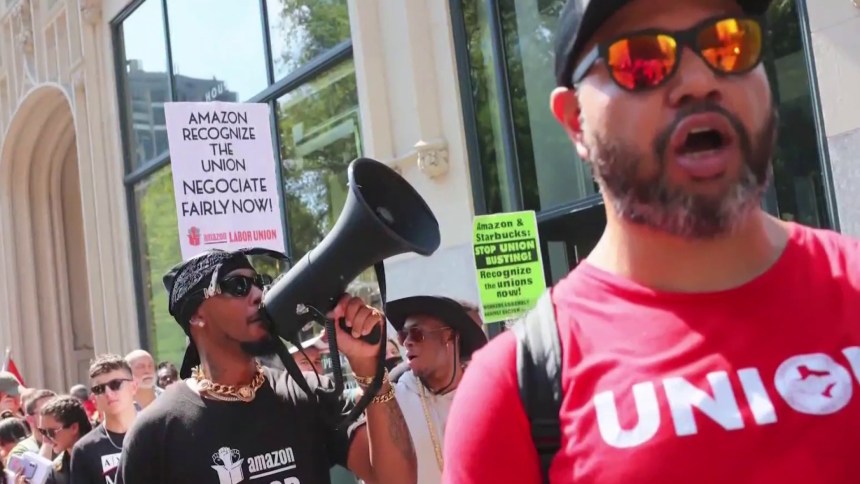
Recent high-profile union activity — like the railroad workers strike threat, a recent win on all demands for striking workers at the Philadelphia Museum of Art, and much-publicized organizing campaigns at Starbucks and Amazon — is building on the new energy the “Red for Ed” movement brought to the movement beginning in 2018. These teachers’ strikes were remarkable not only in their national media coverage, but in that they were technically so-called wildcat strikes that are not protected by labor law. Despite not having legal protections, teachers withdrew their labor and were able to make significant improvements to their job quality, including pay raises and better health care in so-called right to work states.
Ensuring that labor movements can exercise their power is vital not just in the name of social justice, but so overall economic outcomes are actually efficient.
Red for Ed largely contributed to the largest level of work stoppages as labor action since 1986, but what was especially remarkable was how it increased support for unions and their methods. This could have important implications for what we’re seeing now, with mass organizing and workers feeling empowered to reject deals in collective bargaining negotiations that do not live up to their demands. Research from Red for Ed also found that families affected by teacher strikes subsequently expressed more support for worker walkouts and demands. Those families surveyed also expressed more interest in labor actions at their own jobs. The increasing visibility of worker movements reinforces itself, inspiring others to act.
Unfortunately, the declining job quality in the United States since the 1970s was made starker by the pandemic. Railroad workers are demanding better paid sick leave after facing a public health crisis that shut down supply chains in the pandemic. Increasing support for unions and the revival of strikes are a few of the tools in a healthy labor market that improve job quality by ensuring workers are protected from harms and sharing in the value they create. In an imperfect labor market like the United States that has seen a decoupling of productivity and pay, institutional support for organizing and collective action is more crucial than ever. Ensuring that labor movements can exercise their power is vital not just in the name of social justice, but so overall economic outcomes are actually efficient.
It’s not clear as of now if the other major railway unions will follow the Brotherhood of Maintenance of Way Employes Division in rejecting the tentative deal. If they do, it will be in the interest of ensuring that each side of the bargaining table has reasonably balanced power. As workers wield strike threats and engage in other labor actions, unions, policymakers and the general public alike also need to ensure that worker power is solidified in pursuit of a truly healthy economy.

Kate Bahn
Kate Bahn is chief economist at the Washington Center for Equitable Growth.