




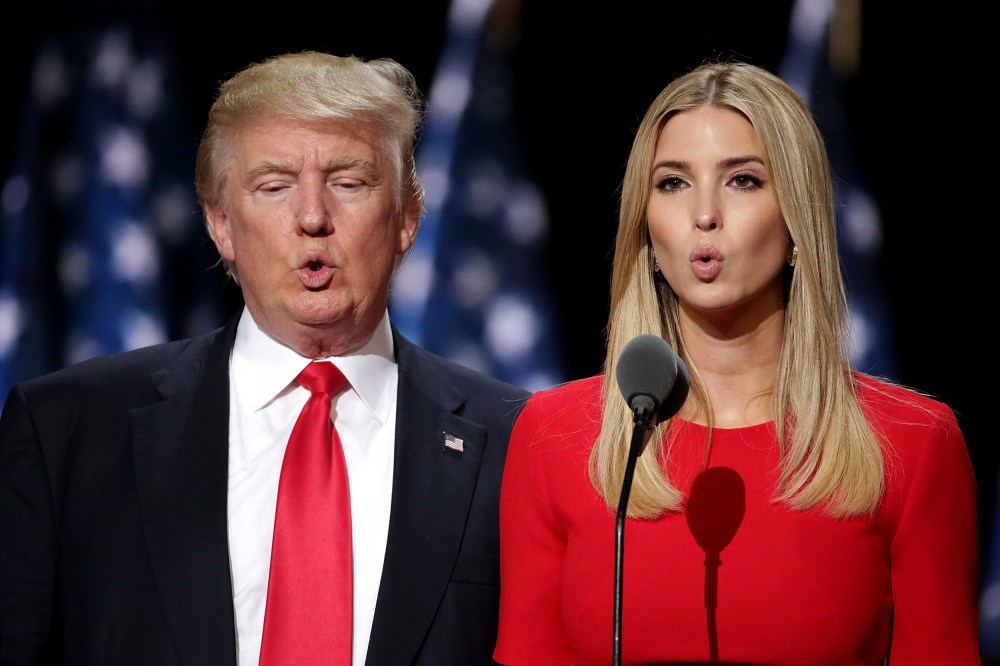
Ivanka Trump, former President Donald Trump’s eldest daughter, recently appeared voluntarily before the House select committee investigating the Jan. 6 attack on the U.S. Capitol. She testified for eight hours, reportedly invoking no privileges. If she testified fully and truthfully, there is a very good chance the information she provided incriminated her father.
Only Ivanka Trump knows why she decided to testify when others close to her father refused.
The Jan. 6 committee has interviewed more than 800 witnesses as part of its probe of the insurrection. The overwhelming majority of witnesses have cooperated with the congressional committee. But a small number of the former president’s closest advisers have refused to submit to questioning, some even defying lawfully issued congressional subpoenas.
Several such Trump administration loyalists have found themselves voted in contempt of Congress and referred to the Department of Justice for criminal prosecution. Those who have defied subpoenas include his former chief of staff Mark Meadows, former deputy chief of staff for communications Dan Scavino and former advisers Steve Bannon and Peter Navarro. All have been voted in contempt of Congress, and all face possible criminal prosecution, though to date only Bannon has been indicted (and he pleaded not guilty).

There are significant risks for those who chose the path of contempt of Congress. Most directly, if convicted, they could be sentenced to up to one year in prison on each count of contempt. But that’s just for openers. If someone has information and evidence relevant to the crimes of others and refuses to provide such information to an investigative body — whether Congress or a grand jury — that person may be subjecting themselves to other criminal charges: obstructing official proceedings, obstructing justice or accessory after the fact, among others. More fundamentally and in layman’s terms, when you hide evidence of a crime, whether your own crime or the crime of another, there’s a term for that: a cover-up.
This brings us back to Ivanka Trump. When called to appear as a witness before the committee, she had a decision to make: Do I testify about my father’s conduct on Jan. 6, 2021, at the risk of incriminating him? Or do I become a member of the cover-up club with Bannon, Meadows and the others?
In a very real and direct way, Ivanka Trump’s testimony could be deeply damaging to her father. For example, Keith Kellogg, former national security adviser to Vice President Mike Pence, reportedly told the committee that as the attack on the Capitol raged, several people tried to convince then-President Donald Trump to condemn the violence and in essence to call off the attack that was in progress. These people included Kellogg himself, Meadows, press secretary Kayleigh McEnany and Ivanka Trump, Kellogg testified, according to a committee letter. Kellogg said the president “rejected” all such “entreaties,” The New York Times reported. In a last-ditch effort, Ivanka Trump “went back there because Ivanka can be pretty tenacious,” he said.


In a very real and direct way, Ivanka Trump’s testimony could be deeply damaging to her father.
This account from Kellogg paints a damning picture of Donald Trump’s conduct as the Capitol attack was in progress. Just hours earlier, at the pre-insurrection rally at the Ellipse, he had told his supporters their votes had been stolen and “if you don’t fight like hell, you’re not going to have a country anymore.” He also told his audience that “we must stop the steal.”
Ivanka Trump’s testimony could tend to prove that although her father was willing to tell his supporters to “stop the steal,” he was later entirely unwilling to tell them to “stop the violence.” As a former career prosecutor, I can assure you that this would be marquee evidence at any eventual criminal trial of Donald Trump over allegations of inciting an insurrection.

So Ivanka Trump decided to testify. Indeed, she apparently did so without even attempting to invoke any privilege, as others have done: no executive privilege; no Fifth Amendment privilege against self-incrimination; and, of course, there is no father-daughter privilege in the law.
Only Ivanka Trump knows why she decided to testify when others close to her father refused. It’s worth noting that her husband, Jared Kushner, reached the same decision: Just days before Ivanka Trump testified, Kushner similarly testified at length before the Jan. 6 committee, providing information that committee members called “valuable” and “helpful” to the investigation.
There are several reasons why Ivanka Trump and Kushner may have made the decision to testify: perhaps to save themselves from contempt charges; possibly to avoid becoming members of the cover-up club and risking further scrutiny; maybe they thought they could navigate the interrogation without providing any information that would be too harmful to their father or father-in-law. Or maybe, just maybe, their truthful testimony would fully exonerate the former president, proving he did nothing wrong on or around Jan. 6, so they happily provided said testimony. Yes, I’d drop a dubious-faced emoji here if I could.

Glenn Kirschner
Glenn Kirschner, a former assistant U.S. attorney for Washington, D.C., is an NBC News and MSNBC legal analyst.