




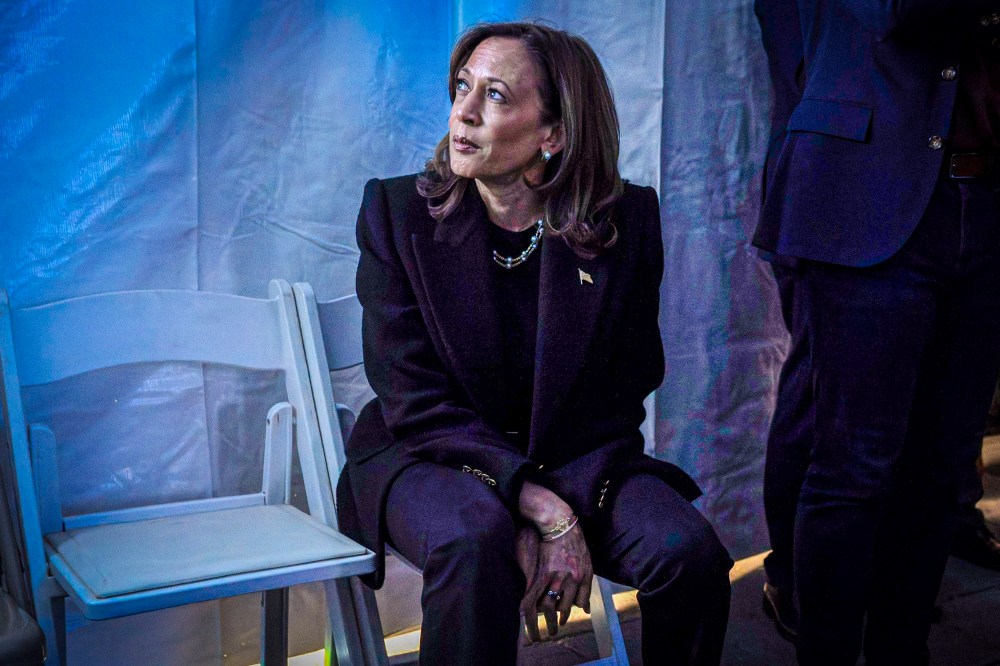
Why Vice President Kamala Harris was so thoroughly trounced by President-elect Donald Trump is going to take weeks, months and years to answer. But one piece of the puzzle can be identified now, by taking a closer look at her appearance on a talk show in October.
On ABC’s “The View,” co-host Sunny Hostin asked Harris, “What, if anything, would you have done something differently than President Biden during the past four years?”
“There is not a thing that comes to mind … and I’ve been a part of most of the decisions that have had impact, the work that we have done,” Harris responded, before going on to discuss some of their shared accomplishments.
Later in the interview Harris amended her answer. She said, unlike Biden, she’d appoint a Republican to her Cabinet. It was a minor symbolic gesture, and her pledge that she would not let “pride get in the way of a good idea” offered from across the political aisle received polite applause.
Harris wanted to play it safe at a time when playing it safe was the wrong move.
Harris’ flat-footedness in that moment was an act of political malpractice — and a sign of how she and the Democratic party establishment misread the political moment. This was a “change election,” largely because of widespread lingering resentment over inflation, and Harris wanted to play it safe at a time when playing it safe was the wrong move.
Harris was in a tricky position during the campaign — she was running simultaneously as incumbent and newcomer, and it’s difficult to create distance from an administration whose accomplishments one wants credit for. But it was far from an inescapable predicament: Competent politicians often get away with talking out of both sides of their mouth. Harris could’ve said that she took pride in working with Biden in shepherding the U.S. out of the Covid crisis, but that she could hear the American people say that they were still hurting, and that she stood for a sharply new perspective on the economy that was laser-focused on bringing down costs.
All the evidence demanded such a focus as Harris took the reins. The polls showed that the economy was the top issue for voters, that a majority recalled Trump’s economy fondly, that Trump was trusted more than Biden on the economy, and that most people in swing states were looking for sweeping change. Biden has been one of the most unpopular presidents in modern American history, and the polls suggested that the main reason, other than his age, was inflation. The results of the race bore this out as well: Thomas Wood, a political scientist at Ohio State University, told The Atlantic that the astonishing breadth of Trump’s improvement across a wide variety of even non-Trump friendly demographics since 2020 suggested a “really simple story … that secular dissatisfaction with Biden’s economic stewardship affected most demographic groups in a fairly homogeneous way.”

To be fair, Harris did not ignore the issue of inflation. She proposed building more affordable housing and providing down payment assistance for first-time homebuyers, and she pitched an expanded child tax credit that she said would help families offset costs. But after taking criticism over her boldest-sounding and most universally beneficial proposal for bringing down prices — a ban on price gouging in grocery and food industries — she downplayed and distanced herself from the idea, apparently out of fear of coming across as a radical. Furthermore, her limited discussion of inflation lacked a clear story or theory of society. Who was to blame for why everything became so expensive? She left hammering corporate greed on the table, and her initial broadsides against big business ebbed as she sought out the input and support of Wall Street and Silicon Valley and even chose billionaires as surrogates.


Harris’ overall economic vision also sounded at odds with the broader political era. Her economic program was titled the “opportunity economy” and featured middle-class tax cuts and assistance for entrepreneurs. It sounded more like a New Democrat presiding over a consensus-backed economy in the 1990s or 2000s than it did a post-Biden Democrat in an era of populism and fiery rhetoric about costs, monopolies, inequality and the social dislocations and costs of neoliberalism and globalization. Later in October, talk show host Stephen Colbert essentially asked Harris the same question she’d been asked on “The View” — how she’d differ from Biden — and again she seemed uneasy articulating what should’ve been her clearest point of focus. She delivered the following pablum that would not have been out of place in a speech from a neoliberal Democrat talking about gutting welfare:
When we think about the significance of what this next generation of leadership looks like where I could be elected president. Frankly, I love the American people, I believe in our country, I love that it is our character and nature to be an ambitious people, we have aspirations, we have dreams, we have incredible work ethic. And I just believe that we can create and build upon the success that we’ve achieved in a way that we continue to grow opportunity and in that way grow the strength of our nation.
After that she finally got around to talking about small business assistance and her first-time homebuyer assistance programs. But the entire framing was odd and unfocused, and the initiatives she mentioned were not universal.
On the whole, Harris’ campaign was thematically diffuse, cycling through different focal points every week, whether through casting the opposition as “weird” and the Democratic ticket as normcore, or talking of “joy” and reclaiming patriotism, or focusing on protecting democracy, which served as her closing argument. She tried to be a lot of things to a lot of people, using ambiguity to present herself as a likable and generic Democrat who sought unity, took interest in technocratic reforms and sought not to upset the corporate world or international order. A key part of her strategy, as many political observers noted, was harnessing nebulous positive vibes. She used her telegenic, quick-to-laugh comportment and the intrigue surrounding the daring nature of her improbable candidacy to whip up excitement. She exhorted voters to reject Trump as an authoritarian criminal. There was a rational strategy here, but it was predicated on a faulty premise: that most voters could place their trust in a status quo agent.
To say that Harris should have run a provocative change campaign focused on finding ways to make America more livable isn’t to say she would have won if she did. She was handed the reins from an extremely unpopular politician. She only had three months to make her case. She was running as a woman of color and faced an opposition that weaponized racism and sexism against her. And people would have to not just hear a different message, but believe it. If she had attempted to reinvent herself as a barnstorming populist type, then she would have faced accusations of phoniness. And it would be a tall — if not impossible — task for the vice president to extricate herself from her own administration’s record on inflation. Every governing party facing election in a developed country this year has lost vote share — a data point suggesting that post-pandemic inflation is lethal to incumbents.
Still, there are lessons to be gleaned. Even though inflation was mostly not Biden’s fault and has cooled off, Harris’ rhetoric and policy should have been oriented around acknowledging how much people hate it and how to take their minds off of it. The latter issue involves developing a positive, attractive and coherent vision of the future. Democrats cannot assume that an identity as a guardian of democracy is sufficient to turn out voters or serve as a bulwark against the siren call of right-wing populism. The party must provide a clear and compelling answer to the problems posed by the collapse of the neoliberal consensus or risk becoming irrelevant.
It is painful to recognize that there is a critical mass of our fellow citizens who are seemingly willing to risk or discard multicultural democracy and basic civic decency in response to a limited episode of inflation. But the consequences of denying that reality are even worse. And it is absurd to suggest that what America was most desperate for was a Republican in a Democrat’s Cabinet.

Zeeshan Aleem is a writer and editor for MS NOW. He primarily writes about politics and foreign policy.