




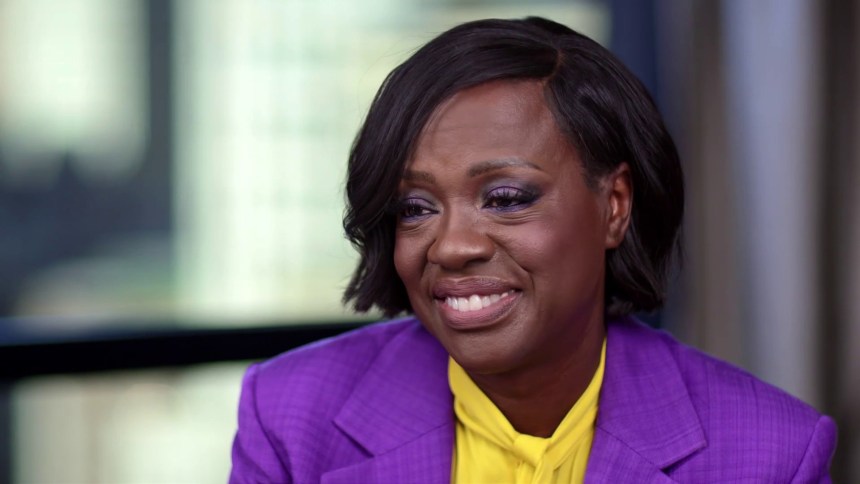
In “The Woman King,” a new film about the 19th century all-female military unit that protected the African Kingdom of Dahomey (present-day Benin), viewers should expect to see the power of Black women’s leadership and the crucial role women played in shaping African societies. Oscar winner Viola Davis portrays General Nanisca, the leader of the Agojie, as those women warriors were called, and the film follows the story of how she trains a new group of women.
The film hit theaters nationwide Friday, but in a speech she gave last week at the Toronto Film Festival, where “The Woman King” premiered, Davis said “the film is for the risk-takers. This film is for the people who maybe even are the naysayers who never believed that a Black woman, especially dark-skinned women, can lead a global box office.”
By highlighting the historical contributions of the Agojie, “The Woman King” places African history at the forefront.
The portrayal of strong, Black women fighters is significant — especially in a film industry that rarely features dark-skinned women in leading roles and even more rarely casts light on African women’s leadership roles. By highlighting the historical contributions of the Agojie, “The Woman King” places African history at the forefront and captures what African historian Nwando Achebe has described as African women’s “power, authority, and influence publicly, temporally, and in spiritual/religious spheres.”
It’s about time.

Director Gina Prince-Blythewood said of “The Woman King”: “My hope is that you’re seeing a part of not only my history, but global history that you didn’t know about.”
Tragically, most Americans know little about African history. LaGarrett J. King, director of the Center for K–12 Black History and Racial Literacy Education at the University at Buffalo, points out that American classrooms fail to introduce students to African history, cultures and societies. “American classrooms,” King argued in an interview for The Insider, “tend to introduce Black people for the first time through slavery, omitting thousands of years of African history, and contextualizing Black American origins with oppression and violence, which can have a dehumanizing effect.” As for Dahomey, the kingdom the Agojie helped protect, it was founded sometime around 1625 and collapsed in 1894.
Though their origins are a bit of a mystery, some scholars believe the Agojie were formed from the gbeto, a group of women elephant hunters in Dahomey. Stanley Alpern, author of “Amazons of Black Sparta: The Women Warriors of Dahomey,” argues that the unit was likely established in the 1720s to strengthen palace security. As Alpern explains, some of the king’s wives became the guards for the palace because men were not allowed on the palace grounds after dark — most likely so those men would not have access to the king’s wives.
By 1772, an estimated 860 women were Agojie soldiers, skillfully trained to fight and fully armed with muskets and cutlasses. By 1772, an estimated 860 women were Agojie soldiers, skillfully trained to fight and fully armed with muskets and cutlasses. In 1781, Dahomey’s King Kpengla led 800 armed women against Agouna, a neighboring country, in an effort to reclaim 100 captive women. This raid would be one of many during the 18th and 19th centuries. That said, some critics have argued that the film “downplays Dahomey’s own practice of capturing and enslaving others.” That the Dahomeans practiced slavery is indisputable, but this film focuses specifically on the Agojies’ bravery and their role in protecting Dahomey. During the 1840s, the Agojie force expanded significantly. An estimated 5,000 women served as Agojie soldiers during these years. In an attack on Atakme in 1840, the Agojie played an instrumental role in helping the Dahomeans succeed. In 1861, Francesco Borghero – a missionary in Dahomey’s capital of Abomey – recounted witnessing a military demonstration of 3,000 Agojie soldiers under the direction of King Glele. And sometime around 1864, women soldiers managed to break through the defenses of the city of Abeokut — a feat their male counterparts had not achieved. Given that they know so little about Africa’s history, it’s not surprising that most Americans know little about international affairs and certainly have little knowledge of contemporary developments on the continent. According to a recent Pew Research Center poll, for example, only 26% of Americans could correctly identify Nigeria as Africa’s most populous nation and its leading oil producer. “The Woman King,” therefore, will help to counter these realities. I know the story of Dahomey well and am still looking forward to seeing it play out on the big screen. For anyone who doesn’t, the film’s focus on the Agojie will help to deepen American knowledge of African history — and may also spark greater interest in contemporary African developments. Perhaps it will also inspire and embolden Black women everywhere who see a glimpse of their stories in “The Woman King.”
Keisha N. Blain
Keisha N. Blain is an award-winning historian and writer. She is a professor of Africana studies and history at Brown University and has written extensively about race, gender and politics in national and global perspectives. Her most recent book is “Until I Am Free: Fannie Lou Hamer’s Enduring Message to America.” 

