




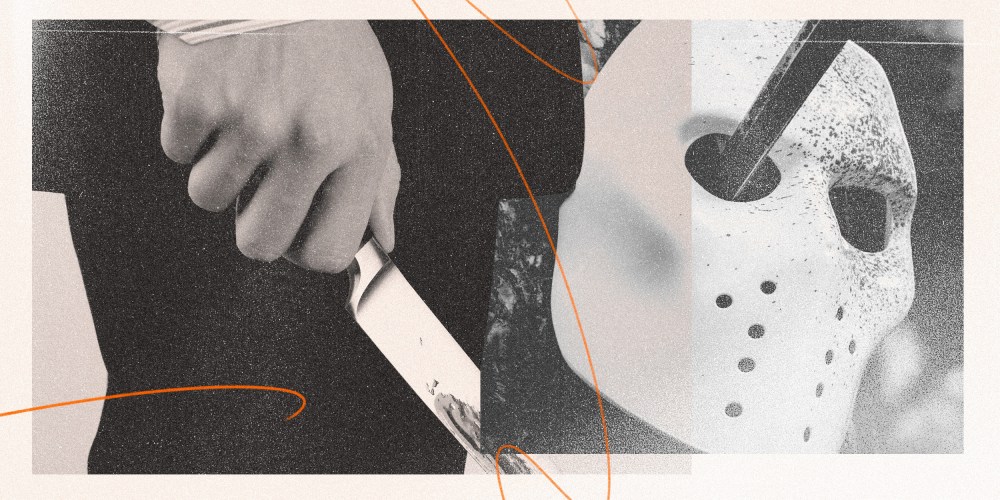
I’ve never been put off by make-believe gore. I love horror movies and the rush of a scare when I know it isn’t real. But somewhere between becoming a mother and a news cycle filled with devastating real-life violence, any tolerance I may have once had for realistically violent Halloween costumes has gone out the window.
There’s a difference between a Halloween costume that’s spooky, and a Halloween costume that’s straight-up disturbing.
There is now no way for me to see a fake murder victim, or baby mafioso costume (replete with machine gun), or bloody baby bodysuit, and not shiver — at least a little — at the fictional violence we are perpetuating and even celebrating, even as real-life violence rages devastatingly out of hand. Because there’s a difference between a Halloween costume that’s spooky, and a Halloween costume that’s straight-up disturbing.
The tradition of wearing scary costumes on Halloween dates back many centuries to the holiday’s Christian and pagan origins — the costumes’ original intention was to confuse ghosts who were believed to return to the earthly world on Halloween night. If people wore costumes, the hope was that the ghosts would leave them alone. That tradition persisted when mainstream America began celebrating the holiday — photographs from the late 19th and early 20th centuries show people dressed up as witches, ghouls, animals or really anything that concealed their identity and evoked a certain degree of spookiness.
Wearing violent Halloween costumes — dressing as someone dripping blood from stab wounds, for instance — is something entirely different. This type of gory get-up dates back only decades, seemingly accelerating in popularity in the wake of a slew of particularly violent Hollywood-adjacent films in the 1980s. Films such as “Halloween” and “The Texas Chainsaw Massacre” spawned cult followings and made Michael Myers Halloween costumes (often complete with a knife dripping with blood) and Leatherface costumes (available in children’s sizes too) cool.
Many schools who allow Halloween celebrations have adopted rules designed to keep the holiday in the realm of spooky and out of the realm of violence. Obviously, I understand that costumes are not meant to be taken seriously. This is a supposed to be a fun holiday that’s not taken too seriously. On the other hand, so far this year there have been 579 mass shootings in the United States — including the recent killing of 18 people in Lewiston, Maine. Any cultural trend that could further desensitize us to violence feels at best, unnecessary. And at worst, irresponsible. Do you really need to arm your young child with a gun … for fun? In the last few decades, many schools who allow Halloween celebrations have adopted rules designed to keep the holiday in the realm of spooky and out of the realm of violence. Just like it’s in society’s best interests to make sure that children don’t wear costumes that are culturally insensitive, why not keep fake weapons out of school celebrations. No child needs a reminder that America’s gun violence epidemic has brutally infected our classrooms. To my mind, these are rules that make sense. Sometimes grown ups need a reminder of the rules too. I am all for a spooky Halloween — goblins and witches and black cats that jump out from cobwebbed corners. But violence isn’t celebratory — and in a country so heavily inundated with it, we are sending ourselves (not to mention our children) confusing messages — even if it is just for one night of the year.
Elena Sheppard
Elena Sheppard is a writer and cultural critic pursuing her MFA in nonfiction at Columbia University. You can follow her on Twitter @eleshepp. 

